
Town · Val d'Orcia
Radicofani
The Pope’s Border Fortress, Blown Up on Purpose
Last updated:
- Region
- Val d'Orcia
- Province
- Province of Siena
- GPS
- 42.90, 11.77
- Best season
- spring, autumn
- Time needed
- half day
- Difficulty
- moderate (hilltop village, uphill walk to the fortress, uneven ground in the ruins)
- Known for
- papal and Medici fortress, Ghino di Tacco, La Posta Medicea, Via Francigena, views toward Monte Amiata
The Last Tuscan Hilltop Before Lazio
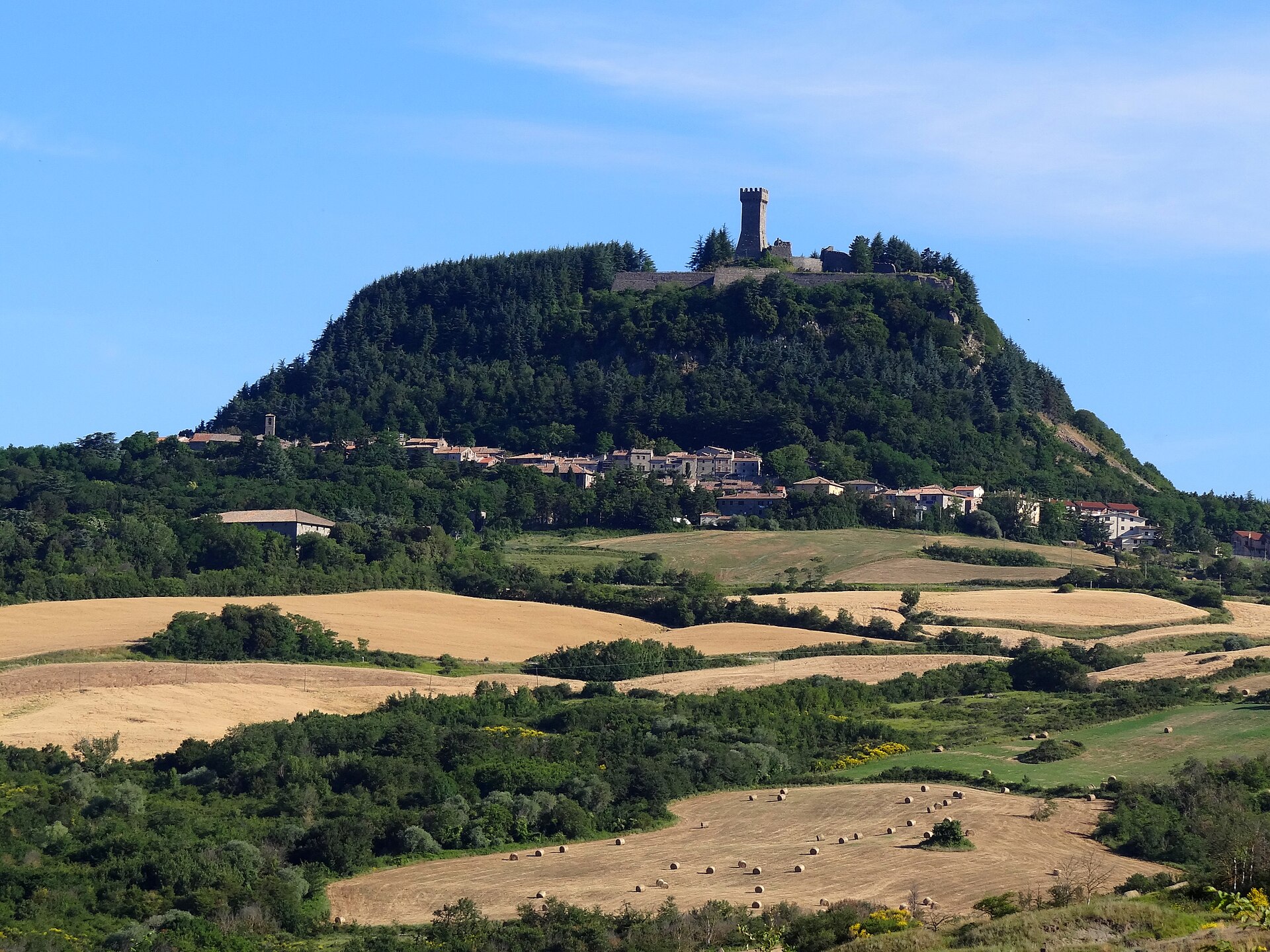
Drive south through the Val d’Orcia and one silhouette keeps showing up on the horizon: a dark rock with a stump of tower on top. That is Radicofani. The village sits at the foot of a basalt outcrop, and the fortress above it watched the border pass between Tuscany and Lazio for centuries. According to the Comune, it controlled that crossing.
This is a different Val d’Orcia from the soft clay country around Pienza. The rock is volcanic, the village stands more than 800 m up, and the view runs toward Monte Amiata. The village is quiet, stone-built, and still working, not a stage set.
Come for three stories stacked on one hill. A pope bought the place to guard a pilgrim road. A bandit made it famous in Dante and Boccaccio. And in 1735 someone set fire to the powder stores and blew much of the fortress apart. You can climb what survived, walk down to a Medici posthouse where popes, an emperor, and novelists stopped on the road to Rome, and be on your way in half a day.
A Place Shaped by Time
A pope buys a hilltop
Radicofani appears in the records in 973, “cum suo castro” (with its castle). The Ecomuseo notes that the first fortifications on the rock go back much further, to the Middle Bronze Age. The monks of San Salvatore, the abbey on Monte Amiata, held the place until 1153. That year Pope Eugenius III bought it. According to the Comune di Radicofani, he wanted control of the pilgrim road against Frederick Barbarossa.
His successor finished the job. From 1154 Pope Adrian IV, the only English pope, built what the Comune calls “an imposing fortification.” The Ecomuseo credits him with the cassero, the fortress’s central keep. So the keep of this Tuscan stronghold was the work of a man from England, working for Rome, guarding a road to Rome.
Ghino di Tacco: the bandit who belongs to literature
Ask anyone in Radicofani about the fortress and you will hear the name Ghino di Tacco. Tradition places him here in the late 13th century. He is best treated as a figure of literature and legend, not documented history. The Ecomuseo itself calls the fortress the “legendary” setting of the gentleman-bandit’s deeds.
Dante gives him two lines in Purgatorio VI, as the man whose “fierce arms” killed a man from Arezzo. Boccaccio gives him a whole tale in the Decameron (X, 2). Ghino captures the Abbot of Cluny on the road, cures his stomach complaint with a diet of bread and wine, and sends him home a friend. The Comune’s own summary calls him cruel at times, but aiming at good. That mix of menace and charm is what keeps his name alive here.
From Siena to the Medici
The fortress changed hands with the politics of central Italy. Siena leased Radicofani in 1411 from the antipope John XXIII. It then received the place as a perpetual grant from Pope Pius II Piccolomini in the mid-15th century. For a few generations, this rock was the southern gate of the Sienese state.
When Siena fell, Radicofani held out, then passed to the Medici in 1559. Between 1560 and 1565 the architect Baldassarre Lanci wrapped the old castle in five bastions. The Ecomuseo calls the result “a true fortified citadel, the largest in Tuscany.”
The night of 14 September 1735
The fortress’s end came from inside. On 14 September 1735, according to the Ecomuseo, a man from Piancastagnaio named Pieri set fire to two powder magazines. The explosion destroyed much of the citadel. It was abandoned in 1750, and its stone was later quarried for building.
Restoration finally came between 1989 and 1999. What you see now is honest about its history: a restored keep, bastion walls, and open ruins where the blast did its work.
What we know vs. what’s repeated: Many English guides say the fortress stands at “about 1,000 m, the highest point of the Val d’Orcia.” It doesn’t. The fortress is at 896 m, and the village at 814 m.
What to See and Do
The fortress and the Museo del Cassero
Start at the top. The fortress crowns a volcanic outcrop with a cassero of three small towers and a 40 m keep called “la Penna.” Around it lie Lanci’s Medici bastions of 1560–65 and the ruins left by the explosion. The Ecomuseo names the five bastions after saints: Sant’Andrea, San Rocco, San Pietro, San Giovanni, and Santa Maria.
Inside the restored keep, the Comune describes the Museo del Cassero. It shows archaeological finds from the Etruscan age to the 16th century, plus photos, models, and virtual reconstructions of the fortress and its restoration. You climb through the levels to a lookout at the top. On a clear day that view is the reason to come: the whole southern Val d’Orcia on one side, Amiata on the other.
Opening days change with the season. Check the Comune di Radicofani fortress page before you drive up. Wear proper shoes, because the ruins are uneven.
La Posta Medicea
Below the village, on the old road, stands La Posta. Work began in 1584 for Grand Duke Ferdinando I de’ Medici, to designs by Bernardo Buontalenti. According to the Parco della Val d’Orcia, he built it over an older hunting lodge of Grand Duke Francesco I. The façade has a two-story loggia with six arches on each level. Across the road, a separate building housed the Sienese customs office.
For three centuries this was a post station, where travelers on the Rome road changed horses. The Parco lists its guests as Popes Pius VI and Pius VII, Emperor Joseph II, Casanova, Dickens, Stendhal, and Mozart. In the 19th century it became the home of the Bologna family. Don’t miss the horse-watering fountain outside, which carries a large Medici coat of arms. It is an easy walk from the historic center.
What we know vs. what’s repeated: You will often read that Montaigne stayed at La Posta. He can’t have. His journey through Italy was in 1580–81, and La Posta was begun in 1584. The Parco della Val d’Orcia’s guest list does not include him.
The village itself
Give yourself time to walk the lanes between the fortress and La Posta. Radicofani is a working village, not a showpiece. If you can, come on market day, the 2nd or 4th Thursday of the month, when the stalls set up in Piazza Garibaldi.
Walking the Via Francigena
Radicofani is a milestone for pilgrims. It is the end of stage 36 of the Via Francigena, 33 km from San Quirico d’Orcia, which the official Via Francigena Toscana site rates “very demanding.” It is also the start of stage 37 to Acquapendente in Lazio. That stage is 24 km, of which about 15 km are in Tuscany. Even if you are not walking the whole route, a short stretch in or out of the village shows you why popes and dukes cared so much about this hill.
Contignano
Radicofani’s frazione, Contignano, at 479 m, was a separate comune until 1 January 1778, when it was joined to Radicofani. Today it has a community cooperative, listed by the Regione Toscana. Its own market runs on the 2nd and 4th Tuesday of the month. It is a quiet detour for the back roads rather than a destination in itself.
Eating Like a Local
Radicofani sits where two food cultures meet. Pici, thick hand-rolled strands of flour and water, are the pasta of the whole Val d’Orcia, so look for them on menus. Pecorino from the valley’s sheep country is the other constant. Toward Amiata, in villages such as Campiglia d’Orcia, the food culture turns to chestnuts.
For wine, look for the valley’s own appellation, the Orcia DOC, created in 2000. It is a small appellation of family cellars squeezed between Brunello di Montalcino and Vino Nobile di Montepulciano.
The most local shopping happens at the market in Piazza Garibaldi on the 2nd and 4th Thursday. Contignano’s market is on the 2nd and 4th Tuesday.
Getting There and Getting Around
By car. Radicofani is a car destination for most visitors. It lies at the southern end of the Val d’Orcia, on the old road to Lazio. It pairs well with Bagni San Filippo or San Quirico d’Orcia in the same day.
By bus. Autolinee Toscane line FT9 runs Chiusi–Sarteano–Radicofani–Abbadia San Salvatore. Timetables change with the school year, so check the line FT9 page before you plan around it. The AT information line is 800 14 24 24.
By train. The nearest working station is Chiusi-Chianciano Terme, on the Florence–Rome line. From there, take the FT9 bus.
On foot. Pilgrims arrive on Via Francigena stage 36 from San Quirico d’Orcia and leave on stage 37 for Acquapendente.
In the village. Walk. The fortress is an uphill walk from the village, and the Parco della Val d’Orcia describes La Posta as easily reached on foot from the center.
Nearby
- Bagni San Filippo: a free hot stream in the woods, with white limestone formations and strict rules about touching them.
- Campiglia d’Orcia: a village once held by the Visconti, on the Amiata edge, with a chestnut festival on the last Sunday of October.
- Castiglione d’Orcia: two fortresses and a Simone Martini Madonna with a swallow.
- San Quirico d’Orcia: the other end of Via Francigena stage 36, with a Medici garden and a Giovanni Pisano portal.
- Monte Amiata: the volcanic mountain filling the view from the fortress, with fir woods and chestnut villages on its slopes.
Information is provided in good faith and may change. Always confirm opening hours, prices, and event dates with the official source before you travel.