
Town · Versilia
Pietrasanta
The Town Where Sculpture Gets Made
Last updated:
- Region
- Versilia
- Province
- Province of Lucca
- GPS
- 43.9532, 10.2258 (town hall)
- Best season
- spring and autumn; summer for the open-air sculpture show
- Time needed
- full day
- Difficulty
- easy
- Known for
- bronze foundries, marble workshops, Museo dei Bozzetti, Fernando Botero, summer sculpture shows
Most Tuscan towns show you art that was finished centuries ago. Pietrasanta shows you art in the making. Sculptors bring their ideas here, and the town’s marble workshops (laboratori) and bronze foundries help turn them into finished works.
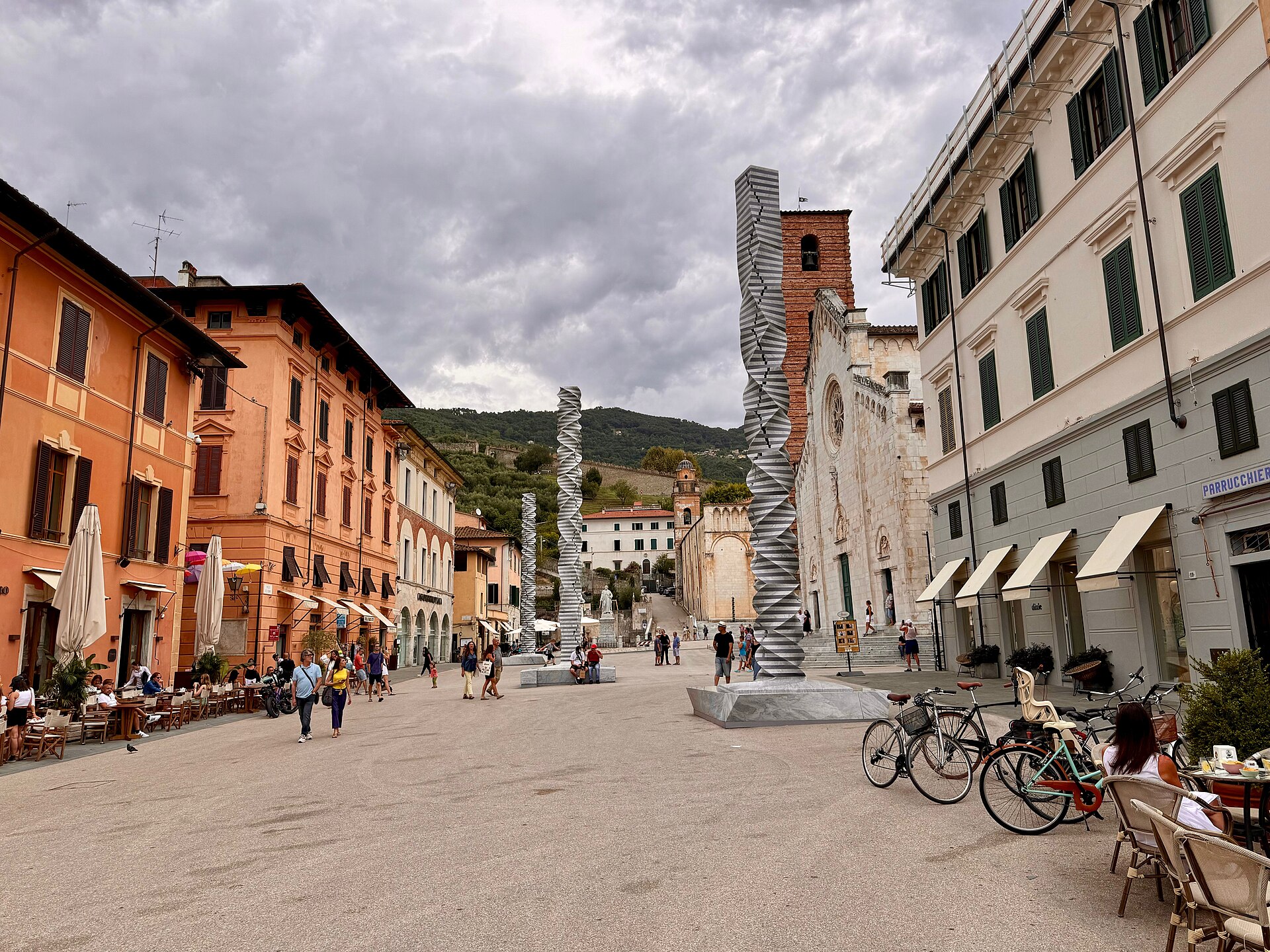
You see the results as soon as you arrive. Every summer, monumental sculpture takes over Piazza del Duomo. A four-meter bronze warrior by Fernando Botero stands in Piazza Matteotti. In a former convent, a museum keeps the plaster models that sculptors made before the marble or bronze version existed.
Be clear about what kind of town this is. Pietrasanta is a place of work first, and its pleasures are quiet ones: a museum of first drafts, a small church with two 20th-century frescoes, and a foundry that opens its doors by appointment. If you want a checklist of Renaissance monuments, Lucca is a better day. If you want to understand how sculpture actually gets made, come here.
A Place Shaped by Time
The town Florence wanted back
Pietrasanta’s history is a story of borders. In 1494, when the French king Charles VIII came down into Italy, Piero de’ Medici handed Pietrasanta to him. The French governor, Francesco d’Intragnes (Entragues), then passed it to Lucca. Florence wanted it back.
The answer came from Rome. In 1513 Florence persuaded Lucca to accept arbitration by the new pope, Leo X: Giovanni de’ Medici, son of Lorenzo the Magnificent. His award of 29 September 1513 placed the four comuni of the old Capitanato di Pietrasanta under Florence: Pietrasanta, Seravezza, Stazzema, and Forte dei Marmi. That is Versilia in its historic sense. Camaiore and Viareggio stayed with Lucca.
The handover took place on 11 October 1513 at the castle of Motrone. The Capitanato stayed Florentine (later Grand Ducal) from 1513 to 1859. In 2013 the four comuni celebrated the 500th anniversary as the birth of “historic Versilia.” Forte dei Marmi, the coastal settlement that grew around the marble trade, stayed part of Pietrasanta until it became a separate comune on 26 April 1914.
“The marbles of Pietrasanta and no others”
Marble was never far from the politics. In 1517 a letter from Cardinal Giulio ordered that, for Michelangelo’s planned façade of San Lorenzo in Florence, “si piglino li marmi di Pietrasancta et non altri”: take the marbles of Pietrasanta and no others. The quarries lay in the mountains above Seravezza, then part of the Capitanato. That story, with its twist in 2021, belongs to our Seravezza profile.
A workshop town
Pietrasanta’s modern reputation rests on its workshops and foundries. In 2005 the Florence magazine The Florentine listed Igor Mitoraj and Botero among the artists who had worked here. Mitoraj’s monumental bronzes later filled Piazza del Duomo for the 2015 summer show.
Botero’s story shows how the town draws artists in. According to Visit Tuscany, Pietrasanta’s foundries brought him here. He bought a house in 1983, recognizable by the round bronze rooster on its roof. He cast work with several local foundries, including Mariani, Versiliese, and Del Chiaro, as La Nazione reported. The town made him an honorary citizen in 2001. After his death in September 2023, his ashes were buried in the town cemetery beside his wife, the artist Sophia Vari.
What to See and Do
Museo dei Bozzetti: the sculptor’s first draft
A bozzetto is a sculptor’s preparatory model, usually in plaster. The Museo dei Bozzetti “Pierluigi Gherardi” collects them from artists who worked in Pietrasanta’s workshops. It was born from an idea of the Danish art critic Jette Muhlendorph and founded in 1984. It occupies the 16th-century former convent of Sant’Agostino.
The collection runs to hundreds of models, mostly plaster, by Italian and foreign artists. For its 40th anniversary in 2024, the heirs of the historic Luisi workshop gave more than 400 models, and the museum opened the Sala Luisi–Gipsoteche Storiche. In March 2025 the museum also opened a display of part of the collection, “Bozzetti in vetrina,” at Palazzo Panichi on Piazza Duomo.
Why go? Because you see sculpture before it became famous: the changes of mind, the scale tests, the working marks. The Sant’Agostino complex has been under restoration in recent years (one phase was handed back to the town in June 2026), so check the museum’s current status on its official site before you go.
Botero’s Heaven and Hell in the Misericordia
The Chiesa della Misericordia on Via Mazzini is dedicated to Sant’Antonio abate (St. Anthony Abbot) and was formerly San Biagio. It was built before 1320 and is one of the oldest churches in town. It is also a stop on the Via Francigena, the medieval pilgrim road to Rome.
Inside are Botero’s two 1993 frescoes, Porta del Paradiso and Porta dell’Inferno (Gate of Paradise and Gate of Hell). They are allegories of Good and Evil. Botero said he put in some of the most important people of the last century to stand for them: Hitler is in the Inferno, and Mother Teresa appears in Paradise. Before you leave, look for the two wooden statues of St. Anthony Abbot and St. Blaise. They are attributed to Antonio Pardini and Jacopo della Quercia.
Sculpture in the open: Piazza Matteotti and Piazza del Duomo
In Piazza Matteotti stands Botero’s Guerriero (Warrior), a four-meter bronze from 1992. It stands in an open square, so you can see it at any hour.
Each summer the comune stages its open-air sculpture show, usually from about June to September. It centers on Piazza del Duomo and often spreads to Sant’Agostino, other squares, and the seafront. Recent artists include Fabio Viale (2020) and Gustavo Vélez (2026), whose show reached the Pontile and Tonfano at Marina di Pietrasanta. The comune owns the church of Sant’Agostino and lends it for contemporary exhibitions. Check the program on the comune’s events page.
The foundries
Fonderia Artistica Mariani, on Via Tre Luci, is run by Adolfo Agolini and casts bronze by the lost-wax method. Botero cast work there. So did the sculptor Helaine Blumenfeld: her pendant Shadow (1974), now in the Victoria and Albert Museum, was made at the foundry.
If you want to see a foundry at work, Fonderia Artistica Versiliese, founded in 1975 on Via Martiri di Sant’Anna, offers foundry tours by appointment through Homo Faber. Check current availability before you plan your day around it. The other workshops are working businesses, so treat them as such.
Marina di Pietrasanta and La Versiliana
Pietrasanta has its own seaside at Marina di Pietrasanta, which includes Tonfano. Expect a beach run almost entirely by private bathing establishments: in 2022 Legambiente found that 98.8% of Pietrasanta’s shore was under concession. Plan to rent a sunbed and umbrella.
Behind the beach lies the park of Villa La Versiliana, 80 hectares of old woodland around a villa from 1886. Visit Tuscany credits the writer Renato Fucini with the name “Versiliana.” Each summer, usually in July and August, the park hosts the La Versiliana Festival of theater, dance, music, and cabaret. It has run for more than 40 editions. Its daily talk series, the Caffè de La Versiliana, brings politicians, writers, and journalists into the pinewood. Check the program on the festival site.
Walking to Sant’Anna: the Cammino ’44
On 20 June 2026 a new long-distance walk was inaugurated from Pietrasanta. The Cammino ’44 links Sant’Anna di Stazzema, where SS troops killed hundreds of civilians on 12 August 1944, with Monte Sole and Marzabotto in Emilia-Romagna. It runs about 180–190 km in 13 stages. The first stage, about 7 km, climbs from Pietrasanta through Valdicastello Carducci and up the valley on CAI trail 114 (formerly 4). Stage details are on the official site.
Eating Like a Local
Tordelli, family by family
The dish to look for is tordelli: half-moon pasta with a rich meat filling, dressed with ragù. Visit Tuscany lists Pietrasanta among the Versilian towns that serve them on feast days. Nobody owns the recipe. Local press notes that there is no codified version: every family and every restaurant has its own. Versions differ in the thickness of the pasta edge, whether cheese goes in, and which meats and herbs are used. Think of them as cousins of Lucca’s tordelli lucchesi, not a fixed regional formula.
Oil and wine
The Lucca DOP olive oil covers all seven Versilia comuni, Pietrasanta included. Pietrasanta also lies in the production area of the olivo quercetano, a local olive named after nearby Querceta and now a Slow Food Presidium (it is not an IGP). Versilia has no wine DOC of its own, so local wines are sold as Toscana or Costa Toscana IGT. At Vallecchia, La Colombetta is a former vineyard replanted with local and international vines.
Where the guides send you
Peposo holds the Chiocciola, Slow Food’s top mark, in Osterie d’Italia. In town, the MICHELIN Guide lists La Martinatica and Filippo. In the Marina di Pietrasanta area, the guide also lists Alex and Vesta Versilia. Guide listings change every year, so check the current editions before you book.
Getting There and Getting Around
By train: Pietrasanta has a station on the Tirrenica, the coastal line between Genoa and Pisa. Check times on Trenitalia.
By bus: Autolinee Toscane runs local buses. Timetables are on at-bus.it.
By car: the historic center has a limited-traffic zone (ZTL). Check the comune’s ZTL page before you drive in, and plan to park outside the zone and walk.
Timing: come in spring or autumn for the town at its own pace. Come in summer for the open-air sculpture show and the Versiliana festival, and expect the coast to be busy.
Nearby
- Seravezza: the town below Michelangelo’s quarries, with a Medici palace on the UNESCO list.
- Forte dei Marmi: Pietrasanta’s former marble landing, a separate comune since 1914.
- Sant’Anna di Stazzema: a place of memory in the hills, reached on foot by the first stage of the Cammino ’44.
- Camaiore: the Lucchese side of Versilia, on the Via Francigena.
For the whole region, start with our Versilia and the Apuan Alps hub.
Information is provided in good faith and may change. Always confirm opening hours, prices, and event dates with the official source before you travel.