
Town · Versilia
Forte dei Marmi
A Marble Wharf Before It Was a Resort
Last updated:
- Region
- Versilia
- Province
- Province of Lucca
- GPS
- 43.9658, 10.1734 (town hall)
- Best season
- late spring and early autumn
- Time needed
- half day (a full day if you add the beach)
- Difficulty
- easy (flat, compact, and walkable)
- Known for
- the Fortino, the marble pier, a 20th-century literary summer colony, MICHELIN-starred dining
Most writing about Forte dei Marmi starts at a beach club. Start with the name instead. Forte dei Marmi means “fort of the marbles.” The town grew around a small fort on a beach where Apuan marble was loaded onto ships. The mountains behind it are the reason the place exists.
The coat of arms tells the same story. Forte dei Marmi became a separate comune, detached from Pietrasanta, on 26 April 1914. It chose the Fortino for its emblem: not a sunshade, but a customs fort.
Follow the marble first, then the writers who came for the summers. You can trace both on foot in an afternoon.
A Place Shaped by Time
A fort for the marble beach
In its historic sense, Versilia is the four comuni of the old Capitanato di Pietrasanta: Pietrasanta, Seravezza, Stazzema, and Forte dei Marmi. A papal arbitration by Leo X, the Medici pope, placed them under Florence on 29 September 1513. From then until 1859 this shore belonged to Florence and later to the Grand Duchy (the full story is in our Versilia hub).
Florence wanted the marble behind this shore. Michelangelo spent much of 1518–1520 opening quarries and a road down to the coast, as our Seravezza profile explains.
The Lorraine grand dukes reclaimed the coastal marshes, and the fort was built for one of them, Grand Duke Pietro Leopoldo. The Fortino was completed in 1788. It defended the coast and the marble-shipping beach, and it also handled customs and health controls. The square around it, today’s Piazza Garibaldi, was the hub of the marble trade.
The marble pier
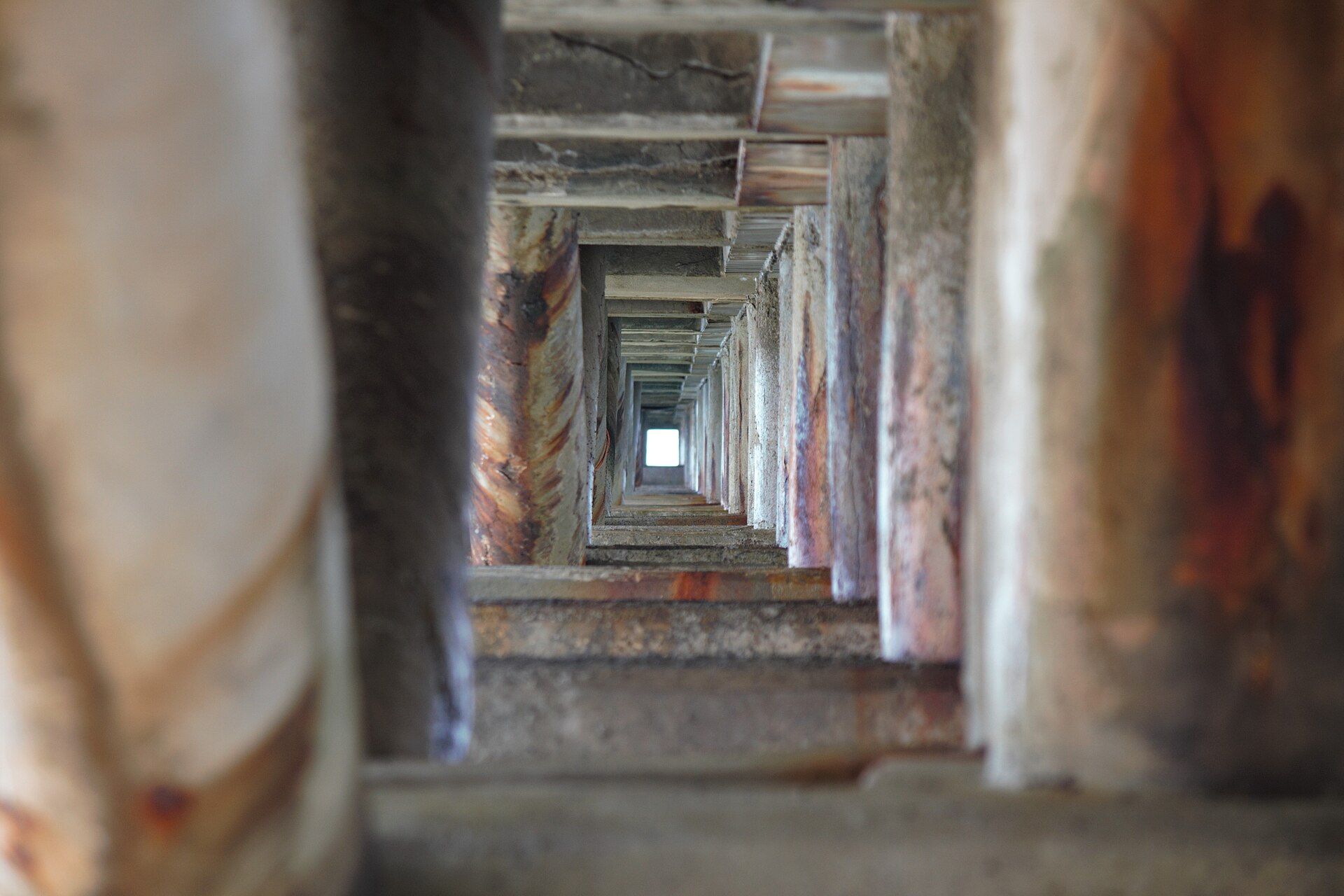
Marble was loaded from the beach here for centuries. As the trade grew, loading straight from the sand was no longer enough, and a long pier, designed by engineer Giovanni Costantini, was built to carry the blocks out to the ships. It was destroyed in the Second World War; today’s pier was rebuilt in 1955, in reinforced concrete.
One regional tourism page even claims the pier’s blocks went into Michelangelo’s statues. Michelangelo died in 1564, long before the first pier was built.
Explosives, then a guesthouse
Marble was not the only cargo. The Società Italiana Prodotti Esplodenti (S.I.P.E.), founded in Milan in 1891, bought an explosives works at Vittoria Apuana in the 1890s. It had its own wooden pier for shipping explosives, dismantled in the early 1930s. Since December 2023 an anchor at the corner of Via Crispi and Viale Italico has commemorated it.
The company’s headquarters was the villa that now carries the Bertelli name. S.I.P.E. made munitions in the First World War and sold up afterward. In 1926 Ilio Bertelli bought the villa and opened it as a hotel-pension. It closed in 1971, stood derelict, and was bought by the comune in 2002.
The fourth plane tree
Over the 20th century the town gained a second identity. Writers and painters made Forte their summer address. Their open-air salon was the “Quarto Platano,” the fourth plane tree of the Caffè Roma. The writer Enrico Pea and the painter Carlo Carrà were its “patron saints” (santi padri).
The sculptor Arturo Dazzi arrived in 1927 and settled at nearby Cinquale. Landolfi, Gadda, and Moravia spent holidays at Vittoria Apuana. When Pea died in 1958, Montale, Ungaretti, and Gadda came to his funeral.
Aldous Huxley lived here too. The comune’s tourism site says he wrote some of his first novels “between Florence and Forte.” A street now carries his name.
Thomas Mann’s expensive summer
Thomas Mann’s stay is well documented. In late summer 1926 he stayed at the Pensione Regina with his wife Katia and their youngest children, Elisabeth and Michael. A passer-by reported little Elisabeth for running naked on the beach, and the family was fined 50 lire.
A stage hypnotist’s xenophobic show from that summer became the basis of Mario und der Zauberer (Mario and the Magician, 1930). In the story, “Torre di Venere” stands for Forte. The magician has been identified as Cesare Gabrielli. The Manns left on 11 September.
What to See and Do
The Fortino and Piazza Garibaldi
Start in the old marble yard. The Fortino, municipal property since 1988, now hosts exhibitions, cultural events, and the tourist office. The turret was demolished long ago and the façade altered in the 20th century, so read it as a working building, not a castle.
The comune’s political satire prize, founded in 1973, is still presented in front of it. Check the Fortino page for current exhibitions.
Walk the pier
Walk out along the pontile (pier), where marble once left for the world, with the Apuan Alps behind the town. Surfers use the break near its end.
The beach
Most of Forte’s beach is run by private bathing establishments (stabilimenti balneari): in 2022 Legambiente found that 93.7% of Forte dei Marmi’s shore was under concession. Expect to rent a sunbed and umbrella. The comune’s beach was awarded the Blue Flag for 2026.
Villa Bertelli and the Quarto Platano museum
Architect Tiziano Lera restored Villa Bertelli. It houses the Fondazione Villa Bertelli and hosts open-air concerts in summer; see the villa’s page.
In summer 2024 a modern art museum named “Quarto Platano” opened in the villa with Milan’s Fondazione Corrente. It has five rooms. The first covers the area’s history and culture, and the artists on show include de Chirico, Guttuso, Carrà, Treccani, Cassinari, and Mattioli. A writers’ room covers Montale and Pea, among others, and the last room is devoted to Dazzi. Check opening times with the tourist office.
The weekly market
Forte’s historic fashion market in Piazza Marconi has run for more than 50 years, and touring “Mercato di Forte dei Marmi” events now copy it elsewhere. Come for the atmosphere rather than bargains; check the schedule.
Eating Like a Local
For a comune of about 6,700 residents, Forte has an unusual number of MICHELIN-starred restaurants. Five hold one star: Lorenzo, La Magnolia, Lux Lucis, Bistrot, and Sciabola. Sciabola, which gained its star in the 2026 guide, is in the St. Mauritius hotel, with chef Alessandro Ferrarini.
Everyday eating here is Versilian. Look for tordelli, half-moon pasta with a meat filling, dressed with ragù and served on feast days across Versilia, Forte included. There is no codified recipe; every family has its own version. Cecina, the chickpea-flour flatbread, is the local street food.
Forte also sits inside the production area of the olivo quercetano, an olive variety listed as a traditional product (PAT) and a Slow Food Presidium. It takes its name from Querceta, just inland, whose raised plain escaped the waterlogging that affected the rest of the coast. Only about sixty plots survive. The wider Lucca DOP olive oil covers Forte as well.
Getting There and Getting Around
By train: the nearest station is Forte dei Marmi-Seravezza-Querceta, about 4 km away in Querceta. For long-distance trains, use Viareggio, about 12 km away. Both are on the Tirrenica line; check times on Trenitalia.
By bus: Autolinee Toscane runs local buses, and lines E1 and E35 serve Forte dei Marmi. Timetables are on at-bus.it.
By car: electronic gates restrict access to the center at set times and seasons. Check the comune’s traffic page before you drive in. Overnight visitors pay a tourist tax.
On the ground: the comune is small (under 9 km²) and flat, so walk or cycle.
Nearby
- Pietrasanta: the workshop city of marble studios and bronze foundries, just inland.
- Seravezza: Michelangelo’s documented quarry campaign and a Medici palace that is part of a UNESCO site.
- Alta Versilia: Levigliani and the Antro del Corchia, Italy’s longest known karst system.
- Viareggio: the Liberty seafront and a Carnival held since 1873, a short way down the coast.
Information is provided in good faith and may change. Always confirm opening hours, prices, and event dates with the official source before you travel.