
Region guide · Province of Lucca
Garfagnana
Tuscany’s Mountain Valley That Looked North
Last updated:
- Province
- Province of Lucca
- Main town
- Castelnuovo di Garfagnana (about 5,600 inhabitants, 270 m)
- Best season
- Late spring to early autumn for hiking and festivals; October–November for chestnuts; winter for snow at the passes
- Known for
- Este fortresses, Ludovico Ariosto, the submerged village of Fabbriche di Careggine, Farro della Garfagnana IGP, chestnut flour (Farina di neccio DOP), Grotta del Vento, Barga's Scottish connection
- Getting there
- Pisa airport (about 1.5 hours by car); Lucca station, then the Lucca–Aulla railway to Castelnuovo (about 1 hour)
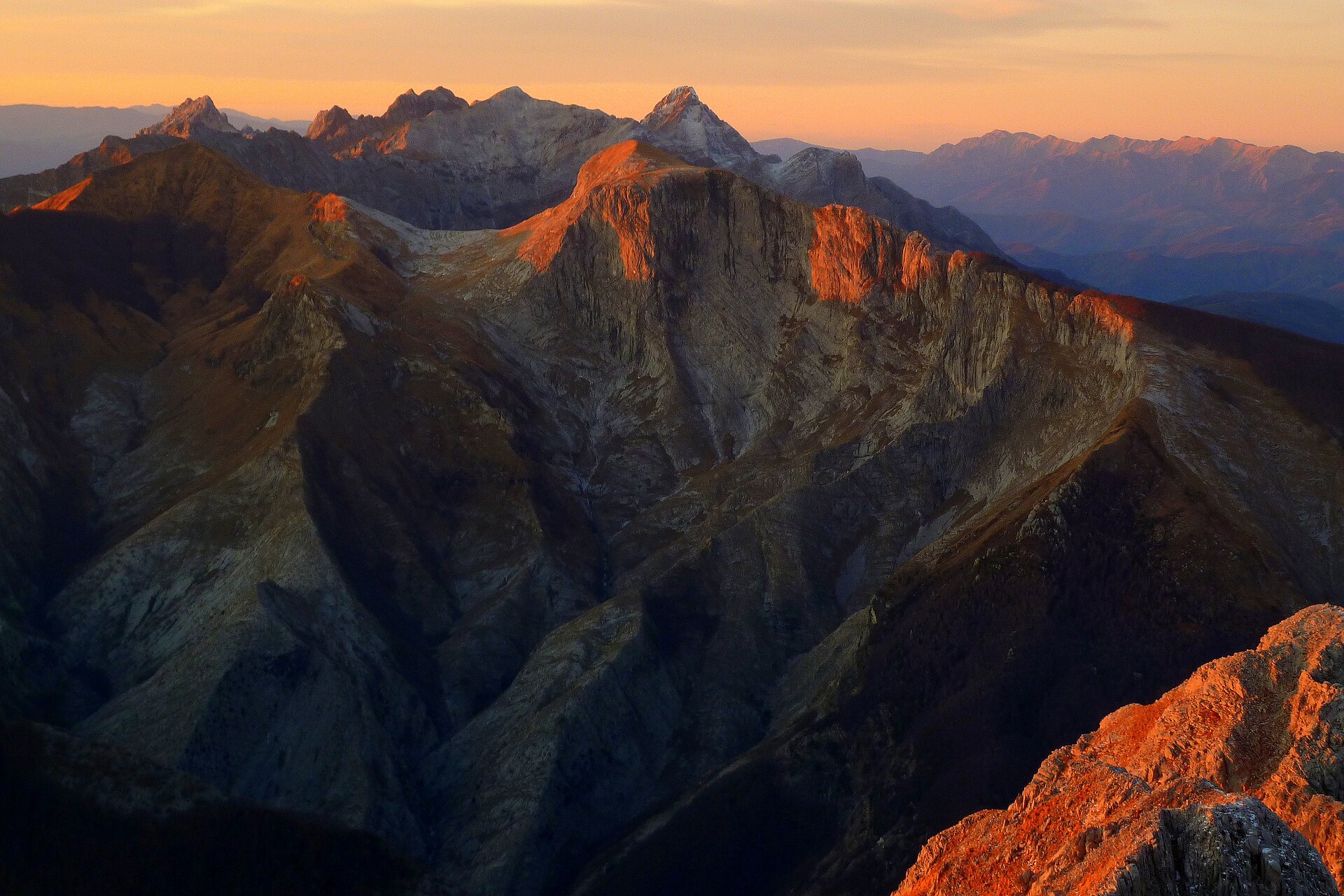
Drive north from Lucca and the valley closes in fast. Within half an hour the olive terraces give way to chestnut woods. The river runs green and quick. On your left, the Apuan Alps rise in sharp white ridges that look more like the Dolomites than anything on a Tuscan postcard. On your right, the Apennines roll away in softer, darker folds toward Emilia.
This is the Garfagnana, the mountain valley of the River Serchio. It is still Tuscany on every map. Yet for four centuries it answered to the dukes of Ferrara and Modena, not to Florence or Lucca. Its roads ran north over the passes, its dialect drifted toward Emilia, and its food stayed stubbornly its own: emmer wheat, chestnut flour, potato bread, and a blood sausage made from a pig’s head.
Most English-language guides give the Garfagnana a paragraph at the end of a Lucca chapter. That undersells it badly. Here you’ll find a poet who governed bandits, a village that surfaces from a lake once a generation, and a Medal of Honor story from the Buffalo Soldiers. There is also a cave that breathes, a hermitage built into a cliff, and a hill town with deep family ties to Scotland.
A hinge between Tuscany and Emilia
The local union of municipalities calls the Garfagnana a cerniera, a hinge. The word fits. The valley borders three other provinces: Massa-Carrara to the northwest, and Reggio Emilia and Modena across the Apennine crest.
The Serchio organizes everything. It has two source branches, one Apennine and one Apuan. Side valleys cut by its tributaries, the various Turrite streams, branch off like ribs. At the head of the valley, around Monte Argegna and the Foce di Carpinelli, the two mountain chains meet. Over that saddle lies the Lunigiana.
Administratively, the core Garfagnana is the Unione Comuni Garfagnana, an association of 14 municipalities. This package also covers the Media Valle del Serchio (middle Serchio valley) just downstream, with Barga, Coreglia, Borgo a Mozzano, and Bagni di Lucca. Locals draw that line carefully. Visitors experience it as one continuous valley, so we treat it that way.
The Towns and Villages
@@TE8@@
The capital sits where the Turrite Secca meets the Serchio. Its fortress, the Rocca Ariostesca, is where the poet Ludovico Ariosto served as governor from 1522 to 1525 and complained bitterly about it. A weekly market fills the center on Thursdays. The September fair dates back to 1430. The town makes the most practical base in the valley.
@@TE9@@
A walled hill town with its 14th-century circuit of walls and towers almost intact. Castiglione was Lucca’s island inside Este territory, so its defenses faced the neighbors, not an outside invader. It belongs to I Borghi più Belli d’Italia (Italy’s most beautiful villages association).
@@TE10@@
Home to the Fortezza delle Verrucole, an Este citadel reborn as a living-history museum with costumed guides. San Romano is also the gateway to the Parco dell’Orecchiella and the processing center for the valley’s farro.
@@TE11@@
The upper valley. Camporgiano has an Este fortress with a surprising collection of Renaissance ceramics in its tower. Piazza al Serchio is the old railway junction and the heart of farro country.
@@TE12@@
Under the Lago di Vagli lies Fabbriche di Careggine, a medieval village drowned by a dam in the 1940s and 1950s. It has resurfaced only four times since. Above the water hangs a suspension footbridge, and upstream sits the stone hamlet of Isola Santa.
@@TE13@@
The best-known town of the middle valley, and famously “the most Scottish town in Italy.” Twice a year, the sun sets twice behind the Monte Forato arch as seen from the cathedral terrace. In the hamlet of Sommocolonia above, an American officer called artillery down on his own position on December 26, 1944.
@@TE14@@
Up the Turrite di Gallicano valley lies the Grotta del Vento, one of Italy’s leading show caves. Nearby, the Eremo di Calomini (Calomini Hermitage) clings to a limestone cliff.
@@TE15@@
The Devil’s Bridge, German Gothic Line fortifications, and a Halloween party billed as Italy’s largest free-entry one, all in Borgo a Mozzano. Up the hill, Coreglia tells the story of the figurinai, the plaster-figurine sellers who walked the world.
@@TE16@@
The thermal town of the Lima valley, once a fashionable resort for the British. It has an Anglican church completed in 1841, an English cemetery, and a guest list that ran from Montaigne to the Shelleys.
The high corners
Two more areas deserve a detour even without their own profiles yet. Minucciano, astride the watershed with the Lunigiana, sits under the climbing wall of the Pizzo d’Uccello (1,781 m). Its hamlet of Gorfigliano lies at the foot of Monte Pisanino, the highest Apuan peak. Sillano Giuncugnano, the highest and northernmost municipality, leads up to the Orecchiella and the Apennine passes.
Food and Drink
The Garfagnana has one of the most distinctive food cultures in Tuscany. It holds two EU-protected products and four Slow Food Presidia. Almost all of it comes from the same mountain logic: grow what survives at altitude, and waste nothing.
Farro and chestnuts
Farro della Garfagnana IGP is emmer wheat, an ancient hulled grain grown between 300 and 1,000 m. It became Italy’s first cereal with a protected geographical indication in 1996. You’ll eat it as zuppa di farro (farro soup with beans), as farrotto (cooked like risotto), and in the savory torta di farro.
Farina di neccio della Garfagnana DOP is chestnut flour, dried for about 40 days over a slow chestnut-wood fire in stone drying huts called metati, then stone-milled. For centuries it was the staple of the rural population. It became a DOP in 2004. New flour is released from December 1. Look for necci (chestnut crêpes with ricotta), castagnaccio, and polenta di neccio.
The Slow Food Presidia
Pane di patate is a dark, salted bread with boiled potato worked into the dough. That makes it unusual in a region known for white, unsalted bread. The potatoes from Metello and Dalli, high in Sillano, are the prized ones.
Biroldo della Garfagnana is a blood sausage made from boiled, deboned pig’s head, a little blood, and spices, above all wild fennel. The Garfagnana version uses only head meat and leaves out pine nuts. It is made from October to April.
Prosciutto Bazzone is a long, jutting ham (bazza is dialect for a protruding chin) from semi-wild grey pigs. It is aged for about two years. Formenton otto file is an old eight-row maize for polenta.
Beer instead of wine
The Garfagnana is not wine country. The nearest DOC, Colline Lucchesi, lies down the valley toward Lucca. The local drink to seek out is craft beer, above all the farro and chestnut beers of Birrificio La Petrognola at Piazza al Serchio.
What Makes This Region Different
The Este centuries
In the early 15th century the Garfagnana communities were tired of being fought over by Florence and Lucca. So they placed themselves, voluntarily, under the House of Este of Ferrara. Castelnuovo submitted in 1430. An imperial decree of May 18, 1452 made the Garfagnana a province of the Este state.
The deal suited both sides. The Este gave the valley its own parliament for local affairs, kept taxes moderate, and kept out the Inquisition. The loyalty ran deep: in 1796–97 the valley rose against the French. Este rule lasted, with interruptions, until 1859. Only in 1923 did the Garfagnana join the Province of Lucca.
That is why the valley can feel subtly un-Tuscan. The fortresses are Este fortresses. The road that mattered, the 18th-century Via Vandelli, ran from Modena to Massa, not to Florence.
The wettest corner of Italy
Moist air from the Tyrrhenian Sea hits the Apuan wall and drops its rain here. The result is one of the wettest areas in Italy, with the Apuan Alps receiving more than 2,000 mm a year. That rain explains the green, the chestnut forests, the fast rivers, and the fact that you should always pack a waterproof.
Two parks, two characters
The Parco Naturale Regionale delle Alpi Apuane (Apuan Alps Regional Park) is sharp, pale, and vertical. Marble quarries scar its ridges. Peaks like the Pania della Croce (about 1,858 m), called the “Queen of the Apuan Alps,” demand real hiking experience.
The Parco dell’Orecchiella on the Apennine side is gentler and wooded. It covers over 5,000 ha around the limestone massif of the Pania di Corfino. It has a visitor center, a birds-of-prey museum, and a botanical garden at 1,370 m. Wild wolves roam here. The bears you may see are in enclosures, not in the woods.
Tuscany’s highest point, Monte Prado (2,054 m), rises on the Apennine crest.
A living seismic memory
At 07:56 on September 7, 1920, a magnitude 6.5 earthquake struck with its epicenter at Villa Collemandina. It killed 171 people. A strong shock the afternoon before had frightened many into sleeping outdoors, and that saved lives. You’ll see its traces in rebuilt churches and damaged fortresses across the upper valley.
When to Visit
Spring (April–June)
Green, fresh, and quiet. Rivers run high, and wildflowers fill the Orecchiella. The Fortezza delle Verrucole opens seasonally from late spring. Check its current opening days. On Holy Thursday night, Castiglione di Garfagnana holds its hooded Crocioni procession. Some high passes may still carry snow in April.
Summer (July–August)
The valley is noticeably cooler than Lucca or Florence. This is festival season. Barga Jazz brings concerts to the town every summer. Barga’s Sagra del Pesce e Patate (Fish & Chips Festival) honors its emigrants to Scotland. Dates change each year, so check the Garfagnana events calendar before you go. Expect Dutch, Belgian, and British visitors.
Autumn (September–November)
Arguably the best season. Castelnuovo’s September fair, held since 1430, falls on the first Sunday of September. October brings chestnut festivals across the valley; see the events calendar for this year’s dates. Borgo a Mozzano’s Halloween culminates on October 31. The woods turn copper, and new chestnut flour arrives from December 1.
Winter (December–March)
Snow falls on the passes. Christmas brings living nativities and the Natalecci bonfires at Gorfigliano. It is also biroldo season. Mountain roads, including the one to the Grotta del Vento, can be difficult.
Practical Tips
Getting there and around
By car, the SS12 and then the SS445 “della Garfagnana” take you from Lucca to Castelnuovo in about an hour (roughly 48 km). From Pisa airport, allow about 1.5 hours. From La Spezia, come in from the north via Aulla, also about 1.5 hours. A car makes the side valleys, lakes, and fortresses far easier.
By train, the single-track Lucca–Aulla line runs through the whole valley, with diesel railcars stopping at Barga-Gallicano, Castelnuovo, Villetta-San Romano, Poggio-Careggine-Vagli, Camporgiano, and Piazza al Serchio. Lucca to Castelnuovo takes about an hour. The line has had summer closures for works in recent years, with replacement buses. Check timetables and service notices on Trenitalia before you travel.
Passes: Passo delle Radici (about 1,529 m) leads to Modena, and Passo del Vestito crosses the Apuan Alps to Massa. Passes can close for snow in winter.
Where to stay
Agriturismi, B&Bs, small hotels, and mountain refuges dominate. Castelnuovo is the practical base for the upper valley. Barga suits anyone who wants evenings in a walled town.
What to plan for
- Rain. Pack for it, even in summer.
- Narrow mountain roads. Allow more time than the map suggests.
- Historic centers. Park outside the old centers of Castelnuovo and Barga and walk in. For local traffic rules, check with the Comune di Castelnuovo or the Comune di Barga.
- Guided visits. The Fortezza delle Verrucole runs guided visits by reservation, so book ahead. The Grotta del Vento also runs guided tours; check current times and prices.
Information is provided in good faith and may change. Always confirm opening hours, prices, and event dates with the official source before you travel.