
Town · Maremma
Montemerano
A Cat-Flap Madonna and a Two-Star Kitchen
Last updated:
- Region
- Maremma
- Province
- Province of Grosseto
- GPS
- 42.62167, 11.49028
- Best season
- spring and autumn
- Time needed
- half day (a full day with Manciano)
- Difficulty
- easy to moderate; a small walled hilltop village with some steep lanes
- Known for
- Madonna della Gattaiola, Sienese art in San Giorgio, Da Caino, medieval walls, Pecorino Toscano
Most people meet Montemerano from a car window. It sits on the road between the hot springs of Saturnia and the coast, and it looks like one more walled village on one more hill. Stop anyway. Inside the walls is one of the oddest paintings in Tuscany, and one of the most admired kitchens in Italy.
The painting is a 15th-century Virgin Mary with a round hole cut near her feet. Local tradition says the hole let the parish cats come and go. The kitchen belongs to Valeria Piccini, a self-taught cook who turned her in-laws’ family restaurant into a two-star Michelin address. Both stories are real, and both are told badly or not at all in most English guides.
Montemerano is also small. It had fewer than 500 residents at the 2011 census, and it is a frazione (a village within a larger municipality) of Manciano. That makes it an easy half day, and a natural pair with Manciano itself, the hill town a short drive away that is home to the area’s cheese cooperative and a museum of prehistory. This profile covers both.
A Place Shaped by Time
Counts, a city-state and a fortress
People lived on this hill long before the village. Italian sources record Neolithic and Roman settlement traces, and the place name appears in documents from the 9th century. The village you walk through today is medieval. The Aldobrandeschi, the counts who ruled much of the southern Maremma, built it on the highest part of the hill in the 13th century. Its walls were begun in the 12th century and completed later.
Control then shifted with the region’s power struggles. In the 14th century the Baschi family held Montemerano and placed it under the city of Orvieto. In the 15th century Siena took it and, in the words of Italian Wikipedia, turned it into “un’imponente fortezza” (an imposing fortress). The Sienese added the Cassero, a fortified complex, and walkways along the walls. After Siena itself fell in the 1550s, Montemerano passed to the Grand Duchy of Tuscany.
A Sienese village in Maremma clothing
That Sienese century matters more than it sounds. It explains why a village this size owns a small collection of Sienese Renaissance art. The church of San Giorgio was built in the 14th century and enlarged around 1430, when the transept and apse were added. Over the following decades it filled with work from Siena’s leading workshops. For a traveler, this is the real surprise of Montemerano: you come for the cat story and find a small, coherent gallery of 15th-century Sienese art.
The panel that became a door
The most famous object has a history of rough handling. The Madonna della Gattaiola (Madonna of the Cat Flap) is an Annunciate Virgin painted in the mid-15th century by an anonymous local artist whom scholars call the Maestro di Montemerano (Master of Montemerano). Italian sources describe the style as Late Gothic with only a surface layer of Renaissance influence. The Virgin was probably one half of an Annunciation, and her partner panel, the Angel, is lost.
At some point the panel was cut down into a rectangular door. Its original pointed top was replaced with an added insert. A round hole sits at the lower right. That hole is a physical fact you can see. The explanation, that it let cats pass in and out, is tradition. A local legend credits a parish priest with the change, but no document of the adaptation has been found. Enjoy the story, and enjoy knowing where fact ends and legend begins.
Recognition, late and modest
Montemerano joined the association of I Borghi più Belli d’Italia (the Most Beautiful Villages of Italy) in 2014. Its best-known modern story, though, is not about stone at all. It is about a family kitchen.
What to See and Do
Chiesa di San Giorgio
Give the church most of your time. The Madonna della Gattaiola hangs in a glass case with a gilded frame. Look at the lower right corner for the hole, then step back and look at the face: this is a serious devotional painting, whatever happened to it later.
Then look around. Sano di Pietro, one of the most prolific Sienese painters of the 15th century, painted the polyptych of the Madonna in trono col Bambino e santi (Madonna Enthroned with Child and Saints), dated 1458. A wooden statue of Saint Peter, from around 1475, is attributed to Francesco di Giorgio Martini. The Pala dell’Assunta, a carved and gilded wooden altarpiece of the Assumption, is attributed to Neroccio di Bartolomeo de’ Landi. On the right side, late 15th-century frescoes by the Sienese painter Andrea di Niccolò tell the story of Saint George and the dragon, the church’s patron. We found no published opening times, so visit in daylight and be ready for a closed door at lunchtime.
The walls, the gates and Piazza del Castello
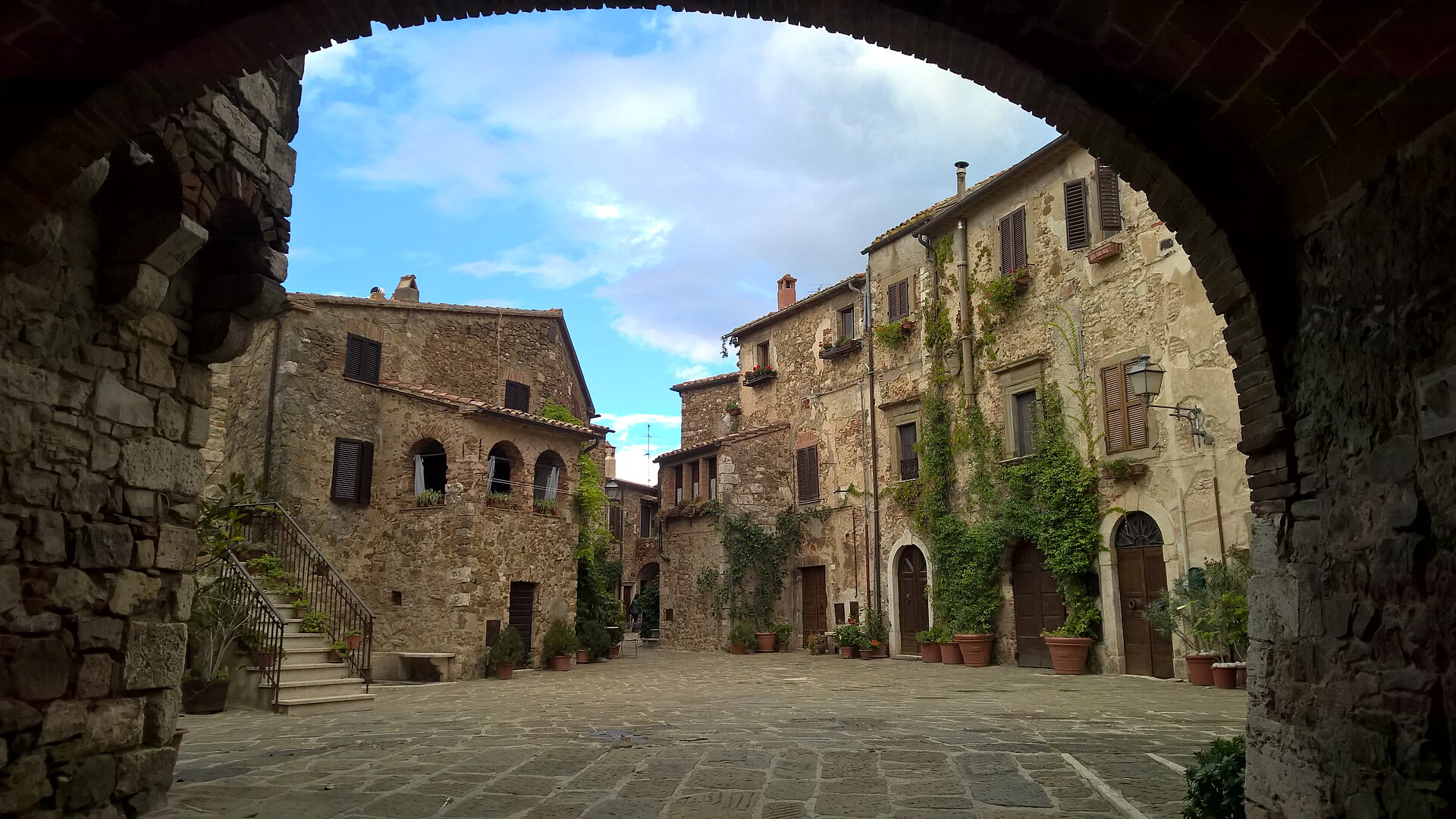
Walk the village in a loop. Three gates lead in: Porta di San Giorgio, Porta Romana and Porta Grossetana. Aim for Piazza del Castello, a small square that keeps its medieval layout intact. It is the village’s most scenic corner, and the best place to understand how tightly the Aldobrandeschi packed their castle onto the hilltop.
Pieve di San Lorenzo and the Madonna del Cavalluzzo
The Pieve di San Lorenzo is Montemerano’s oldest church, documented in 1188. It is now used as a venue for cultural events, so you may see it only from outside. Outside the village, the rural chapel of the Madonna del Cavalluzzo, which dates back at least to the 15th century, frames a 15th-century fresco of the Madonna and Child above its altar. Treat it as a bonus if you are exploring the lanes around the village, rather than a reason to come.
Manciano: The Town on the Next Hill
A frontier town with a first in 1944
Manciano is the municipal seat, at 440 m, and it has its own layered past. A papal privilege first records it in 1188. It passed from the Aldobrandeschi to Orvieto, the Baschi and the Orsini, fell to Siena in 1416 and joined the Medici state in 1557. Its sharpest modern memory is recent: on 12 June 1944, it became, in Italian Wikipedia’s words, “the first center of Tuscany to see the entry of the Allies.”
The Rocca Aldobrandesca, a 12th-century fortress, now houses the municipal offices. Nearby are the 15th-century church of San Leonardo and a monument in Piazza Garibaldi to Pietro Aldi (1852–1888), a painter born in the town’s Palazzo Aldi.
Before the Etruscans: the prehistory museum
The Museo di Preistoria e Protostoria della Valle del Fiora (Museum of Prehistory and Protohistory of the Fiora Valley) is at Via Corsini 5. It covers the long stretch from the Palaeolithic to the Bronze Age: the “communities that preceded Etruscan culture.” In a region where every sign points to the Etruscans, this is the place that explains who came first. Check hours with the museum network at museimanciano.org or by phone (+39 0564 620532) before you go.
A cheese cooperative born of necessity
The Caseificio Sociale Manciano is a genuine community story. Twenty-one farmers founded it in 1961 because selling their cheese was the hardest problem small herders faced. It moved out of town to Piano di Cirignano in 1986, joined the Pecorino Toscano consortium in 1985 and gained DOP (protected designation of origin) status in 1996. It now has nearly 500 members. For its 60th anniversary in 2021 it launched a lactose-free cheese, “il Manciano dalla Bella Insegna.” See caseificiomanciano.it for its shop and visiting information.
Near Manciano, the hamlet of Marsiliana d’Albegna has an unexpected link to the history of writing. Excavations by Prince Tommaso Corsini at the Banditella necropolis produced the Tavoletta di Marsiliana, an ivory writing tablet with a 26-letter archaic Etruscan alphabet. The tablet itself is in Florence.
Eating Like a Local
Da Caino and Valeria Piccini
Da Caino, at Via della Chiesa 4, is the reason many food travelers know Montemerano’s name. Its story starts as a family business. The name comes from “Caino,” the nickname of Carisio, the father of Valeria Piccini’s husband, Maurizio Menichetti. Piccini taught herself to cook. Her mother-in-law saw her talent and put her in charge of the family kitchen.
The restaurant won its first Michelin star in 1991 and its second in 1999, and it has held two stars since. Piccini’s own summary of her approach is plain: “La Maremma è la mia scuola, la mia materia, la mia tradizione” (the Maremma is my school, my subject matter, my tradition). Her son Andrea now runs the dining room, a role her husband held for many years. The Michelin Guide notes a cellar of about 2,500 wine labels and dishes rooted in local produce. This is a top-price, special-occasion meal. Book well ahead and check the current days and hours on dacaino.it.
Everyday Maremma food
You do not need a tasting menu to eat well here. Manciano’s own dish is the ciaffagnone, a thin fritter topped with Pecorino Toscano and folded like a handkerchief. Around Sorano and Pitigliano the same thing is called migliaccio. You may hear that it is the ancestor of the French crêpe; treat that as folklore. Look out too for acquacotta, the herders’ soup of onion, tomato, celery and wild herbs poured over stale bread, and tortelli maremmani, large squares filled with ricotta and chard.
The Michelin Guide also lists La Filanda in Manciano. For cheese, go to the source: the Caseificio Sociale’s Pecorino Toscano DOP. The surrounding hills also grow Ciliegiolo, a red grape with more than half of Tuscany’s plantings in the province of Grosseto.
Getting There and Getting Around
By car
Montemerano is realistically a car destination. It lies in the hills of the Albegna and Fiora valleys, between Saturnia and Manciano, and makes an easy combination with both. From the coast, you leave the SS1 Aurelia and head inland on country roads. Parking and any ZTL (zona a traffico limitato, a restricted traffic zone) rules for Montemerano were not confirmed at the time of writing, so park outside the walls and walk in. The village is small enough that this costs you only minutes.
By bus
There is no railway station in the area. Autolinee Toscane’s line 41P (Pitigliano–Manciano–Albinia–Grosseto) stops in Manciano. Check routes and timetables on at-bus.it before relying on it, and do not assume it serves Montemerano or Saturnia.
When to go
Spring and autumn suit a village walk and a long lunch. In summer, come in the late afternoon, after the heat and before dinner. If you are pairing Montemerano with the Cascate del Mulino at Saturnia, note that the car park beside the springs is paid.
Nearby
- Saturnia has the free thermal waters of the Cascate del Mulino and a Roman gate on the line of the Via Clodia; see our Saturnia profile.
- Pitigliano is the tufa town with a Jewish quarter that earned it the name “Little Jerusalem”; see our Pitigliano profile.
- Sovana is a tiny village with a Romanesque cathedral and an Etruscan necropolis; see our Sovana profile.
- Scansano is the hill town where Grosseto’s government spent its summers to escape malaria; see our Scansano profile.
- Capalbio is a double-walled village near the coast, with Niki de Saint Phalle’s Tarot Garden in the countryside below; see our Capalbio profile.
Information is provided in good faith and may change. Always confirm opening hours, prices, and event dates with the official source before you travel.