
Town · Val d'Orcia
Castelmuzio
The Confraternity’s Castle Above the Val d’Orcia
Last updated:
- Region
- Val d'Orcia
- Province
- Province of Siena
- GPS
- 43.1417, 11.6594
- Best season
- spring and autumn
- Time needed
- 2–3 hours, including the Pieve di Cennano
- Difficulty
- easy (a small, compact walled village; plan on a car)
- Known for
- San Bernardino's stone, the confraternity museum, Sienese painting, the Pieve di Cennano, olive oil
The Village Its People Call “the Castle”
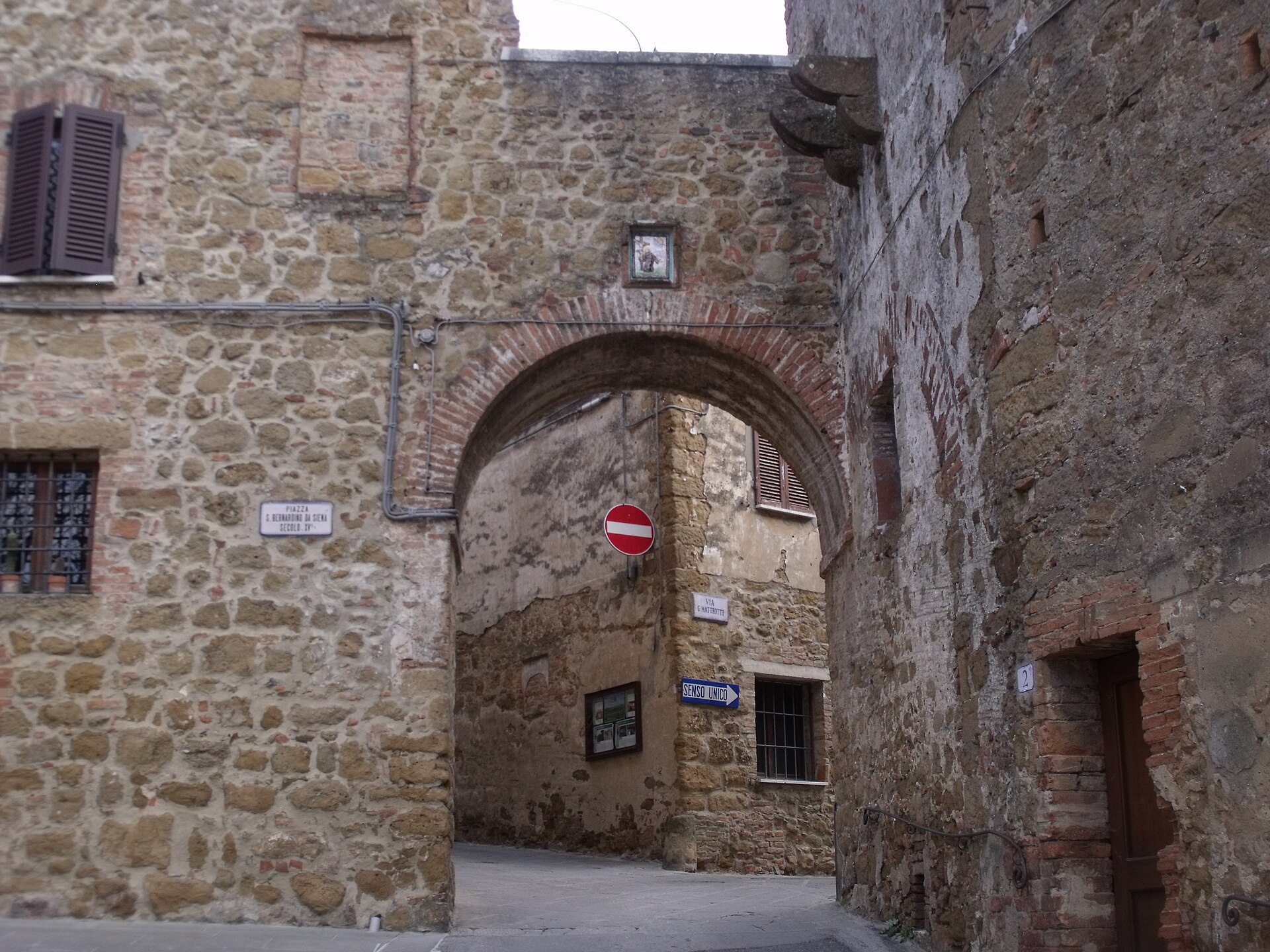
Start with a boundary, because it matters here. Castelmuzio is in the comune of Trequanda, just outside the UNESCO World Heritage Val d’Orcia. It looks across at the valley from the clay country of the Crete, on the other side of the line. We include it because it belongs to the same story. The Comune di Trequanda also calls it an almost intact medieval village, and a walk inside the walls bears that out.
Its name has changed several times over a thousand years. Its residents never bothered. According to the Comune di Trequanda, “i suoi abitanti lo chiamano semplicemente Castello.” Its people simply call it “the Castle.”
What makes Castelmuzio special is not a view or a monument. It is a village built around a religious brotherhood, a hospice for travelers, and a pharmacy. Its museum sits in the brotherhood’s oratory. And at the gate, set into the war memorial, is a stone on which San Bernardino of Siena is said to have rested. Here the legend stands right at the roadside.
A Place Shaped by Time
A stumpy tower and a string of names
The site is old. The Ecomuseo of the Terre di Siena reports Etruscan finds here from the 2nd century BC. In the 9th century, documents of the Badia Amiatina, the abbey of Abbadia San Salvatore, record the place as Casale Mustia.
By 1213 it had become Castel Mozzo, roughly “stumpy castle.” The Ecomuseo explains the name: from a distance the fortified village looked dominated by a very low tower. The modern name, Castelmuzio, appears in the early 1500s. The Ecomuseo suggests it probably comes from “Muzia,” a population of Roman origin.
From lords to a hospital to the Piccolomini
The first known lords were the Cacciaconti, of the Scialenga branch. In 1270 they handed the castle to the Republic of Siena, which installed a vicar the following year. In 1354 it passed to the great Sienese hospital of Santa Maria della Scala. The hospital’s emblem, a ladder, can still be seen on farmhouses around the village.
The Salimbeni years were rough. From his fortress at Rocca a Tentennano, across the valley, Cocco Salimbeni raided neighboring villages, Castelmuzio included. The raids ended only when Siena defeated him in 1418.
Then came the Piccolomini. In 1462 Pope Pius II, a Piccolomini, moved Castelmuzio’s churches from the diocese of Arezzo to that of Pienza. In 1470 Count Andrea Piccolomini bought the village. Siena took it back in 1551. In 1559 it passed for good to Medici Florence, and it followed the fortunes of the Grand Duchy of Tuscany.
Why it sits outside the UNESCO line
For centuries Castelmuzio looked to Pienza. In 1833 it was moved from the comune of Pienza to that of Trequanda. The Ecomuseo notes that the split left some neighbors behind: the monastery of Sant’Anna in Camprena stayed with Pienza.
That 19th-century redrawing still has consequences. When the Val d’Orcia was inscribed as a World Heritage site in 2004, the protected area followed five comuni. Trequanda was not one of them.
A saint on the road
San Bernardino of Siena knew this village well. According to the Ecomuseo, he stopped repeatedly at its hospice between 1405 and 1410. Tradition says he rested on a large stone here. In the 17th century, the Comune di Trequanda explains, the stone was split in two. One half went into a monument at the village entrance, and the other beneath the altar table of the confraternity’s oratory.
The village also sheltered a later scholar. Gaetano Milanesi (1813–1895), a paleographer and director of the Florence State Archive, lived here for long periods. A plaque marks his house.
What to See and Do
The gate and San Bernardino’s stone
Begin at the entrance. The gate still has its original hinges and machicolations, the openings from which defenders could drop things on attackers. Beside it, the war memorial holds half of San Bernardino’s stone. It is a plain object with a long story, and it sets the tone for the whole village.
The village sits on a hilltop inside its walls and bastions. Take a slow loop inside. Look for Palazzo Fratini, with its tower, rebuilt on the foundations of the old Casa della Comunità, where the village priors once met. The church of Santa Maria Assunta, originally dedicated to San Giusto, is also inside the walls.
The Museo d’Arte Sacra
The main sight is the Museo d’Arte Sacra (Museum of Sacred Art). It has been open since 1973 in the oratory of the Confraternita della SS. Trinità e San Bernardino (Confraternity of the Holy Trinity and San Bernardino). The oratory keeps its adjoining hospice and pharmacy. You are walking through the rooms of a centuries-old welfare system.
The collection is mostly Sienese painting. The Ecomuseo lists works of the school of Duccio, by Niccolò di Segna, and by Giovanni di Paolo, along with liturgical objects and textiles. The Comune’s tourism page also lists works by Beccafumi, Domenico Manetti, and Sano di Pietro. There is an Etruscan cinerary urn in terracotta, dated by the Ecomuseo to the 3rd century BC.
Look too for a gilded 18th-century tabernacle. It frames a small panel with the monogram of Christ that San Bernardino is said to have given the village.
The Comune lists access as “libero” (free), but opening is limited. Contact the Comune di Trequanda before you go. Do not simply turn up and hope.
The Pieve di Santo Stefano a Cennano
Outside the village, on the road to Montisi, stands the Pieve di Santo Stefano a Cennano. Its present form dates from 1285, “come riportato nell’iscrizione latina sul portale” (as recorded in the Latin inscription on the portal). Find that inscription, and then look at the carvings around it. The Ecomuseo describes them as archaic sculptures of the allegories of the Four Gospels.
The building has had a hard life. An 18th-century collapse turned its three aisles into a single nave, and the bell tower was added in the 18th century. Walk around the back to see the three apses with their small hanging arches.
The site is older than the church. Roman tombs and a small bath complex from the 2nd century AD were found nearby. The Ecomuseo places it on an ancient Etruscan-Roman road, the “strada dei monti.”
Eating Like a Local
Olive oil and the table of the Crete
Castelmuzio has long been olive country. The Ecomuseo records three historic oil mills in or near the walls and praises the area’s extra virgin oil. If you visit in autumn, this is the season of new oil across the whole area.
The dishes are those of the Pienza side. Expect pici, the thick hand-rolled pasta of the Val d’Orcia, and pecorino from the dairies around Pienza. Remember that “Pecorino di Pienza DOP” does not exist; the protected cheese is Pecorino Toscano DOP.
A winery on the same side of the line
Trequanda has its own wine address. Donatella Cinelli Colombini’s Fattoria del Colle makes Orcia DOC, the valley’s own appellation, and offers visits and a cooking school. It is a good way to taste Orcia wine without crossing back into the park.
We have not listed a restaurant inside Castelmuzio, because we could not confirm one from an official source. Monticchiello‘s cooperative restaurants are a short drive away.
Getting There and Getting Around
Plan on a car. Castelmuzio lies on the Pienza side of the valley, in the comune of Trequanda. We could not confirm a practical bus service from official timetables, so check Autolinee Toscane if you need one.
The working rail stations for the Val d’Orcia are Chiusi-Chianciano Terme, on the Florence–Rome line, and Buonconvento, on the Siena–Grosseto line. From either, you will need a car or taxi.
The village is compact and easy to explore on foot. The Pieve di Cennano is a short drive out on the Montisi road. Combine the two, and add Pienza or Monticchiello for a full day.
What we know vs. what’s repeated: Many English sources place Castelmuzio inside the UNESCO Val d’Orcia. It is not. The World Heritage site covers five comuni: Castiglione d’Orcia, Montalcino, Pienza, Radicofani, and San Quirico d’Orcia. Castelmuzio moved from Pienza to Trequanda in 1833, so it sits just outside the line. The same goes for its neighbor Montisi, also in Trequanda.
Nearby
- Montisi: Castelmuzio’s neighbor on the Cennano road, also in the comune of Trequanda.
- Pienza: the Renaissance town that Castelmuzio belonged to until 1833, and a pecorino center.
- Monticchiello: the village that has written and staged its own play every summer since 1967.
- Rocca d’Orcia: the Salimbeni fortress of Tentennano, from which Cocco Salimbeni raided Castelmuzio.
- San Quirico d’Orcia: a Renaissance garden, a Giovanni Pisano portal, and the Barbarossa festival.
Information is provided in good faith and may change. Always confirm opening hours, prices, and event dates with the official source before you travel.