
Town · Val d'Orcia
San Quirico d’Orcia
An Emperor, a Pisano Portal, and a Garden
Last updated:
- Region
- Val d'Orcia
- Province
- Province of Siena
- GPS
- 43.067, 11.600
- Best season
- Spring to autumn (the Horti Leonini keep seasonal hours)
- Time needed
- half day to full day
- Difficulty
- easy (a compact center)
- Known for
- Horti Leonini, Collegiata portals, Festa del Barbarossa, Via Francigena, saffron, and olive oil
The Town Everyone Drives Past
San Quirico d’Orcia sits in the middle of the Val d’Orcia, and most traffic treats it as a junction. Pienza lies east, Montalcino west, and Bagno Vignoni south. That’s a pity, because San Quirico packs three very different stories into a few walkable streets.
The first is an emperor. In 1155, Frederick Barbarossa stopped here on his way to be crowned in Rome, and a heretic was handed over as the price of a deal with the pope. The second is a church door. The Collegiata has carved portals of real quality, one of them attributed to the great sculptor Giovanni Pisano. The third is a garden. The Horti Leonini, laid out around 1580, is a formal Italian garden of box hedges in the heart of the town, open to the public.
San Quirico is also a real working town, with a fortnightly market, a busy events calendar, and saffron and olive oil producers. It makes a practical base for the whole valley.
A Place Shaped by Time
Barbarossa and the price of a crown
The story that San Quirico still celebrates every June took place in 1155. According to the Comune, Frederick Barbarossa arrived “per ottenere l’incoronazione ad imperatore” (to obtain his coronation as emperor). He met cardinals sent by Pope Adrian IV, the only English pope. Their agreement required Frederick’s army to capture the preacher Arnaldo da Brescia, whom the Church considered a heretic.
Arnaldo was handed over. It’s a dark bargain to build a festival around, but it shows why this small town mattered: it sat on the Via Francigena, the road that emperors, popes, and pilgrims all had to use.
A Medici gift and a Chigi fief
The Horti Leonini carry the name of Diomede Leoni, who laid them out around 1580 on land given by Grand Duke Francesco I de’ Medici. A century later, in 1677, the territory was granted as a fief to Cardinal Flavio Chigi. The tourism office quotes the phrase that followed: San Quirico became “la nobil terra senese” (the noble Sienese land). The cardinal also commissioned Palazzo Chigi, designed by the Baroque architect Carlo Fontana.
War damage
The 20th century left its mark too. The medieval Torre del Cassero, the tower at the top of the Horti Leonini, was destroyed on 14 June 1944. Its remains still stand in the garden.
What to See and Do
The Collegiata and its three doors
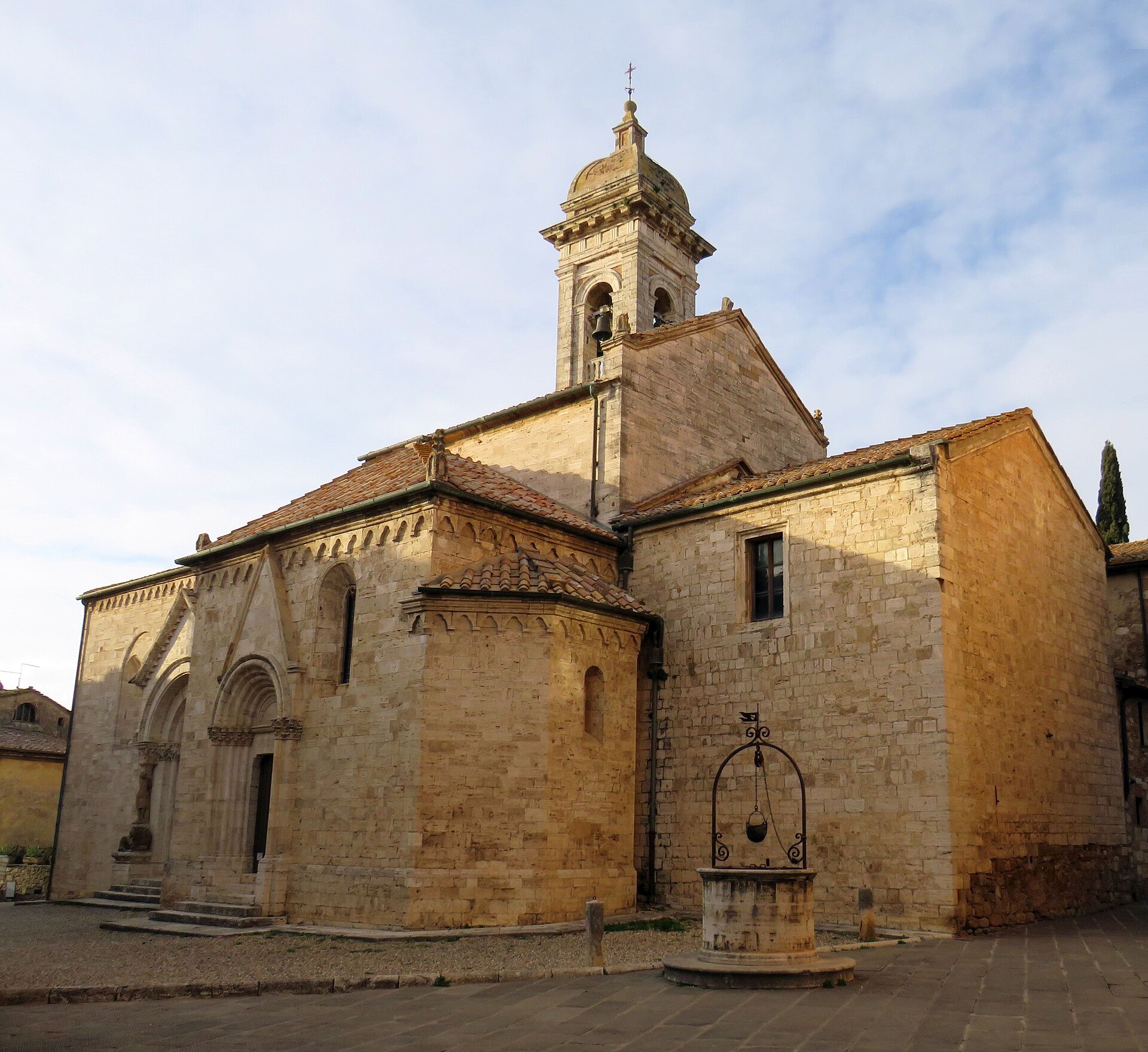
The Collegiata dei Santi Quirico e Giulitta began as a pieve (rural parish church), preceded by an 8th-century baptistery. Its present form dates from the 13th and 14th centuries. What makes it special is the carving around its doors, and it’s worth walking all the way round.
The main façade has a Romanesque portal from the 12th century. Its arch rests on columns with knotted shafts, which stand on two lionesses. Above it sits a Gothic rose window.
The south portal, “il portale di mezzogiorno,” is attributed to Giovanni Pisano. Look up at the arch: the tourism office describes a relief of two monstrous figures locked in a fight.
The third portal, on the right side, is a separate work. It shows “influssi lombardi” (Lombard influence) and has a pointed porch held up by two caryatids, which in turn stand on lions. It dates from the second half of the 13th century, and no artist is named.
Inside, the Collegiata has a polyptych by Sano di Pietro, inlaid choir stalls by Antonio Barili, and the funerary stone of Count Henry of Nassau.
The Horti Leonini
The garden is the town’s living room. The lower part is geometric: low hedges of box and holm oak around a marble statue of Cosimo III de’ Medici, dated 1688 and moved here in 1951. A Roman two-faced Janus head marks the boundary with the “wild” upper part, a wood of holm oaks. The remains of the Torre del Cassero stand up here. From the lower level, an avenue of holm oaks leads to a separate rose garden.
The garden has belonged to the comune since 1975. Hours change with the seasons, so check visitsanquirico.it before you go. Every summer since around 1970, the garden has also hosted Forme nel Verde (Forms in the Green), an exhibition of contemporary sculpture. It presents itself as Italy’s longest-running exhibition after the Venice Biennale.
Palazzo Chigi and the Barbarossa museum
Palazzo Chigi is now the seat of the comune. Its rooms carry frescoes of the Seasons, the Zodiac, the Elements, and the Arts, and a first-floor hall has large canvases of the life of Alexander the Great by Michelangelo Ricciolini. On the second floor, the Museo del Barbarossa Orfeo Sorbellini tells the festival’s story. It keeps the costumes worn by the actors playing Frederick and Beatrice of Burgundy, archives of the four quarters, and the Emperor’s jug that the quarters compete for.
The chapel of Vitaleta
The Cappella della Madonna di Vitaleta, the small chapel alone among the fields, is in San Quirico’s territory. Italy’s national tourism portal calls it one of the most recognizable places in the Val d’Orcia. It was restored conservatively in 2021, with funding from Pasquale Forte of Podere Forte and under the supervision of the heritage authority. Admire it from the road or the public paths.
What we know vs. what’s repeated: Vitaleta is often called “the Gladiator chapel.” Italy’s national tourism portal says it “has never been used as a film location.” The wheat-field scene was shot on the Terrapille estate, near the Pieve di Corsignano in Pienza’s territory.
Vignoni Alto and Bagno Vignoni
Two of San Quirico’s frazioni (outlying villages) lie just south. Bagno Vignoni has a square made of hot water. Above it, Vignoni Alto is a quiet hamlet with a cassero tower rebuilt by the Sienese in 1339. Both deserve their own visit.
Festivals Through the Year
San Quirico’s calendar is one of the fullest in the valley. The Orcia Wine Festival, usually over a long weekend in late April, is the showcase of the Orcia DOC, with tastings alongside the producers.
In mid-June, the Festa del Barbarossa fills the town for several days. The four quarters (Borgo, Canneti, Castello, and Prato) compete in archery and flag-throwing for the Emperor’s jugs. A historical reenactment brings back the emperor and the pope’s cardinals.
Forme nel Verde runs from summer into autumn. Then, in early December, around the Immacolata holiday weekend, the Festa dell’Olio celebrates the new season’s oil with tastings, bruschetta, music, and street games. Check the Comune’s events pages for this year’s dates.
What we know vs. what’s repeated: Some English guides say the Barbarossa festival recalls events “around the year 1000.” The Comune dates the episode to 1155. Guides also often promise a weekly market. San Quirico’s market is fortnightly, on the second and fourth Tuesday of the month.
Eating Like a Local
Saffron, revived
The Val d’Orcia grew saffron widely in the Middle Ages, according to the Parco della Val d’Orcia, then stopped in the 16th century. It returned only recently. In San Quirico, Egisto Brandi of CrocusBrandi writes that he came across saffron “casualmente nel 1995” (by chance in 1995). His farm, on Vicolo del Vecchietta, is inside the park. It doesn’t advertise visits, so contact the farm directly. Read our CrocusBrandi profile for his story. Pura Crocus also grows saffron in San Quirico and Montalcino.
Oil and the old mill
The Ecomuseo documents the Frantoio storico Simonelli-Santi, an olive mill in an old building in the town center, restored in 2000. The Festa dell’Olio’s own program has included booked mill visits, which is a good reason to plan an early-December trip. Ask at the tourist office what is on this year.
What to order
The valley’s pasta is pici, thick hand-rolled strands of flour and water. The cheese is pecorino. The protected designation is Pecorino Toscano DOP, while Pienza’s barrique-aged pecorino is a regional traditional product, not a DOP. Drink Orcia DOC, the small appellation squeezed between Brunello di Montalcino and Vino Nobile di Montepulciano.
Market day
The market sets up on Via dei Canneti on the second and fourth Tuesday of each month. There is no market in Bagno Vignoni. The rules are in the Comune’s market regulations.
Getting There and Getting Around
By car
San Quirico is the valley’s crossroads. By road it is about 120–125 km from Florence via Siena, and about 210–220 km from Rome Fiumicino via the A1 (exit Chiusi).
By bus and train
Autolinee Toscane line 112 runs Siena–Buonconvento–San Quirico–Pienza–Montepulciano. Line 54A continues south to Bagno Vignoni, Castiglione d’Orcia, and the Amiata villages. Timetables change with the school year, so check the line pages. The nearest working stations are Buonconvento (Siena–Grosseto line) and Chiusi-Chianciano Terme (Florence–Rome line). Torrenieri, still listed in some guides, has had no regular trains since 1994.
On foot: the Via Francigena
San Quirico is a key stop on the pilgrim road. Stage 35 arrives from Ponte d’Arbia via Buonconvento (26.25 km). Stage 36 starts at the Collegiata and runs 33.02 km to Radicofani, via Vignoni Alto and Bagno Vignoni. It is rated “very demanding,” so if you only want a taste, walk the first section to Bagno Vignoni.
The tourist office runs visitsanquirico.it, the comune’s official tourism site.
Nearby
- Bagno Vignoni (south, short drive): a medieval square built around a pool of hot water.
- Castiglione d’Orcia (south): two fortresses and a Simone Martini Madonna whose Child holds a swallow.
- Rocca d’Orcia (south): the Salimbeni tower where Catherine of Siena stayed in 1377.
- Monticchiello (east, beyond Pienza): the village that writes and stages its own play every summer.
- Radicofani (end of stage 36): the papal border fortress blown up in 1735.
Information is provided in good faith and may change. Always confirm opening hours, prices, and event dates with the official source before you travel.