
Town · Lunigiana
Fosdinovo
The Castle Where You Can Sleep in the Middle Ages
Last updated:
- Region
- Lunigiana
- Province
- Province of Massa-Carrara
- GPS
- 44.1342, 10.0175
- Best season
- Year-round; spring and autumn for hiking; summer for combining with the coast
- Time needed
- Half day for the castle and village; overnight if staying in the castle B&B
- Difficulty
- moderate
- Known for
- Inhabited Malaspina castle (B&B), ghost of Bianca Maria, views to Corsica, Dante connection, proximity to Carrara and Cinque Terre
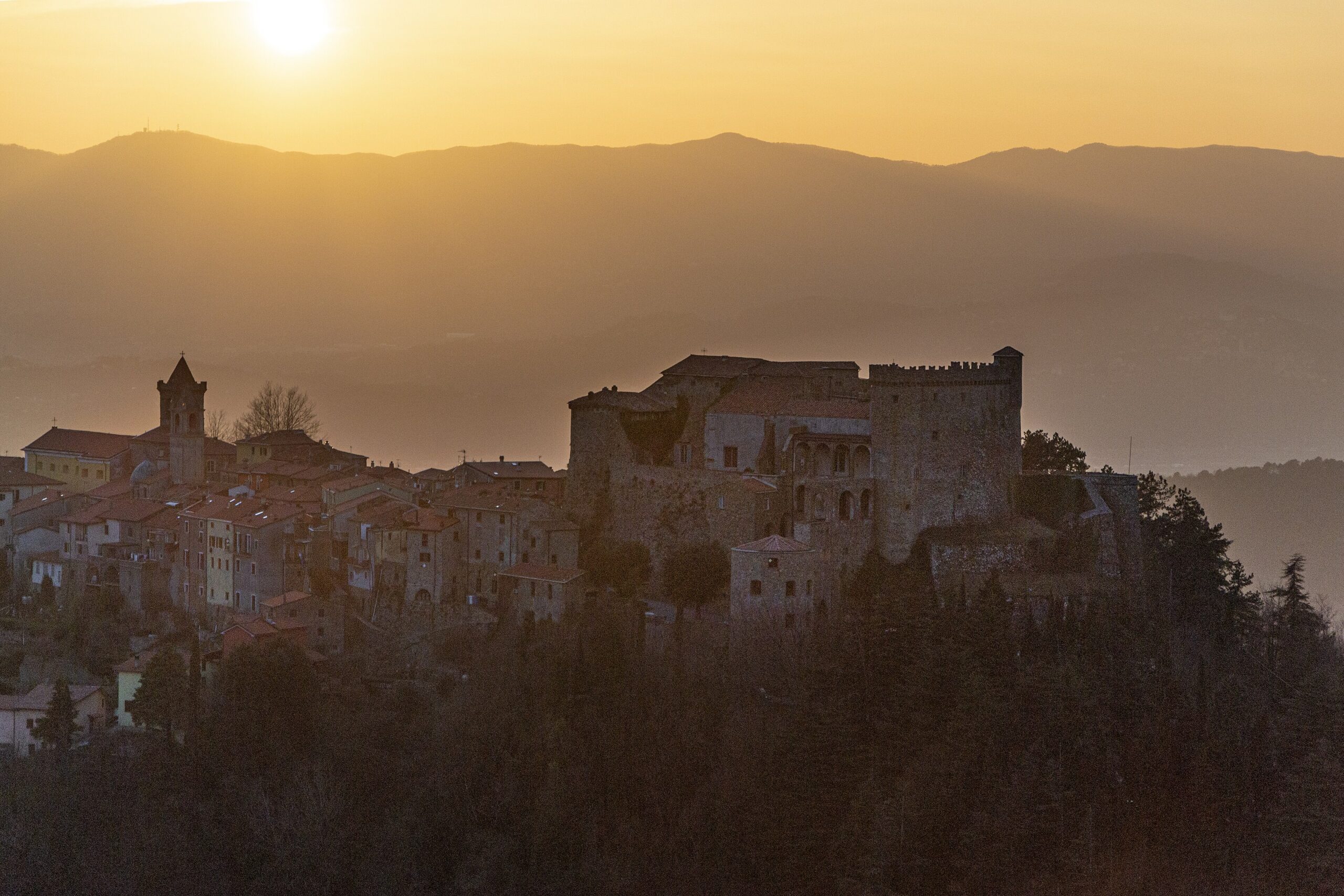
Fosdinovo’s Malaspina castle is not a museum. It is not a ruin. It is a place that has been lived in for centuries, where you can book a room, sleep among antique furniture, and wonder whether the floorboards creak from age or from the ghost of Bianca Maria Aloisia Malaspina, who — according to local legend — was walled up alive by her own family for falling in love with a stable boy.
The castle is the point. Everything in Fosdinovo — a town of roughly 4,500 inhabitants perched at 500 meters on a ridge between the Magra plain and the Ligurian coast — radiates from this quadrangular fortress with its four round towers. On clear days, the views extend from the Apennine ridge behind you to the Ligurian Sea ahead, and on the best days, all the way to Corsica. The Carrara marble quarries gleam white on the Apuan slopes to the southeast, barely 9 kilometers away. Cinque Terre is 30 minutes by car to the coast and then along. This is Lunigiana‘s southern gateway, the point where the mountains finally descend toward the sea.
A Place Shaped by Time
The castle, first recorded in 1084, came to the Malaspina in 1340, when Spinetta Malaspina of the Spino Fiorito (Flowering Thorn) branch — one of the two lines created by the family’s 1221 division — acquired it from the local nobles of Fosdinovo. Over the following centuries, successive marquises expanded the fortress from a defensive structure into a noble residence — adding the loggia, the painted halls, the armory, the chapel — without ever losing the military bones underneath. The quadrangular plan with four round corner towers is classic Italian late-medieval military architecture, built to withstand sieges.
The castle’s most famous legend involves Bianca Maria Aloisia Malaspina, alleged to have been condemned to death by her family for an impossible love affair with a servant. Whether she was walled up alive, as the most dramatic version claims, or simply poisoned, or whether the story is entirely apocryphal, varies depending on who tells it. What doesn’t vary is that visitors and staff report hearing unexplained sounds, cold drafts in warm rooms, and — very occasionally — a presence in the corridors at night. The castle leans into this reputation without overplaying it.
A more historically documented guest is Dante Alighieri. The castle preserves a “Dante’s Room,” though documentary proof of his stay at Fosdinovo specifically (as opposed to other Malaspina residences in Lunigiana) does not exist. What is certain is that Dante was in the Magra Valley in 1306 as a guest of the Malaspina, and Fosdinovo was among the most important Malaspina seats — it would be surprising if he didn’t visit.
The castle remained in Malaspina hands through various branches and marriages, eventually passing to the Torrigiani-Malaspina family, who own it to this day. The decision to open part of the castle as a B&B and cultural center (CastelloInMovimento) was a practical response to the reality of maintaining a medieval fortress in the 21st century — and it has given visitors an experience available nowhere else in Lunigiana.
What to See and Do
The castle is the essential visit. Guided tours reveal the painted reception halls, the armory with period weapons, the chapel, and the famous room attributed to Dante. The atmosphere is unlike a museum — this is a place with furniture that gets used, rooms that are slept in, a kitchen that produces breakfast. The mix of medieval architecture, Renaissance decoration, and the accumulated objects of centuries of continuous inhabitation creates something more intimate and human than any restored-for-tourists castle can achieve.
Since 2008 the castle has also been home to CastelloInMovimento, a contemporary arts center that runs residencies for artists and writers, seminars, and a summer program of public events. The juxtaposition works precisely because the space is alive rather than frozen. Castle visits are guided and must be booked in advance.
The village of Fosdinovo itself is small but atmospheric — stone houses clustered below the castle, narrow lanes, and the parish church. The views from the village terraces are the reward: the Magra plain stretching south toward Aulla, the Apuan Alps rising to the east with Carrara’s white quarry scars, and on the clearest days, the blue line of the Ligurian Sea.
For hikers, Fosdinovo sits on routes connecting the mountains to the coast. The Via Francigena passes through the surrounding territory. Trails lead both uphill into the Apennine forests and downhill toward the coast — it is entirely possible to walk from Fosdinovo to the sea in a long day.
The hamlet of Tendola, within Fosdinovo’s municipality, hosts an annual Sagra dei Testaroli — one of the best places to eat the ancient pasta in its most traditional form.
Eating Like a Local
Fosdinovo’s position at the junction of mountains and coast means its kitchen draws from both traditions. Testaroli are the staple — the Sagra dei Testaroli in Tendola is the local celebration. The proximity to Liguria means pesto is the default dressing. Ligurian Vermentino — from the Colli di Luni DOC zone, which includes Fosdinovo’s vineyards — is the natural pairing. The best-known producer in the wider Colli di Luni area, Cantine Lunae, is based just across the border in Liguria.
The coast’s influence brings seafood into the mix — not traditional for mountain Lunigiana, but available here because the sea is close. Focaccia, farinata, and other Ligurian flatbread traditions coexist with Lunigiana’s testaroli and panigacci.
The castle B&B’s own breakfast, served in the loggia, reportedly features local products — honey, cheeses, chestnut-based preparations — sourced from the surrounding territory.
Getting There and Getting Around
By car: From the A15 motorway, exit at Aulla and follow signs for Fosdinovo — about 15 minutes of climbing road. From La Spezia, approximately 30 minutes. From Carrara, about 20 minutes. The road from the plain to the hilltop is winding but well-maintained.
By train: The nearest station is Aulla Lunigiana on the Pontremolese line. From Aulla, you’ll need a car or taxi to reach Fosdinovo (about 15 minutes uphill).
Parking is available near the castle and at the edge of the village. The village itself is compact enough to walk in under an hour.
Timing: A half day covers the castle tour and village walk comfortably. An overnight stay in the castle B&B transforms the visit into something memorable. If combining with Carrara marble quarries (guided jeep tours available, 30 minutes away) or a train to Cinque Terre from Aulla, plan a full day or two.
Nearby
Aulla — Transport hub with the Abbey of San Caprasio and connections to Cinque Terre (43 minutes by train to Monterosso). Fifteen minutes downhill.
Carrara marble quarries — Guided jeep tours into active extraction basins, some of the most dramatic industrial landscapes in Italy. Only 9 km as the crow flies; about 30 minutes by road.
Cinque Terre — Aulla to La Spezia by train in 23 minutes, then onwards to Monterosso in another 20. Fosdinovo is one of the closest Lunigiana bases for a Cinque Terre day trip.
Pontremoli — The stele museum and cultural capital of Lunigiana. About 45 minutes north via the valley road.
Tendola — The hamlet within Fosdinovo’s municipality where the Sagra dei Testaroli takes place. Ten minutes by car.
Luni archaeological site — The ruins of the Roman colony that gave Lunigiana its name, with an amphitheater and mosaics. About 20 minutes south, just across the Liguria border near Sarzana.
Information is provided in good faith and may change. Always confirm opening hours, prices, and event dates with the official source before you travel.