
Town · Lunigiana
Pontremoli
The Northernmost Town in Tuscany and Its Five-Thousand-Year Secret
Last updated:
- Region
- Lunigiana
- Province
- Province of Massa-Carrara
- GPS
- 44.3752, 9.8792
- Best season
- Spring (April–June) and autumn (September–October); January for the Disfida dei Falò; late July for the Premio Bancarella
- Time needed
- Full day (half day minimum for the stele museum and old town)
- Difficulty
- easy
- Known for
- Stele statues museum, Via Francigena, Premio Bancarella literary prize, Baroque palaces, Amor pastry, testaroli, Disfida dei Falò
Most visitors to Tuscany have no reason to know that the region’s northernmost town exists. Pontremoli sits at the bottom of the Cisa Pass, where the Apennines finally relent and the road from Parma drops into the Magra Valley — a position that made it, for a thousand years, the single most important gateway between the Mediterranean and northern Europe. Frederick II called it clavis et ianua Tusciae: the key and gateway to Tuscany. Archbishop Sigeric of Canterbury recorded it as stage XXXI of his pilgrimage from Rome to England around 990 AD, writing it down as Puntremel; its Latin name, Pons Tremulus, means the Trembling Bridge.
That bridge is gone, but everything it represented remains. Pontremoli is still a threshold town, balanced between Tuscany and Emilia-Romagna, between Ligurian pesto and Parmigiano, between the sea you can almost smell and the mountains that enclose you on three sides. Its population of roughly 6,900 feels like a proper town rather than a village — there are Baroque palaces with frescoed ceilings, a castle on the hill, a literary prize that draws national attention every July, and a museum that houses one of Europe’s most enigmatic archaeological collections. It is also, quietly, one of the best food towns in northwestern Tuscany, built on testaroli and chestnut flour and a pastry whose cream filling has been kept secret for over a century.
A Place Shaped by Time
The name tells the first story. Pons Tremulus — trembling bridge — described either a wooden bridge over the River Verde that shook under the weight of travelers and their carts, or the poplar wood it was made from, since the poplar tree was called tremulus for the way its leaves quivered in the slightest breeze. Either way, the bridge was the point. Pontremoli existed because of the crossing — the place where the Via Francigena descended from the Cisa Pass and needed to ford the rivers before continuing south toward Lucca and Rome.
By the early medieval period, Pontremoli was wealthy enough to attract trouble. The town was a free commune — one of the few in Lunigiana that never fell under Malaspina rule — but its strategic position meant that everyone wanted it. The Guelphs and Ghibellines fought so viciously within the walls that in the 14th century, the warlord Castruccio Castracani ordered a wall built down the center of the town to physically separate the two factions. The Campanone — a bell tower that still dominates the central piazza — is the surviving fragment of that dividing wall. It is an oddly moving monument: not to victory or faith, but to the exhausted pragmatism of a town that found the only way to stop its citizens killing each other was to build a wall between them.
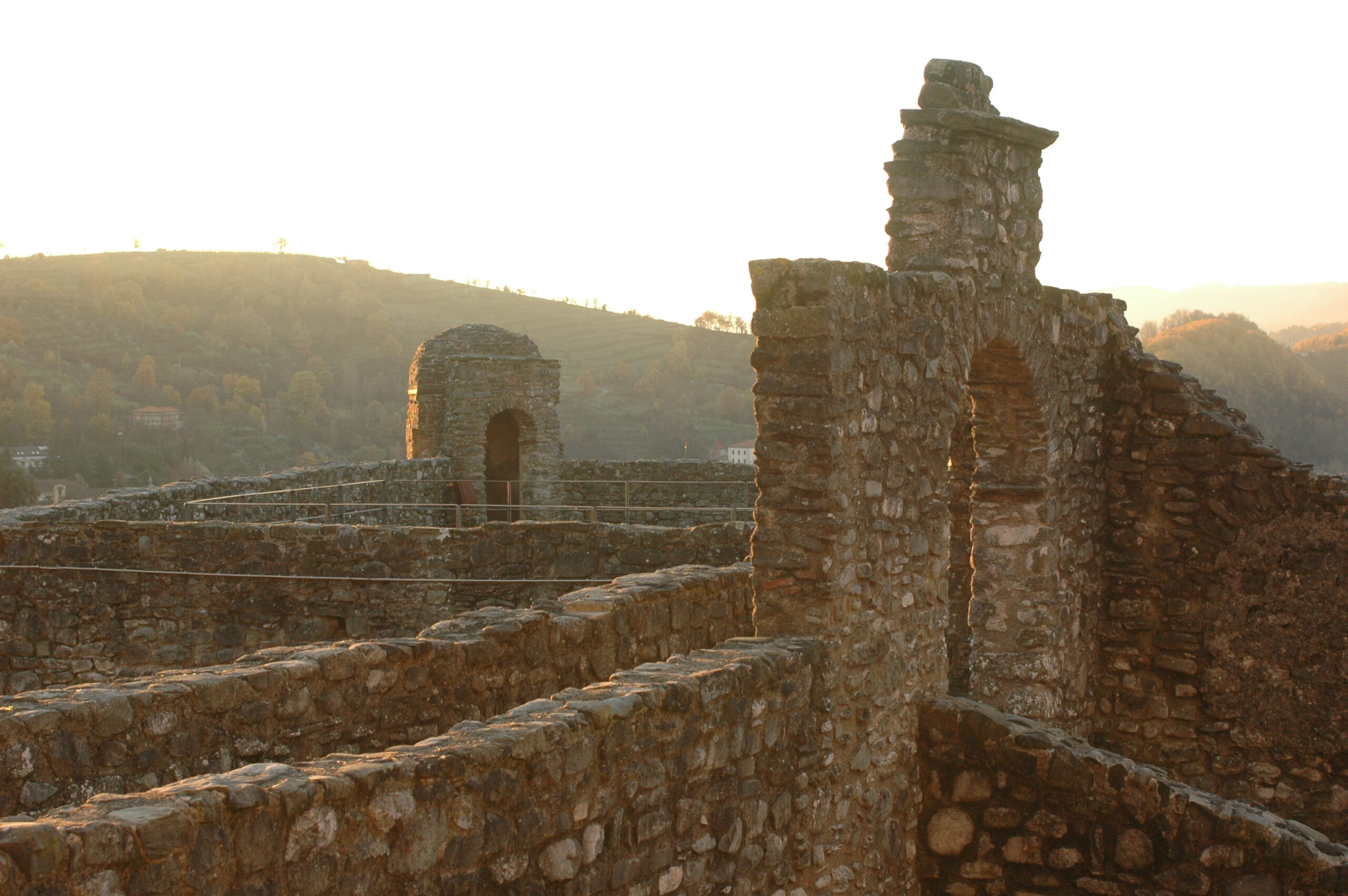
Above the town, Piagnaro Castle has watched over the Cisa Pass route since at least the 10th century. Named either for the flat stone slabs (piagne) used in its roofing or for the tears (pianto) of the people forced to build it, the castle changed hands repeatedly (Fieschi, Visconti, Sforza, and finally the Medici) before settling into its current role as the home of one of Italy’s most unusual museums.
The Museo delle Statue Stele Lunigianesi, opened in the castle in 1975 and built on the work of Professor Augusto Cesare Ambrosi, was significantly expanded in 2015. It is devoted to the stele statues of Lunigiana, anthropomorphic stone sculptures carved between the 4th and 1st millennium BC, 85 of which are known to date. These are the stele statues of Lunigiana — sandstone figures with U-shaped faces, so-called “carabiniere hat” heads, male figures carrying daggers and axes, females wearing necklaces and earrings. They stand between one and three meters tall and were driven vertically into the ground across the Magra Valley over a span of three thousand years. Their purpose remains a genuine mystery: gods, ancestors, territorial markers, funerary monuments — scholars have proposed all of these and proven none. What is certain is that they are unique to this valley, that they represent one of the most significant megalithic traditions in Europe, and that for centuries they were recycled as building material by farmers who had no idea what they were digging up. The museum displays them chronologically across three typological groups of increasing realism, set against the atmospheric backdrop of the castle’s medieval walls. It is the kind of small museum that changes how you see a place.
The Baroque period gave Pontremoli a second layer of distinction. The wealth from controlling the Cisa trade route produced a constellation of noble palaces along Via Garibaldi and the two connected piazzas, including Palazzo Dosi Magnavacca, Palazzo Pavesi-Ruschi Noceti and Palazzo Zucchi Castellini, their interiors rich in quadraturismo, the Baroque art of painting trompe-l’oeil architecture on walls and ceilings. Most are privately owned and open to the public only during occasional spring festivals, though some can be visited by arrangement. The 17th-century Cathedral, designed by Alessandro Capra of Cremona, features a Latin-cross plan crowned by a large dome. The Teatro della Rosa, a small 18th-century jewel, was built for the Accademia della Rosa, founded in 1739.
What to See and Do
The Museo delle Statue Stele inside Piagnaro Castle is the essential visit. The walk up from the center takes about ten minutes; the museum itself deserves at least an hour, more if the subject grabs you. The 2015 redesign added multimedia content and English-language panels. The castle itself offers views over the rooftops to the surrounding mountains.
Back in the town center, the walk along Via Garibaldi between the two main piazzas — Piazza della Repubblica and Piazza del Duomo — passes the finest Baroque palaces and ends at the Cathedral. The Campanone tower anchors the route. The Church of San Pietro, near the confluence of the Verde and the Magra, is one of the oldest in Pontremoli and served as a reference point for Via Francigena pilgrims.
The old town occupies a narrow strip of land between the Verde and Magra rivers, which gives Pontremoli its particular character — a town of bridges. The medieval stone bridges are among the most photogenic elements, particularly in morning light when the rivers run low and the reflections are clean.
North of town at the hamlet of Groppodalosio, a striking single-arch stone bridge dated to 1572 carries the Via Francigena over the Magra. The Stretti di Giaredo, a canyon carved by the Gordana stream with multicolored rock walls over 20 meters high, can be explored on a guided river trek with Sigeric (June–September; check current prices, and never go after heavy rain). For a gentler outing, the Via Francigena stage from the Cisa Pass down to Pontremoli is one of the most atmospheric sections of the entire trail.
Eating Like a Local
Testaroli are the defining dish — the ancient batter-cooked pasta served with pesto, olive oil and Parmigiano, or mushroom sauce. In Pontremoli, the artisanal version is thin, soft and light, cooked on a two-piece cast-iron testo over a wood fire. This specific preparation holds Slow Food Presidium status. Testarolando, a local producer, has taken part in reviving Grano 23, a heritage Lunigiana wheat variety.
The Caffè degli Svizzeri is a Pontremoli institution, founded in 1842 by Swiss immigrants from Canton Grisons. The essential order is the Amor — two thin wafers sandwiching a cream filling whose recipe has been kept secret for over a century, the chantilly rich enough to make you wonder what exactly the Swiss brought with them besides a work ethic. The café also serves spongata, the local Christmas cake made from dried fruit, nuts, honey, and spices in a pastry shell — a preparation of possible Sephardic Jewish origin, carried along medieval trade routes.
For a full meal: Osteria della Luna serves traditional testaroli and lamb of Zeri (the rare Zerasca breed, another Slow Food Presidium). Osteria San Francesco e il Lupo is another Gambero Rosso pick in town. Trattoria Norina is the spot for no-nonsense home cooking — the kind of place where the menu depends on what arrived that morning.
The weekly market fills Piazza della Repubblica and surrounding streets on Wednesday and Saturday mornings — local cheese, honey, chestnut products, seasonal vegetables, and the general convivial chaos of an Italian market town that hasn’t been gentrified.
Getting There and Getting Around
By car: Take the A15 motorway (the Autocamionale della Cisa, connecting Parma to La Spezia) and exit at Pontremoli. From Parma, it’s roughly 45 minutes. From La Spezia, about 40 minutes. From Florence, take the A11 → A12 → A15 — approximately two hours total. Parking is available near the old town; the center is compact and best explored on foot.
By train: The Pontremolese railway (Parma–La Spezia) stops at Pontremoli station, with regional trains in both directions. The station is a short walk from the old town. Trains run south to Aulla (for the Cinque Terre) and north to Parma, but maintenance work periodically replaces trains with buses on parts of the line, so check Trenitalia before you travel.
By bus: Autolinee Toscane operates services connecting Pontremoli to other Lunigiana towns, but runs are limited. A car is strongly recommended for exploring beyond the town itself.
Best time to visit: Morning light is best for the old town and river bridges. The stele museum works well at any time. Allow a full day if you want to combine the museum, old town, a proper lunch, and possibly a walk to the Romanesque bridge or along the Via Francigena. A focused half-day covers the museum and center.
Nearby
Montereggio — The booksellers’ village, population under 50, the only Italian member of the International Organization of Book Towns. Twenty minutes south. Annual Book Festival in August.
Mulazzo — Capital of the Malaspina Spino Secco branch, with the hexagonal Torre di Dante and the Dantesque Lunigiana Museum in the tower-house where, by tradition, Dante stayed in 1306. Fifteen minutes south.
Filattiera — The Byzantine garrison town with the Romanesque Pieve di Santo Stefano di Sorano, built of river pebbles — one of the most elegant small churches in Lunigiana and a Via Francigena highlight. Twenty minutes south.
Cisa Pass — The historic Apennine crossing (1,041 m) where the Via Francigena enters Tuscany. The walk down from the pass to Pontremoli is one of the trail’s most atmospheric stages. Twenty minutes by car.
Stretti di Giaredo — A river canyon carved by the Gordana stream, accessible by guided trek. Cooperativa Sigeric runs excursions from June to September. About twenty minutes west of Pontremoli.
Zeri — Mountain pastures at 750 m, home to the Zerasca sheep and the Zum Zeri ski area with sea views. Forty minutes west.
Information is provided in good faith and may change. Always confirm opening hours, prices, and event dates with the official source before you travel.