
Itinerary · 3 days · Lunigiana
3 Days in Lunigiana
Castles, Testaroli, and the Oldest Road to Rome
Last updated:
- Duration
- 3 days / 2 nights
- Best season
- Spring (April–June) or autumn (September–October). Summer works but is hotter in the valley. Winter is quiet and atmospheric, though some sites may have reduced hours.
- Budget
- Budget to mid-range — Lunigiana is significantly cheaper than central Tuscany
- Best for
- Couples, solo travelers, food lovers, hikers, history enthusiasts. Families with older children.
- Driving required
- Yes — a car is essential for this itinerary. Mountain roads are winding but well-maintained.
This itinerary moves through Lunigiana from north to south, following the Magra River valley the way pilgrims, traders, and armies have for a thousand years — from the Cisa Pass at the Apennine ridge to the coast near Cinque Terre. You can reach Lunigiana from Parma in 45 minutes, from La Spezia in 30, or from Florence in about two hours — making it a natural extension of any northern Tuscany, Emilia-Romagna, or Ligurian coast trip. Three days is enough to understand why this small territory holds 160 castles, three Slow Food Presidia, and Europe’s finest collection of prehistoric stone sculptures, all within 30 minutes of the Ligurian Sea.
Day 1: Pontremoli and the Upper Valley
Getting there: From Parma, take the A15 south through the Cisa Pass — roughly 45 minutes of increasingly dramatic mountain scenery, and you arrive at Pontremoli having crossed the Apennines the same way medieval pilgrims did. From La Spezia or Cinque Terre, the A15 runs north — about 40 minutes. From Florence, take the A11 toward Lucca, then the A12 toward La Spezia, then the A15 north — approximately 2 hours total. From Pisa, about 90 minutes via the same A12/A15 route. The Parma approach is the most scenic; the La Spezia approach is the most practical if you’re combining Lunigiana with the Ligurian coast.
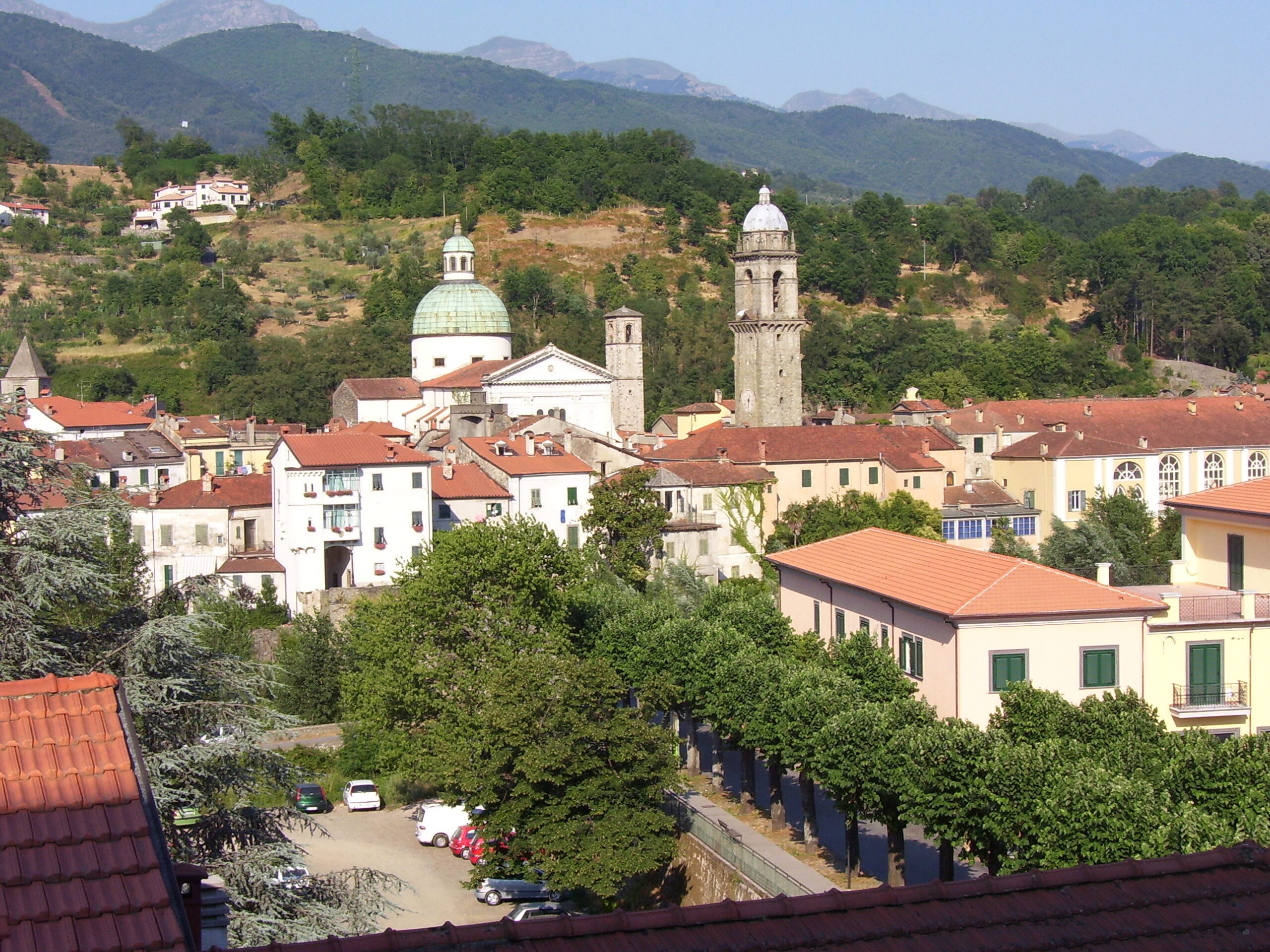
Morning: Start at Pontremoli, Lunigiana‘s cultural capital. Walk into the old town between the Verde and the Magra rivers and climb to Piagnaro Castle for the Museo delle Statue Stele — the collection of 85 prehistoric stone sculptures (4th–1st millennium BC) displayed against medieval castle walls. This museum alone justifies the trip to Lunigiana. Allow at least an hour, more if the subject grabs you. On the way down, stop at the Campanone tower in the central piazza — the 14th-century wall fragment that once physically divided the town’s Guelph and Ghibelline factions.
Lunch: Testaroli at Osteria della Luna or Trattoria Norina — order the version with pesto (Pontremolese-style, coarsely cut rather than pounded). If the season is right, mushroom sauce. Follow with an Amor pastry and coffee at the Caffè degli Svizzeri (founded 1842, secret cream recipe maintained for over a century).
Afternoon: Drive 15 minutes south to Mulazzo, capital of the Malaspina Spino Secco branch. See the hexagonal Torre di Dante and the small Dantesque museum in the tower-house where Dante stayed during his 1306 diplomatic mission. If time and energy allow, continue 20 minutes up the mountain road to Montereggio — the booksellers’ hamlet, population under 50, the only Italian member of the International Organization of Book Towns. The drive alone is beautiful; the village is hauntingly quiet.
Return to Pontremoli. Walk the Baroque palace facades along Via Garibaldi in the evening light — among them the Dosi Magnavacca, Pavesi-Ruschi Noceti, and Zucchi Castellini palaces, funded by centuries of Cisa Pass trade wealth. If it’s Wednesday or Saturday, catch the end of the morning market in Piazza della Repubblica.
Dinner: Osteria San Francesco e il Lupo (a Gambero Rosso pick) for a more refined treatment of local ingredients, or return to one of the trattorie for the comfort of repetition.
Sleep: Pontremoli — agriturismo in the surrounding hills, or a B&B in the center.
Day 2: The Central Valley — Borghi, Watermills, and a Via Francigena Walk
Morning: Drive 15 minutes south to Filattiera and the Romanesque Pieve di Santo Stefano di Sorano — the church built from smooth river pebbles, one of the most distinctive stops on the Via Francigena. If you want to walk a section of the trail, the Filattiera to Filetto stage is one of the most atmospheric — roughly 10 km through forests and fields, finishing at the walled village. If you’d rather drive, continue to Bagnone (15 minutes east) — the fairy-tale borgo cascading down a hillside to the river, crowned by a Malaspina circular tower. Enter through Porta di Santa Caterina, cross the medieval bridge, and climb through the lanes. In summer, the river gorge below offers natural swimming pools.
Lunch: Picnic in Bagnone (buy bread, cheese, and local cured meats at a village shop) or drive 15 minutes to Villafranca for lunch in a local trattoria. The Locanda Gavarini serves traditional Lunigianese cooking.
Afternoon: In Villafranca, visit the Ethnographic Museum of Lunigiana in an old watermill against the town walls — the most complete portrait of traditional mountain life in the region (call ahead for opening times). Then drive 5 minutes to Filetto — the Byzantine walled village. Walk in through the gates, cross the piazza, and absorb the enclosed atmosphere of a village whose plan is traditionally traced to a Byzantine garrison. Outside the walls, the chestnut grove where 11 stele statues were found connects this tiny hamlet to Lunigiana’s deepest prehistory.
If you arrived in August (11–15), the Filetto Rinascimentale transforms the village with torchlit medieval reenactments, falconry, and communal dinners (€38, book well ahead).
Late afternoon/evening option: Drive 20 minutes to Podenzana for panigacci at La Gavarina D’Oro — the celebrated restaurant where unleavened flatbreads are cooked between stacked terracotta discs and served with stracchino and cured meats. This is one of Lunigiana’s essential food experiences.
Sleep: Pontremoli (return to base) or move south toward Fosdinovo / Aulla for Day 3.
Day 3: The Southern Gateway — Castles, Caves, and the Coast
Morning: Drive to Fosdinovo (30 minutes from Villafranca, 45 from Pontremoli). The Malaspina castle here is the most dramatic in Lunigiana — nine centuries old, still owned by the founding family’s descendants, with rooms you can tour and a B&B where you can sleep. The guided tour reveals painted halls, armor, the ghost story of Bianca Maria Aloisia. The views from the terrace — Apennines behind, Apuan Alps to the east, the Ligurian Sea ahead, Corsica on clear days — put the entire geography of Lunigiana into perspective.
Alternative morning (for active travelers): Drive to Equi Terme (25 minutes from Aulla) for a walk into the Solco di Equi gorge below the Apuan peaks. Or visit the Grotte di Equi — karst caves with Neanderthal-era archaeology — and follow with a dip in the mildly warm sulfurous springs (around 24°C, pools open in summer).
Lunch: In Fosdinovo or drive down to Aulla. Keep it light — afternoon has options.
Afternoon — choose your ending:
Option A: Cinque Terre. From Aulla, take the train to La Spezia (23 minutes) and onward to Monterosso (20 more minutes). Spend the afternoon walking between villages on the coastal path, swimming, and eating focaccia. Return to Aulla by evening. This is the trip that demonstrates Lunigiana’s extraordinary connectivity — mountains at breakfast, medieval castle at mid-morning, Mediterranean coast by lunch.
Option B: Carrara marble quarries. From Fosdinovo, drive 30 minutes south to the quarries above Carrara. Guided jeep tours take you into active extraction basins where marble has been cut since Roman times — walls of white stone rising hundreds of meters, trucks navigating switchbacks the width of a truck, and the visceral strangeness of mountains being slowly taken apart. Some of the most dramatic industrial landscape in Italy.
Option C: Luni archaeological site. Continue 20 minutes south of Aulla to the ruins of the Roman colony that gave Lunigiana its name — amphitheater, mosaics, a small but good archaeological museum. A quiet, reflective end to three days of layered history.
Dinner: If returning through Aulla, the town’s restaurants serve Lunigianese staples with a coastal twist — the proximity to Liguria means seafood appears alongside testaroli. Or stop in Fivizzano (20 minutes from Equi Terme) for a final meal in the elegant piazza of “the Florence of Lunigiana.”
Practical Tips for This Route
Driving: All main roads are paved and well-maintained. Mountain side roads (to Montereggio, Zeri, some castle hamlets) are narrow and winding — take your time. Total driving over three days is approximately 150–180 km, but the mountain roads make journey times longer than distances suggest.
Parking: Free and straightforward in all Lunigiana towns. Pontremoli has parking near the old town; Bagnone has parking at the base of the borgo; Fosdinovo has parking near the castle. This is not Florence — parking stress does not exist here.
Booking: The Fosdinovo Castle B&B should be booked in advance, especially in summer and during festivals. The Grotte di Equi recommend booking cave visits online in advance. Filetto Rinascimentale medieval dinners sell out — book as early as possible.
Budget: Lunigiana is significantly cheaper than Chianti, Val d’Orcia, or the Versilia coast. Agriturismo accommodation with half-board runs €70–120 per person. Restaurant meals: €25–40 per person with wine. Museum entries are modest (typically €5–8).
Connectivity: Cell coverage is reliable in valley towns, patchy in mountain hamlets and deep valleys. ATMs are available in Pontremoli, Aulla, Fivizzano, Villafranca — carry cash for smaller villages. Wi-Fi in agriturismi varies from excellent to nonexistent.
Language: English is less widely spoken in Lunigiana than in Florence or the Cinque Terre. Basic Italian helps enormously and is genuinely appreciated. Restaurant menus may be Italian-only — treat this as a sign of quality.
Extending the trip: A fourth day could add Fivizzano (Medici walls, and the Verrucola fortress on a booked guided tour) and Casola in Lunigiana (the sole-producer Marocca bread, Apuan Alps access). A fifth day could push into the Garfagnana via the Cerreto Pass — the neighboring valley with its own castles, food traditions, and the poet Ariosto’s story.
Information is provided in good faith and may change. Always confirm opening hours, prices, and event dates with the official source before you travel.