
Town · Lunigiana
Fivizzano
The Florence of Lunigiana, Printed Before London
Last updated:
- Region
- Lunigiana
- Province
- Province of Massa-Carrara
- GPS
- 44.2362, 10.1219
- Best season
- Spring and early autumn; July for the Disfida degli Arcieri
- Time needed
- Half day to full day (longer if combining with Verrucola and Equi Terme)
- Difficulty
- easy
- Known for
- Medici walls, early printing press, Piazza Medicea, Verrucola fortress, 1920 earthquake history
In 1472, while Gutenberg’s revolution was still spreading unevenly across Europe, a man named Jacopo da Fivizzano set up a movable-type printing press in this small town in eastern Lunigiana. He printed books here — documented, dated, physical objects — before Vienna, before London, before Barcelona. This fact alone would make Fivizzano worth a footnote in cultural history. But the town earned its nickname, “the Florence of Lunigiana,” not through a single innovation but through centuries of choosing Florence as its model — voluntarily submitting to Florentine rule in 1477, receiving Medici patronage in return, and building itself into a miniature version of the capital: elegant piazzas, fine-windowed palaces, defensive walls designed by the same political minds that fortified the Tuscan state.
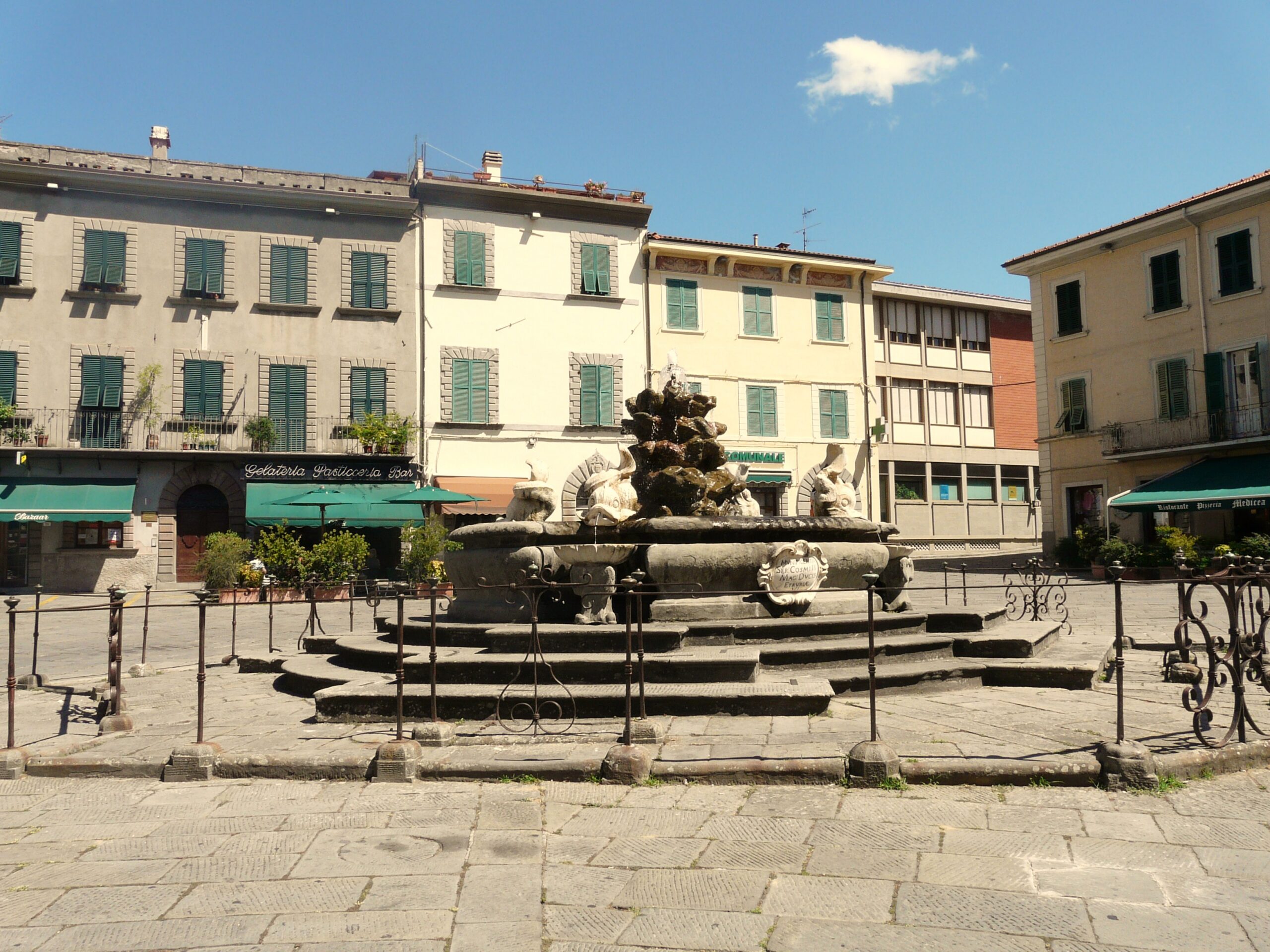
Today Fivizzano is a town of roughly 6,900 people at 326 meters elevation, spread across a large municipality that includes dozens of hamlets in the mountains above. The center itself is compact and handsome — anchored by Piazza Medicea with its Cosimo III fountain, enclosed within the remains of walls that Cosimo I ordered built in 1540, and scarred by the 1920 earthquake that nearly destroyed everything. That earthquake, and the reconstruction that followed, gives Fivizzano its particular character: Renaissance bones visible beneath early-20th-century skin, elegance interrupted and rebuilt.
A Place Shaped by Time
Fivizzano’s voluntary submission to Florence in 1477 was not conquest but calculation. The town chose Florentine protection over Malaspina feudalism, and the Medici rewarded it with investment. Cosimo I built the defensive walls in 1540 — substantial fortifications with gates and bastions, sections of which still define the town’s perimeter. The Medici also brought administrative order, cultural ambition, and a Florentine aesthetic sensibility that manifests in the palaces lining the main streets. Their fine windows — arched, proportioned, decorated with carved stone surrounds — earned Fivizzano the secondary nickname “Town of Beautiful Windows.”
Piazza Medicea is the civic heart: a graceful rectangle anchored by a fountain installed in 1683 under Cosimo III, surrounded by aristocratic palaces that speak of a town that took itself seriously. The Museo della Stampa (Museum of Printing), in the Fantoni-Bononi Palace (closed since the 2013 earthquake), documents Jacopo da Fivizzano’s achievement — one of Italy’s earliest printing operations, producing books that circulated across the peninsula when the technology was still a novelty in most European capitals.
Above the town, the Fortezza della Verrucola commands a narrow valley from its position on a rocky spur. First documented in the 12th century, it was expanded by Spinetta Malaspina “the Great” in the 14th century — a warlord who spent years fighting Castruccio Castracani, the lord of Lucca. The fortress changed hands repeatedly and decayed for centuries before sculptor Pietro Cascella purchased it in 1977. Cascella — whose monumental works stand in public spaces across Italy and beyond — lived in the fortress until his death in 2008, restoring it as both home and studio. The combination of medieval military architecture with a 20th-century sculptor’s sensibility makes the Verrucola unlike any other castle in Lunigiana.
The 1920 earthquake is the other defining event. On September 7, shortly before 8 AM, a magnitude-6.5 tremor — among the most destructive in Tuscany’s recorded history — struck the Lunigiana and Garfagnana, hitting Fivizzano among the hardest. The toll was devastating: 171 dead and 650 injured across the region, and Fivizzano itself left practically razed, with barely a habitable house standing. The reconstruction blended what survived of the Renaissance fabric with new construction, creating the layered texture the town wears today. If you look carefully at the buildings around Piazza Medicea, you can read the earthquake in the architecture — older stonework sitting alongside newer masonry, a palimpsest of disaster and recovery.
What to See and Do
Piazza Medicea is the natural starting point — the fountain, the surrounding palaces, the sense of a provincial town that once aspired to Florentine standards. The streets radiating from the piazza pass through what remains of the Medici walls, with their gates and bastions best appreciated from outside the historic center.
Palazzo Fantoni-Bononi housed the Museo della Stampa, which tells the story of Jacopo da Fivizzano and early printing in Lunigiana. It has been closed since the 2013 earthquake damaged the building, so admire the palazzo from outside and ask the comune about any reopening.
The Fortezza della Verrucola stands just below Fivizzano in the hamlet of Verrucola, a short drive from the center. It is a private home, restored from 1977 by the sculptor Pietro Cascella, and can only be visited on occasional guided tours booked through the Istituto Valorizzazione Castelli. It’s worth arranging for the rare atmosphere of a medieval fortress lived in and shaped by a modern artist.
The Disfida degli Arcieri (Challenge of the Archers), held each July, is a medieval archery tournament between Fivizzano’s historic neighborhoods — costumes, processions, genuine competitive tension, and an excuse to fill the piazza with food stalls serving local specialties.
From Fivizzano, the hamlet of Equi Terme is a short drive into the mountains and offers a concentrated burst of natural attractions: karst show caves with Neanderthal-era archaeology, mildly warm sulfurous springs (around 24°C), and a geo-adventure park with a 200-meter zipline. The Stretti di Giaredo canyon, between Pontremoli and Zeri, is about an hour’s drive away.
The area around Fivizzano was devastated during World War II — the SS massacre at Vinca in August 1944, which killed over 170 civilians, is commemorated with a memorial in the hamlet. This is a difficult but important piece of the region’s history, largely unknown outside Italy.
Eating Like a Local
Fivizzano shares Lunigiana’s culinary traditions — testaroli, torta d’erbi, chestnut flour preparations — but sits at a slightly higher elevation that emphasizes mountain cooking. Autumn brings porcini mushrooms from the surrounding forests and chestnut flour under the Farina di Castagne della Lunigiana DOP, dried in traditional stone gradili.
The restaurants in the center tend toward traditional Lunigianese cooking: testaroli with pesto or mushroom sauce, torta d’erbi (the savory herb pie cooked in testi), game ragù in autumn, and the chestnut-flour preparations — castagnaccio, necci, lasagne bastarde — that appear as the weather cools.
The surrounding hamlets often have agriturismi offering half-board with home-cooked meals — this is some of the most affordable and authentic eating in Tuscany, where the cook is usually also the farmer.
The weekly market brings local producers into the center with honey, cheese, chestnut flour, and seasonal vegetables.
Getting There and Getting Around
By car: Fivizzano is reached from the A15 motorway by exiting at Aulla and following signs northeast along the SS63 toward the Cerreto Pass — roughly 20 minutes of winding mountain road. From La Spezia, approximately 45 minutes. From Florence, about 2 hours via A11 → A12 → A15 → SS63.
By train: The scenic, non-electrified Aulla–Lucca railway has a station at Fivizzano (actually at Soliera, below the town). Services are infrequent; check schedules in advance. Aulla, with its Pontremolese line connections, is the main rail hub.
By bus: Autolinee Toscane operates services from Aulla to Fivizzano, but runs are limited. A car is strongly recommended.
Parking is available outside the walls; the center is small enough to cover on foot in an hour or two. Allow a half day for the town itself, a full day if combining with the Verrucola fortress and Equi Terme.
Nearby
Equi Terme — Karst caves, thermal springs (around 24°C), and a geo-adventure park with zipline. The Solco di Equi, a deep rocky gorge, rises right behind the village. Fifteen minutes east.
Pontremoli — Lunigiana’s cultural capital with the stele museum, Baroque palaces, and the Caffè degli Svizzeri. Thirty-five minutes north.
Aulla — The transport hub at the valley’s southern gateway, with the Abbey of San Caprasio and connections to Cinque Terre. Twenty minutes southwest.
Cerreto Pass (1,261 m) — The Apennine crossing to Reggio Emilia, also a modest ski station. The road from Fivizzano climbs through increasingly dramatic mountain scenery. Thirty minutes east.
Casola in Lunigiana — The gateway to the Apuan Alps, home of the Marocca di Casola Slow Food bread. Twenty minutes south.
Information is provided in good faith and may change. Always confirm opening hours, prices, and event dates with the official source before you travel.