
Town · Lunigiana
Aulla
The Town That Was Erased and Built Again
Last updated:
- Region
- Lunigiana
- Province
- Province of Massa-Carrara
- GPS
- 44.2089, 9.9631
- Best season
- Year-round (transport hub works in any season); Saturday for the antiques market
- Time needed
- 2–3 hours for the abbey and fortress; longer if using Aulla as a base
- Difficulty
- easy
- Known for
- Abbey of San Caprasio, Brunella Fortress, WWII destruction and reconstruction, rail junction for Cinque Terre
Aulla is honest about what it is. It does not pretend to be picturesque, and it does not try to sell you the Middle Ages. It is a town of roughly 10,800 people at 64 meters elevation — the lowest point in Lunigiana, the place where the Magra and the Aulella rivers meet, and the strategic crossroads where three mountain passes converge: the Cisa from the north, the Cerreto from the east, the Lagastrello from the northeast. For a thousand years, anyone who wanted to control the routes between the Tyrrhenian coast and the Po Valley needed to hold this spot.
The Germans understood this in 1944, which is why Allied bombers targeted Aulla’s railway junction. A catastrophic explosion — the exact circumstances are still debated, with accounts variously attributing it to a partisan mortar shell hitting a German munitions train or to direct Allied bombing — flattened most of the town. When the dust settled, much of the historic town was gone, and most of what you see today was rebuilt after the war.
This means that Aulla today is not a place you visit for streetscape or atmosphere. You visit it for two specific things — the abbey and the Brunella Fortress — and for its extraordinary utility as a transport hub connecting Lunigiana to the Ligurian coast, the Cinque Terre, the Garfagnana, and the marble quarries of Carrara.
A Place Shaped by Time
The Abbey of San Caprasio was founded in 884 AD and is Aulla’s anchor — badly damaged in the Second World War and restored, but still standing at the heart of the town. The church itself is modest from the outside, but the real story lies underneath. Archaeological excavations beneath the church uncovered earlier phases of building, burial sites, and most significantly, in 2003, the relics of San Caprasio himself, a hermit-monk of Lérins who died around 430 and whose tomb had been lost for centuries. The discovery transformed the abbey from a parish church into a site of genuine archaeological importance. The crypt and excavation area can be visited.
The abbey also connects to the Via Francigena: Archbishop Sigeric of Canterbury recorded Aulla as stage XXIX (Aguilla) on his 990 AD journey from Rome to England. The town was a natural rest point — the last flat ground before the trail climbed into the mountains toward the Cisa Pass.
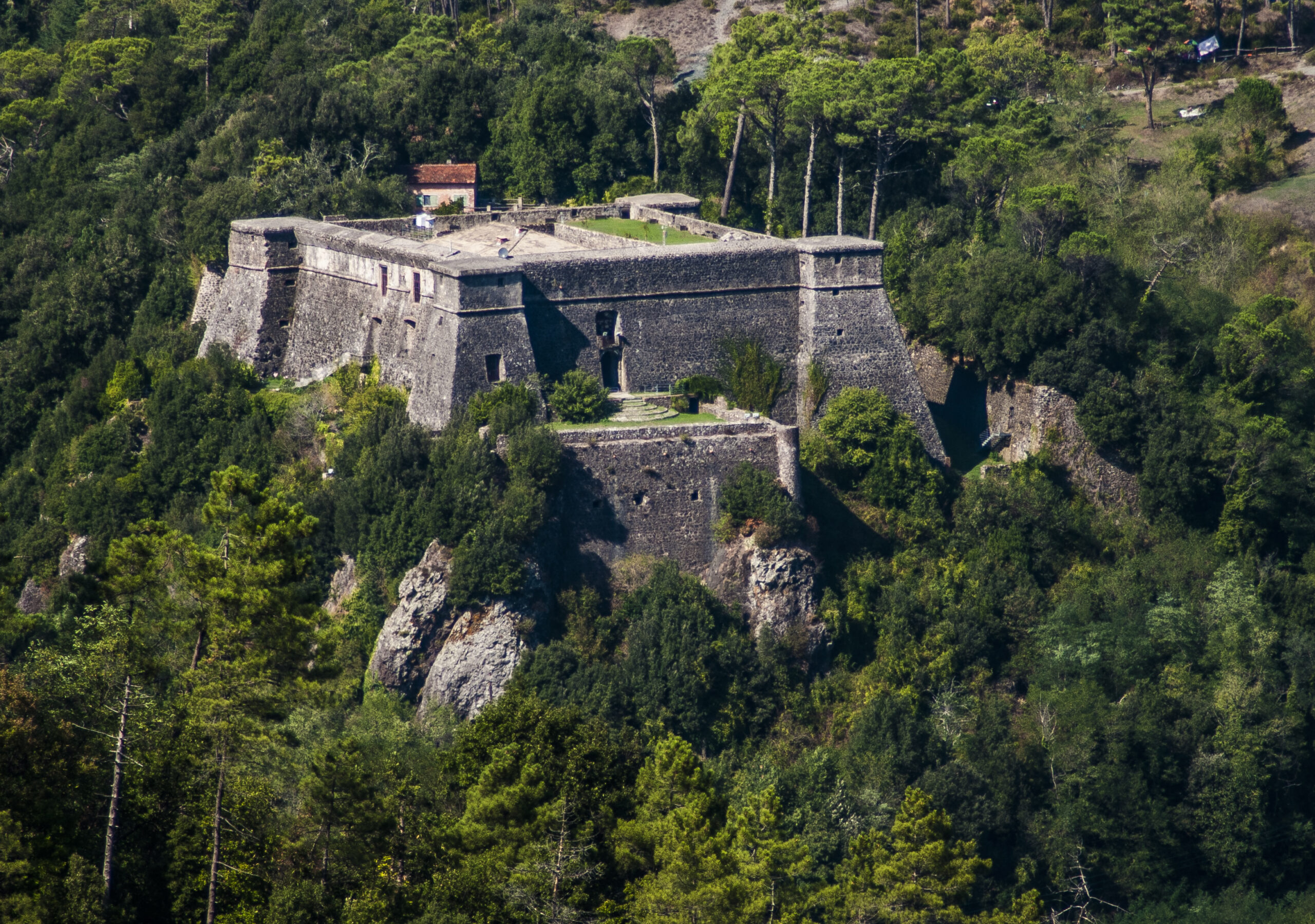
Above the town, the Brunella Fortress commands the confluence of the rivers from a rocky outcrop. Traditionally attributed to Giovanni dalle Bande Nere — the condottiere father of Cosimo I, first Grand Duke of Tuscany, who acquired the fief of Aulla in 1522 — it is a blocky, functional piece of Renaissance military architecture. Today it houses the Natural History Museum of Lunigiana, focused on the Magra river basin; visits are by guided tour on scheduled opening days, so check dates before you go. The views from the fortress terrace are the reward: the river junction below, the town spread across the valley floor, and the mountains rising on three sides.
The liberation of Aulla on April 25, 1945 — the same date as Italy’s national Liberation Day — was accomplished by the 442nd Regimental Combat Team, the decorated Japanese-American Nisei unit that had broken through the western end of the Gothic Line above Massa. The regiment had already liberated Massa (April 10) and Carrara (April 11).
What to See and Do
The Abbey of San Caprasio is the essential visit — the excavated earlier layers, the abbey museum, and the rediscovered relics give it genuine depth. Plan 30–45 minutes. The abbey sits in the town center and is easily walkable.
The Brunella Fortress requires a short uphill walk from the center. Even if the Natural History Museum is closed, the exterior and the view from the approach are worth the climb. The fortress is a handsome, severe building — no decoration, all function.
Aulla’s Saturday market has an antiques and vintage focus that distinguishes it from the standard produce markets in other Lunigiana towns. Worth a browse if your timing aligns.
The real value of Aulla is logistical. From here:
- Cinque Terre: Aulla to La Spezia by train in 23 minutes, then onward to Monterosso in another 20. This makes Aulla one of the most practical inland bases for visiting the coast.
- Carrara marble quarries: 20–30 km south, guided jeep tours available into active extraction basins.
- Garfagnana: The scenic Aulla–Lucca railway climbs through eastern Lunigiana, stopping at Fivizzano, Gragnola, and Equi Terme before crossing into the Garfagnana — roughly two hours to Lucca, and sections close for engineering works, so check before you travel.
- Fosdinovo Castle: 15 minutes uphill to the most imposing Malaspina fortress in Lunigiana.
Eating Like a Local
Aulla’s food reflects its position at the valley’s lowest point, where mountain and coastal traditions meet. The standard Lunigiana repertoire — testaroli, panigacci, torta d’erbi — is available, but the proximity to Liguria and the coast also brings Ligurian influences: focaccia, farinata, and seafood appear more naturally here than in the mountain towns further north.
Fagiolo di Bigliolo — a thin-skinned, easily digestible bean from the Aulla area — is a local specialty worth seeking out in restaurants or at the market.
The surrounding area includes vineyards within the Colli di Luni DOC zone, producing Vermentino and Sangiovese blends. Aulla is not a food destination in itself — Pontremoli and Podenzana are stronger — but as a base, it puts you within easy reach of every food tradition in the valley.
Getting There and Getting Around
By car: Exit the A15 motorway at Aulla. The town is immediately accessible from the junction. From La Spezia, approximately 25 minutes. From Florence, about 2 hours via A11 → A12 → A15. Parking is straightforward throughout the town.
By train: Aulla Lunigiana station sits on the Pontremolese line (Parma–La Spezia), making it Lunigiana’s main rail hub. Trains run north to Pontremoli and Parma, south to La Spezia and onward to Cinque Terre and Genoa. The Aulla–Lucca line heads east through the Garfagnana. Aulla to La Spezia: 23 minutes. Aulla to Monterosso: 43 minutes.
As a base: Aulla is the most practical base in Lunigiana for travelers who want transport flexibility. It lacks the atmosphere of Pontremoli or the castle drama of Fosdinovo, but it compensates with connections in every direction. Hotels and B&Bs serve the transport-hub market; agriturismi in the surrounding hills offer more character.
Nearby
Fosdinovo — The inhabited Malaspina castle with B&B, views to Corsica. Fifteen minutes uphill.
Villafranca — The Ethnographic Museum and Filetto walled village. Fifteen minutes north.
Cinque Terre — Train from Aulla to La Spezia in 23 minutes, then Monterosso in another 20. The most accessible day trip from inland Lunigiana.
Carrara marble quarries — Guided jeep tours into the active quarries, among the most dramatic industrial landscapes in Italy. Twenty to thirty minutes south.
Luni archaeological site — The ruins of the Roman colony that gave Lunigiana its name: amphitheater, mosaics, archaeological museum. Twenty minutes south near Sarzana, just across the Liguria border.
Pontremoli — The cultural capital of Lunigiana. Forty minutes north by car, or by train on the Pontremolese line.
Information is provided in good faith and may change. Always confirm opening hours, prices, and event dates with the official source before you travel.