
Region guide · Province of Arezzo
Valdichiana
The Valley They Reversed a River to Save
Last updated:
- Province
- Province of Arezzo
- Best season
- April–June (wildflowers, festivals, mild heat) and September–October (harvest, vendemmia, fewer crowds)
- Known for
- Chianina beef, Vino Nobile di Montepulciano DOCG, pici all'aglione, Etruscan heritage, the bonifica reclamation, Renaissance architecture, thermal baths
- Getting there
- Chiusi-Chianciano Terme station on the Florence–Rome main line (~1h 20m from Florence, ~1h 30m from Rome); A1 motorway exits at Monte San Savino, Valdichiana/Bettolle, and Chiusi
What they uncovered — or rather, what they created — is one of Italy’s most productive agricultural plains, flanked by hill towns that compress an implausible density of history into a single valley. Four of the twelve cities of the Etruscan Dodecapolis sit along the ancient Clanis river route. The world’s first DOCG wine comes from these slopes. The Chianina, possibly the oldest documented cattle breed on earth, grazes the reclaimed floor. And around the edges — in the elliptical rings of Lucignano, the underground labyrinth of Chiusi, the barrel-race streets of Montepulciano — sit towns that would be household names if they were anywhere near a major airport.
Most English-language travel content treats Valdichiana as the scenic stretch between the Florence–Rome train and a Val d’Orcia Instagram shoot. This guide treats the valley as the protagonist.
A valley divided by politics, united by water
Valdichiana is one geographic valley but, confusingly, four administrative ones. The distinction that matters for travelers is between the Valdichiana Aretina in the north (Province of Arezzo) and the Valdichiana Senese in the south (Province of Siena). They were separated in 1860 during Italian unification, and they still carry different temperaments — the Aretina a little more workaday and Florentine in its allegiances, the Senese more wine-country elegant and Siena-facing. Two Umbrian extensions continue the valley south toward Orvieto, but this guide focuses on the Tuscan core.
The valley itself is roughly 104 kilometers long and 15 to 20 kilometers wide, with a floor averaging around 250 meters in elevation. The surrounding ridges are modest but meaningful: Monte Cetona reaches 1,148 meters to the south, Alta Sant’Egidio rises to 1,057 meters near Cortona, and a broken chain of hills separates the valley from the Crete Senesi to the west and Umbria’s Lake Trasimeno to the east. The landscape is a patchwork of wheat, sunflowers, tobacco, vineyards, and olive groves — prosperous and orderly in a way that gives no hint of the centuries of swamp and disease that preceded it.
The spine of the valley is the Canale Maestro della Chiana, a 62-kilometer artificial channel running from a point between Lake Chiusi and Lake Montepulciano north to the Chiusa dei Monaci near Arezzo, where it enters the Arno. Those two lakes — the only surviving remnants of the ancient Lacus Clusinus — are today important nature reserves, home to heron colonies and some of central Italy’s best birdwatching. The elevation drop along the entire canal is barely 20 meters. A flat, car-free cycle path called the Sentiero della Bonifica follows its full length — and reading it is like pedaling through an open-air engineering textbook.
The climate is warm-continental for Tuscany: January averages around 5°C, July and August sit at about 24°C, and the annual rainfall of 840 millimeters falls heaviest in October and November. Spring brings wildflowers and photogenic green; summer can be genuinely hot at 30–35°C on the valley floor; autumn is golden and harvest-scented; winter is quiet, cold, and good for thermal baths.
From Etruscans to engineers: a valley that kept remaking itself
Valdichiana’s history is not a neat chronology but a cycle of construction, decay, and transformation — with the same waterlogged geography forcing every generation to choose between fighting the land or fleeing it.
The Etruscans made it work first. Four of their most powerful city-states — Arezzo (Aritim), Cortona (Curtun), Chiusi (Clevsin), and Orvieto (Velzna) — sat along the Clanis river, which was navigable in antiquity and linked the valley to the Tiber. Tradition remembers this stretch as “the granary of Etruria.” Chiusi was one of the great capitals of the Etruscan Dodecapolis, home to the semi-legendary Lars Porsena, who besieged Rome around 508 BC after the fall of Tarquinius Superbus. Pliny described Porsena’s tomb as a vast stone monument with an “inextricable labyrinth” beneath and five pyramids above, each topped with bronze discs from which bells hung in the wind. It has never been found. Today’s visitable Labirinto di Porsenna beneath Chiusi cathedral is actually a sixth-to-fifth-century BC Etruscan aqueduct system, but the connection to the legend keeps visitors coming — and wondering.
The Romans marched through in force. The most dramatic episode was the Battle of Lake Trasimene in June 217 BC, when Hannibal baited the consul Gaius Flaminius out of Arretium (Arezzo), marched his army through the Val di Chiana deliberately devastating the countryside, then trapped two Roman legions in a dawn-fog ambush on the north shore of Trasimeno. Around 15,000 Romans were killed, including Flaminius himself. It is often described as the largest ambush in military history. The Via Cassia and Via Clodia ran through the valley for centuries afterward, keeping it commercially alive.
Then came the collapse. When Roman maintenance of the drainage channels ended, tectonic uplift near Chiusi combined with silt buildup to turn the valley into a stagnant swamp. Two medieval construction projects sealed the disaster: a dam near Carnaiola built in the 1050s, and the Chiusa dei Monaci — a weir built by monks near Arezzo for their grain mill — that blocked the Chiana’s northward flow entirely. For the next seven hundred years, the valley was an engine of malaria. Dante’s Inferno (Canto XXIX) invokes “the hospitals of Valdichiana between July and September” as the image of maximum pestilence.
The political consequences were savage. Every major power in central Italy — Florence, Siena, Perugia, the Papacy — fought to control the valley’s strategic corridor without actually being able to live in it. The Battle of Scannagallo in August 1554, near Marciano della Chiana, saw the forces of Cosimo I de’ Medici crush a Franco-Sienese army, sealing the fate of the Sienese Republic, which surrendered the following year. Vasari painted the victory in the Salone dei Cinquecento in Florence, and an octagonal commemorative church, the Tempio di Santo Stefano della Vittoria, still stands near the battle site at Pozzo della Chiana. But the marshes remained.
The darkest chapter came in the twentieth century. In June 1944, German forces built the Trasimeno Line and Arezzo Line through the valley as delaying positions south of the Gothic Line. The Civitella in Val di Chiana massacre on June 29, 1944, killed 244 civilians — a reprisal by the Hermann Göring Division for a partisan attack on June 18 that left three German soldiers dead. Cortona was liberated on July 3; Arezzo followed on July 16. Civitella received Italy’s Gold Medal for Civilian Valour in 1963.
The great bonifica: six centuries to reverse a river
This is, quite possibly, the most underused story in English-language Tuscan travel writing. The transformation of the valley’s malarial marshes into productive farmland unfolded across six centuries and involved reversing the flow direction of an entire river. It deserves its own article, but here is the essential arc.
Leonardo da Vinci arrived in August 1502 as military engineer to Cesare Borgia. Three famous drawings from this campaign survive — including his extraordinary bird’s-eye map of central Italy (Royal Library, Windsor, RL 12278) — and in the Codex Atlanticus he proposed sluice gates and a navigable canal from the Arno to Lake Trasimeno, with the Val di Chiana as a compensation basin. The project was never carried out.
Under the Medici, systematic work began. Galileo, Torricelli, and Viviani were all consulted. Torricelli championed a method called colmata — controlled flooding that deposits sediment and physically raises the ground level — against rival proposals for pure drainage. Between the late sixteenth and early eighteenth centuries, the first segments of the Canale Maestro were dug and the key Callone di Valiano sluice was built in 1723 to regulate the two lakes.
In 1780, a concordat between Grand Duke Pietro Leopoldo and Pope Pius VI built the Argine di Separazione — a permanent divide that split the valley into an Arno basin (draining north) and a Tiber basin (draining south). This was the critical political and hydrological fix.
Then came the protagonist: Vittorio Fossombroni (1754–1844), an Arezzo-born jurist-engineer who published the first comprehensive reclamation plan in 1789 and served as superintendent of the bonifica from 1788 to 1827. His key innovation was the systematic use of colmata on a massive scale — particularly at Brolio, in the commune of Castiglion Fiorentino. A key step came in 1792, when the Chiusa dei Monaci was lowered by just over a meter to restore downstream slope. Napoleon is said to have remarked that it was a pity so great a minister served so small a state.
Works continued under Alessandro Manetti after 1828 and were essentially complete by the late nineteenth century. What they left behind is staggering in its quiet ambition: 185 square kilometers reclaimed, around 80 square kilometers wrested directly from water, 630 kilometers of embankments, and a valley floor that now grows tobacco, wheat, sunflowers, and sorghum where malaria once reigned unchallenged.
The 62-kilometer Sentiero della Bonifica cycle path, opened in 2008 and part of EuroVelo 7, reads this entire transformation. Starting from the Chiusa dei Monaci near Arezzo and ending at Chiusi Scalo between the two lakes, it passes the Botte allo Strozzo (where two canals cross each other at different levels without mixing), the Callone di Valiano, and two medieval border towers with the magnificent names of Beccati Questo (“Take that!”) and Beccati Quell’altro (“Take that right back!”) — one Sienese, one Perugian, built within shouting distance of each other. The entire route is flat, car-free, and approximately 62 kilometers of pure narrative.
Ten towns, two provinces, one valley
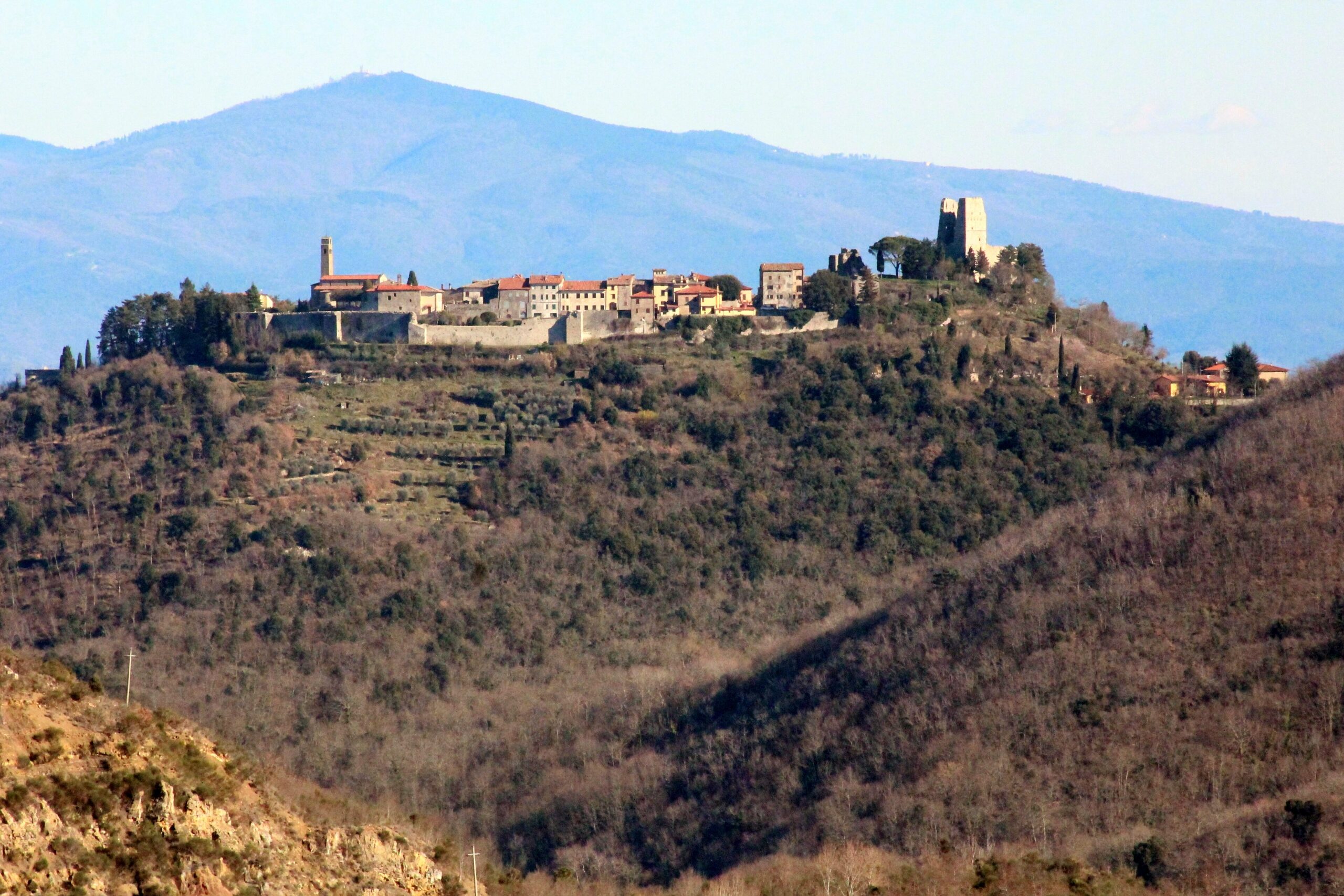
Valdichiana’s towns cluster on the hills flanking the reclaimed plain, each with its own personality and allegiance. The Aretine towns tend to be smaller, less tourist-oriented, and full of surprises. The Senese towns — especially Montepulciano and Cortona — draw more international visitors but still reward deeper attention.
Lucignano (population roughly 3,550) is the aesthetic jewel of the Aretina: a tiny hill town with one of Italy’s best-preserved concentric medieval plans — four elliptical ring streets spiraling up to a central piazza. Its extraordinary treasure is the Albero d’Oro, a 2.7-meter-tall tree-shaped reliquary in gilded copper, silver, enamel, coral, and rock crystal — often described as unique in the world, begun in 1350 and completed in 1471. Abbas Kiarostami filmed Certified Copy here. The Maggiolata flower-float festival in late May fills the streets with color.
Foiano della Chiana (population roughly 9,000) claims Italy’s oldest documented Carnival, running since 1539 — giant papier-mâché floats, four competing cantieri, and the ceremonial burning of the straw effigy “Re Giocondo” on the final Sunday. Between carnivals, Foiano is a quiet “Della Robbia museum” — one of the highest concentrations of Andrea and Giovanni della Robbia glazed terracottas anywhere, spread across three churches, alongside Luca Signorelli’s last completed painting.
Castiglion Fiorentino (population roughly 12,900) is the sleeper pick. The town between the Val di Chiana and the Val di Chio has a nine-arched loggia framing a valley view so perfect it gets attributed to Vasari — though it was actually built in 1513, with Vasari likely supervising only the 1560s renovation. The Cassero tower houses a fine pinacoteca. Roberto Benigni was born in the nearby frazione of Manciano La Misericordia, and the town’s Via Trento appears in La Vita è Bella as the street where Guido is mistaken for the king. A horse-racing Palio dei Rioni runs every June.
Monte San Savino (population roughly 8,500) is a Renaissance town shaped by two names tied to it: the sculptor Andrea Sansovino (1467–1529), born here, and Pope Julius III (reigned 1550–1555), who was born in Rome to the town’s Del Monte family. Antonio da Sangallo the Elder designed the main palazzo. A vanished Jewish quarter — destroyed in the anti-French “Viva Maria” pogrom of 1799 — adds a more complicated historical dimension. The Sagra della Porchetta in September once produced a Guinness World Record for the longest roast pork: 44.93 meters.
Chiusi (population roughly 8,100) is the Etruscan anchor — capital of the great lucumone Porsenna, with one of Italy’s finest Etruscan archaeology museums, an underground “labyrinth” of ancient aqueducts, early Christian catacombs, and a cathedral built around AD 560 with columns recycled from Roman temples. Lake Chiusi, five kilometers away, is one of the two surviving remnants of the Lacus Clusinus and serves some of the best lake-fish cooking in Tuscany — whole lake fish grilled over reeds in the ancient brustico method.
Cortona (population roughly 20,900) is the best-known town in the valley, largely thanks to Frances Mayes’s Under the Tuscan Sun. But the deeper story is Etruscan. The MAEC museum holds the Tabula Cortonensis — the third-longest Etruscan inscription known — and a spectacular fourth-century BC bronze chandelier. Outside the walls, the Melone del Sodo tumulus has a monumental staircase with sphinx sculptures unique in Italy. Futurist painter Gino Severini was born here, and his mosaic Via Crucis — commissioned after the war as thanksgiving to Saint Margaret for sparing the town — climbs from Porta Berarda to Santa Margherita. The Cortona On The Move photography festival (July–November) is one of Italy’s best. The August Sagra della Bistecca grills Chianina T-bones on a 14-meter grill.
Montepulciano (population roughly 13,400) sits on a limestone ridge between Valdichiana and Val d’Orcia, its main street climbing 1.5 kilometers to Piazza Grande — often called Tuscany’s most perfect Renaissance square. The Palazzo Comunale, remodeled by Michelozzo, has a climbable tower. Below the walls, Antonio da Sangallo the Elder’s Tempio di San Biagio (first stone 1518) is a High Renaissance masterpiece in travertine. Montepulciano’s Vino Nobile was Italy’s first DOCG wine (1980), and in 2025 the new Pievi subzone debuted — a precision-zoning system requiring 85% Sangiovese, estate-grown grapes, vineyards at least fifteen years old, and 36 months of aging. The Bravio delle Botti barrel race in late August sends eight contrade pushing 80-kilogram oak barrels uphill to Piazza Grande. Underground cellars — particularly Cantina de’ Ricci, carved from Etruscan-era tuff — run beneath the entire town.
Torrita di Siena (population roughly 7,000) hosts the Palio dei Somari — a donkey race established in 1966 with eight competing contrade. Its frazione of Montefollonico is a Bandiera Arancione village known as the “Borgo del Vin Santo,” where homemade Vin Santo is judged at the annual festival “Lo gradireste un goccio di Vin Santo?”
Cetona (population roughly 2,850) combines deep prehistoric archaeology with Renaissance-era calm and a touch of celebrity glamour. The Parco Archeologico di Belverde on Monte Cetona preserves caves used by Neanderthals 50,000 years ago and Bronze Age settlements, and nearby the Grotta Lattaia became an ancient sanctuary with votive terracotta breasts related to a nursing cult. Designer Valentino Garavani bought his country estate here in the 1980s.
Sinalunga (population roughly 12,000) is the quiet workhorse of the Senese side, with a handsome Collegiata and works by Il Sodoma. Its frazione of Bettolle is the spiritual home of the Chianina breed — birthplace of Prof. Ezio Marchi, “father” of the modern breed standard.
What Valdichiana tastes like
Three things define the table here, and all three have roots deeper than almost anywhere else in Italy.
Chianina beef comes from one of the oldest documented cattle breeds in the world. Around AD 55, Columella described the cattle of Umbria as vastos et albos — “vast and white” — a description often linked to the Chianina’s ancestors. Bulls routinely exceed 1,600 kilograms. The breed nearly disappeared after World War II, when mechanization made draught oxen redundant, but it was rescued by dedicated breeders — particularly around Bettolle and Sinalunga — and in 1998 received the first EU protected geographical indication for fresh beef in Italy (as “Vitellone Bianco dell’Appennino Centrale” IGP). The benchmark bistecca alla fiorentina is a thick Chianina T-bone grilled very rare over wood embers. The best way to experience it in Valdichiana is at Cortona’s Sagra della Bistecca in mid-August, where a 14-meter grill serves 750–800 gram steaks to a fixed menu, or year-round at restaurants in Bettolle, Cortona, and Chiusi.
Pici all’aglione is the signature first course: hand-rolled, thick, irregular eggless pasta — just flour, water, salt, and perhaps a splash of olive oil — served with a slow-cooked tomato sauce flavored with aglione della Valdichiana, a giant garlic (technically Allium ampeloprasum) with outsized cloves and a sweet, delicate flavor rather than a sharp one. The aglione is known for being far gentler and more digestible than ordinary garlic, earning it the local nickname aglio del bacio — “kissing garlic.” Once close to disappearing from the fields, it has been revived over the past decade by a new generation of growers across the valley, and an application for EU protected status (as an IGP, not a DOP) is now under review in Brussels.
Vino Nobile di Montepulciano DOCG was Italy’s first wine to receive the highest quality classification, in 1980. Made from at least 70% Sangiovese (locally called “Prugnolo Gentile”), it ages a minimum of 24 months before release. One of the most exciting developments is the Pieve category, approved in 2023 and released from January 2025 with vintage 2021: twelve named subzones requiring 85% Sangiovese, estate-grown grapes from vineyards at least fifteen years old, and 36 months of aging including 12 in wood and 12 in bottle. It is one of the most ambitious terroir projects in Tuscan winemaking; the 2021 debut vintage ran to around 300,000 bottles. The label “Montepulciano d’ogni vino è Re” — “Montepulciano is the king of all wines” — comes from Francesco Redi’s 1685 poem Bacco in Toscana.
Beyond the headline trio, look for scottiglia (a mixed-meat stew of beef, chicken, rabbit, guinea fowl, and pork, slow-cooked for three hours in terracotta and served over garlic-rubbed toast); brustico (whole lake fish grilled over dried reeds at Lake Chiusi — a local specialty); porchetta aretina celebrated at Monte San Savino‘s September sagra; and Vin Santo, especially the homemade versions judged at Montefollonico’s annual festival. The Cortona DOC has become one of Italy’s most respected appellations for Syrah, led by the biodynamic producer Stefano Amerighi.
Lakes, thermal baths, and one very flat bike ride
Valdichiana is not a hiking-first destination in the way that the Apuan Alps or the Casentino are, but it offers a distinctive set of outdoor experiences that connect directly to its history.
The Sentiero della Bonifica is the standout — 62 kilometers of flat, car-free cycling from Chiusi Scalo to the Chiusa dei Monaci near Arezzo, following the Canale Maestro. It won the European Greenways Award in 2011 and forms part of EuroVelo 7. The entire route gains only about 20 meters of elevation. Bike rentals are available in Chiusi, Foiano, and Arezzo, and at the La Casetta visitor center on Lake Montepulciano. For those wanting to combine cycling with culture, a 12-kilometer spur called the Sentiero dei Principes Etruschi climbs from the canal up to Cortona.
Lake Chiusi (3.87 square kilometers, maximum depth 5 meters) is Tuscany’s second-largest lake and the more accessible of the two surviving remnants of the ancient Lacus Clusinus. A reed-bed trail and a roughly 12-kilometer perimeter cycle loop circle the lake. The southern end is a WWF oasis protecting one of central Italy’s most important heron colonies. Fishing is regulated and popular; birdwatchers come for grey and purple heron, glossy ibis, osprey, and marsh harrier.
Lake Montepulciano is smaller and wilder, its open water fluctuating between 70 and 170 hectares depending on season and agricultural draw-down. The Riserva Naturale Regionale del Lago di Montepulciano offers electric-boat trips, bike rental, and a perimeter walking loop; check its website for current schedules. Over 200 bird species have been recorded.
The valley’s thermal tradition runs deep. Chianciano Terme has four distinct spring complexes — including the atmospheric Terme Sensoriali and the family-friendly Piscine Theia — drawing on sources the Etruscans already used. Terme di Montepulciano at Sant’Albino specializes in respiratory therapy from a sulphurous spring at 132 meters’ depth. And just outside the valley, Bagno Vignoni in San Quirico d’Orcia has one of Italy’s most magical thermal settings: a monumental Renaissance basin fed by a 51°C spring that fills the entire village piazza.
Monte Cetona (1,148 meters) offers the valley’s most serious hiking — a one-and-a-half-hour ascent from Fonte Vetriana with views that, on clear days, reach from the Apennines to the sea. The Parco Archeologico di Belverde combines archaeology with nature: cave itineraries ranging from 50 minutes to two hours pass through Neanderthal habitation sites and Bronze Age sanctuaries.
Two long-distance pilgrimage routes cross Valdichiana: the Via Lauretana (Siena to Cortona, roughly 115 kilometers in five stages) and the Via Romea Germanica (Stade to Rome, 2,271 kilometers total), which passes through Arezzo, Castiglion Fiorentino, and Cortona on its Tuscan stages.
Getting there and getting around
Valdichiana has something rare in Tuscany: genuinely useful train connections. Chiusi-Chianciano Terme sits on the Florence–Rome main line and takes the fastest Frecciargento and Intercity services — roughly 1 hour 20 minutes from Florence Santa Maria Novella and 1 hour 30 minutes from Rome Termini, with over 20 daily trains. Terontola-Cortona is the main regional stop for the northern valley (about 1 hour 30 minutes from Florence). Camucia-Cortona is 5 kilometers from Cortona’s Piazza Garibaldi. Arezzo is about 35–40 minutes from Florence on the fastest trains and around an hour by regional train. A slower regional line links Sinalunga, Torrita, and Montepulciano Stazione (but note that the station is about 8 kilometers from Montepulciano itself; the integrated “Montepulciano Centro” train-plus-bus ticket covers the last stretch).
By car, the A1 Autostrada del Sole runs the entire length of the valley. The three main exits are Monte San Savino, Valdichiana/Bettolle-Sinalunga (also the junction for the Raccordo to Siena and Perugia), and Chiusi-Chianciano Terme. Driving times: Florence to Cortona about 1 hour 30 minutes; Rome to Chiusi about 2 hours; Siena to Montepulciano about 45 minutes; Arezzo to Cortona about 35 minutes.
Cortona’s ZTL covers the entire historic center, 24 hours a day, camera-enforced. The most convenient parking is Spirito Santo (paid; older guides list it as free), with escalators up into the historic center. The Mercato Vecchio and Porta Bifora lots remain free. Montepulciano also enforces a strict ZTL; the easiest strategy is P1 at Porta al Prato (largest lot, manageable uphill walk) or San Donato (closest to Piazza Grande but tricky — overshoot and you enter the ZTL). A shuttle bus climbs from the lower lots. Set your navigation to “Fortezza” and enter via the San Donato gate for upper parking.
The four base strategies: Cortona for the northern Aretine valley plus Lake Trasimeno access. Montepulciano for the Senese valley plus Val d’Orcia. Foiano or Lucignano for a central, authentic, less expensive agriturismo base. Chiusi for budget travelers with the best rail connections.
Accommodation ranges from agriturismi (€80–200 per night) through boutique hotels (€120–350) to B&Bs (€70–150) and private villa rentals (€1,500–8,000 per week). Peak pricing runs late July through mid-August; the best value is April through June and September through October. Book three to six months ahead for major festival weekends — Bravio delle Botti, Sagra della Bistecca, and Maggiolata dates sell out fast.
When Valdichiana celebrates
The valley has an exceptionally dense festival calendar. The Carnevale di Foiano (five Sundays in February–March, documented since 1539) claims to be Italy’s oldest Carnival — giant floats, four competing teams, and the burning of Re Giocondo. The Palio dei Somari in Torrita di Siena (March) is a donkey race with eight contrade. The Maggiolata Lucignanese (late May–early June) fills Lucignano with flower floats. The Palio dei Rioni in Castiglion Fiorentino (June) stages a horse race below the medieval walls. Cortona’s Giostra dell’Archidado (early June) is a crossbow tournament. Summer builds to the Sagra della Bistecca (mid-August in Cortona) and the Bravio delle Botti (late August in Montepulciano). The Sagra della Porchetta fills Monte San Savino in September. And Cortona On The Move runs a full photography festival season from July through November.
For wine lovers, the Anteprima del Vino Nobile in February offers the first public tasting of the new vintage at Montepulciano’s Fortezza Medicea. Calici di Stelle (around August 10, dates vary by town) brings nighttime wine tasting to piazzas across the valley.
Weekly markets rotate through the towns on a fixed schedule: Monday in Foiano and Chiusi Scalo; Tuesday in Chiusi and Sinalunga; Wednesday in Monte San Savino and Chianciano; Thursday in Lucignano and Montepulciano; Friday in Castiglion Fiorentino and Torrita; Saturday in Arezzo (where the monthly Fiera Antiquaria on the first weekend is central Italy’s largest antiques market) and Cortona.
Why Valdichiana — the valley, not just the towns
English-language travel writing tends to treat Cortona and Montepulciano as standalone destinations — day trips from Florence, scenic detours on the way to Rome. But that approach misses the thread that connects everything here. The Etruscans who built Chiusi and Cortona used the same river that Fossombroni reversed. The Chianina cattle that once pulled the drainage plows now provide the steaks grilled at Cortona’s August sagra. The pici you eat at lunch were hand-rolled by the same technique that Etruscan tomb paintings suggest has been in use for two and a half millennia. The landscape Leonardo drew in 1502 can be ridden end to end on a rental bike.
Valdichiana rewards the traveler who sees it as a single story — a valley where human ambition, ecological catastrophe, and engineering genius produced one of Italy’s great landscape transformations, and where the culture that grew from that transformation is still visible in every town piazza, every plate of food, and every autumn vineyard. Other Tuscan valleys have prettier postcards. This one has a better plot.
Information is provided in good faith and may change. Always confirm opening hours, prices, and event dates with the official source before you travel.