
Itinerary · 7 days · Maremma
7 Days in the Maremma
Tufo, Thermal Water, and the Spanish Coast
Last updated:
- Duration
- 7 days
- Best season
- spring, or late September to October
- Budget
- mid-range, with one optional splurge dinner
- Best for
- couples and independent travelers who like history, food, and walking
- Driving required
- yes
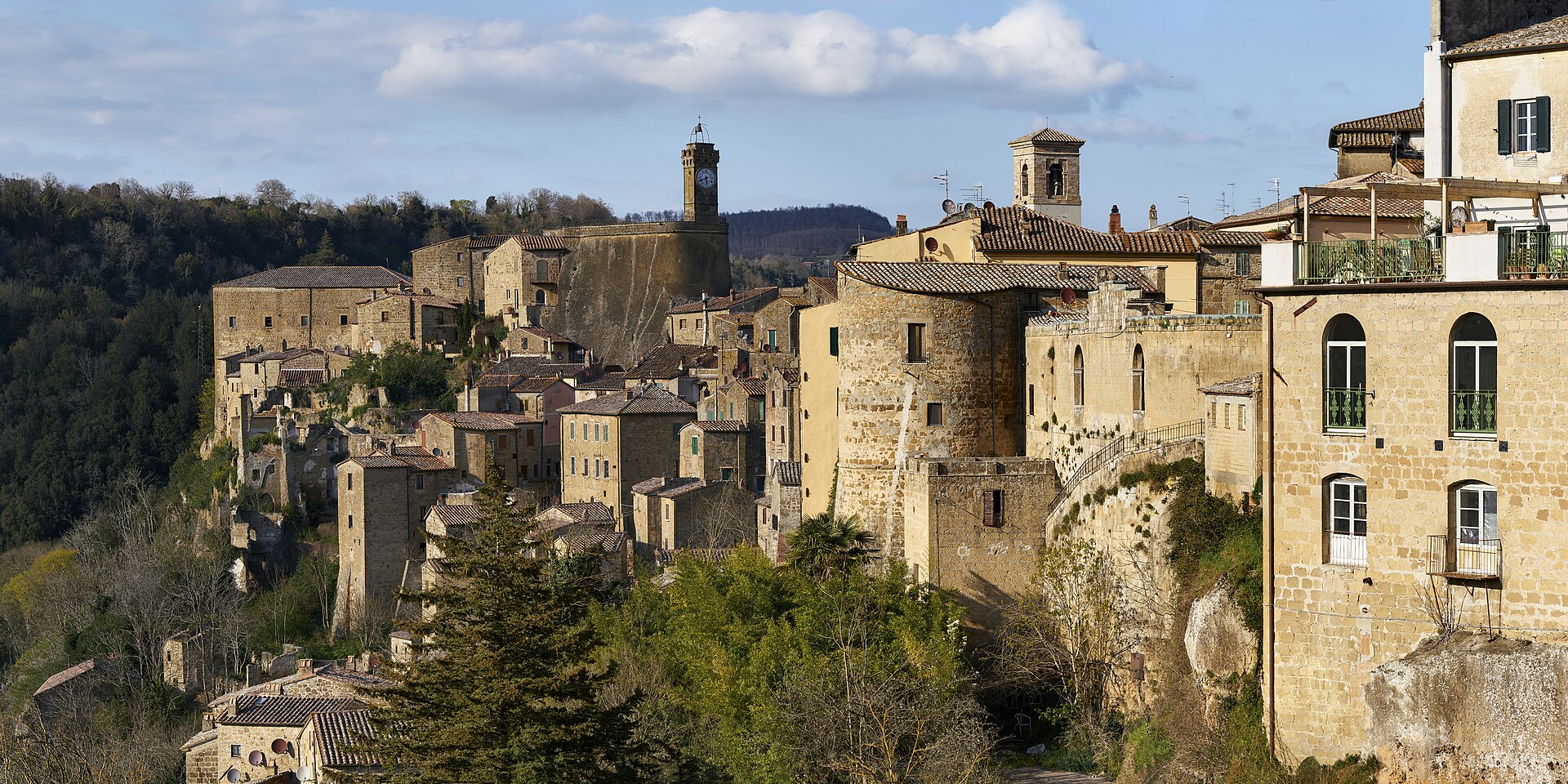
This Maremma itinerary follows the southern half of the province of Grosseto from the inside out. You start on the volcanic tufo (tuff) plateau, where towns sit on cliffs and Etruscan roads run through the rock. You move through the hills of Saturnia and Morellino wine, cross the reclaimed plain around Grosseto, and finish on a coast that stayed outside Tuscany for about 250 years, in a garrison state founded by Spain.
It is a car trip. Buses do reach Pitigliano, but Sorano has no railway station, Saturnia does not appear on the main bus line, and several stops sit in open country. We have not given drive times, because we could not source reliable ones. Plan each day on a map before you set off, and leave slack. For the wider picture of the region, start with our Maremma hub page.
A note on timing. Spring and late September to October avoid two summer headaches: the guided-only regime in the Parco della Maremma and the evening traffic zones on the coast. Autumn brings its own issue, the wild boar hunt, which we cover in the Practical Tips.
Day 1: Pitigliano, “Little Jerusalem”
Morning: Start with the Jewish itinerary in Pitigliano: the synagogue, the museum, and the old ghetto. The visit is by guided tour on reservation, so book before you arrive (Musei di Maremma). The synagogue was completed in 1598, paid for by a weaver named Leone di Sabato, and the Medici grand dukes imposed the ghetto in 1622. Below it are rooms cut into the tufa: a ritual bath, a kosher butchery, a wine cellar, a dyeing room, and a matzah oven used until 1939. Ask your guide about the local families recognized as Righteous Among the Nations for sheltering Jews during the war. The route is not wheelchair accessible.
Lunch: Il Tufo Allegro, a MICHELIN Guide selection near the synagogue, has dining rooms carved into the tufa. Its chef, Domenico Pichini, has been called a champion of cucina goym, the local crossover between Jewish and non-Jewish cooking. Check its closing days on the MICHELIN page before you plan around it.
Afternoon: Palazzo Orsini holds the diocesan museum and, through a separate entrance, the civic archaeological museum. The comune has announced restoration works, so confirm opening before you go (Comune di Pitigliano). Then walk the vie cave (sunken Etruscan roads). A local guide describes a loop of about 6 km from Porta di Sovana along the Via Cava di Poggio Cani, with a branch to Madonna delle Grazie. The descent is steep and slippery, so wear proper shoes. Before you leave town, look for sfratto, a honey-and-walnut pastry whose name means “eviction.” It recalls the stick officials used to knock on Jewish doors when families were ordered into the ghetto.
Dinner: An osteria in the historic center. Ask for Bianco di Pitigliano, one of Italy’s earliest DOC wines. The Cantina di Pitigliano also makes a white and a red kosher wine under the supervision of the Rabbi of Livorno.
Sleep: An agriturismo in the countryside near Pitigliano.
Day 2: Sovana and Sorano
Morning: Sovana had 122 residents at the 2011 census, yet it has a cathedral, a necropolis, and a museum that was robbed. Start at the Duomo, whose crypt holds relics of San Mamiliano, then see the 9th-century ciborium in Santa Maria Maggiore. Tradition places the birth of Pope Gregory VII here; the Dizionario Biografico degli Italiani says only “perhaps.” The San Mamiliano museum displays gold coins from a hoard of 498 found in 2004. Thieves took most of those on show in November 2019, and we found no report of their recovery.
Then head out to the necropolis and the Cavone, a deep sunken road. Look for the Etruscan family name Vertna carved about 170 cm above today’s ground, a reminder that the road floor has been lowered over the centuries. The Tomba Ildebranda, a temple-shaped tomb, returned to private owners after a 2013 court ruling, and we could not confirm current access. The park that manages these sites publishes no hours online, so phone (+39 0564 614074) or email (info@leviecave.it) ahead and ask about the Ildebranda specifically (Città del Tufo).
Lunch: Taverna Etrusca on Piazza del Pretorio, a rustic place with a summer terrace.
Afternoon: Drive on to Sorano. The Fortezza Orsini was completed in 1552 for Count Niccolò IV Orsini. Its museum shows ceramics recovered from medieval rubbish dumps, and guided tours go down into the underground passages; bring a jacket. The official English page mentions “fifth-century frescoes.” That is probably a mistranslation of Cinquecento, the 1500s. Climb to the Masso Leopoldino, the old fortress rock that was damaged by landslides in 1801–1804. Sorano had its own ghetto too: the former synagogue survives as an exhibition space, and marks of the ghetto gate’s hinges are still visible. An audio guide in English runs through QR codes around town.
If you would rather soak, Terme di Sorano has a main pool at 37.4°C that is open year-round (Terme di Sorano).
Dinner: A trattoria in Sorano or back near your base.
Sleep: The same agriturismo near Pitigliano.
Day 3: Saturnia, Montemerano, and Manciano
Morning: Go early to the Cascate del Mulino below Saturnia. Bathing in the hot-water pools is free. The municipal car park beside them has been paid since April 2023, and campers are banned. The figures you see quoted online, 37.5°C and 500 liters per second, are the Terme di Saturnia resort’s data for its own spring, not measurements of the falls. Check the Comune di Manciano news page for current parking rules.
Then drive up to the village. The story of Saturn’s thunderbolt creating the springs is modern folklore with no classical source. The real history is better. Pliny calls the place Aurinia, Rome founded a colony here in 183 BC on the Via Clodia, and Porta Romana, a round arch, is the only surviving gate. The Museo Archeologico di Saturnia holds the Ciacci collection.
Lunch: A trattoria or bar in Saturnia village. I Due Cippi dal 1976, listed in the MICHELIN Guide, is an evening option; check its days on the MICHELIN page.
Afternoon: In Montemerano, the church of San Giorgio holds the Madonna della Gattaiola, a 15th-century panel that was later cut down and used as a door. A round hole at lower right is traditionally a cat flap. The hole is real; the cats are tradition. Continue to Manciano for the Museo di Preistoria e Protostoria della Valle del Fiora, which covers the communities that lived here before the Etruscans (Musei di Manciano). Manciano is also home to ciaffagnone, a thin fritter topped with pecorino and folded like a handkerchief. The Caseificio Sociale Manciano, a cheese cooperative founded by 21 farmers in 1961, is at Piano di Cirignano outside town; check its website for visits.
Dinner: This is the splurge night. Da Caino in Montemerano holds two MICHELIN stars under chef Valeria Piccini. Book well ahead through dacaino.it. For something simpler, La Filanda in Manciano is also in the Guide.
Sleep: An agriturismo near Saturnia or Manciano.
Day 4: Scansano, Magliano, and on to the Coast
Morning: Scansano explains why the Maremma stayed empty for so long. Under the estatatura, Grosseto’s public offices moved uphill every summer to escape malaria. The practice was regulated in 1780, and a French decree of 1810 made Scansano the main summer seat, with the court and prisons. It was formally abolished by law in 1897, and a plaque at the Palazzo Comunale marks it. That is why a town this size has a 19th-century theater and a string of palazzi. The Museo Archeologico e della Vite e del Vino, which also houses the tourist office, links Etruscan finds to the wine that carries the town’s name (Musei di Maremma). Morellino di Scansano became a DOCG in 2006 and added a legal Superiore category in 2026.
Lunch: A trattoria in Scansano’s old center, with a glass of Morellino.
Afternoon: Magliano in Toscana is wrapped in walls begun in the Middle Ages and completed in the Renaissance. Outside the town, San Bruzio is the roofless shell of an 11th–12th-century monastery church. The Olivo della Strega (witch’s olive), a monumental tree with a trunk 8.5 m round, stands next to the church of SS. Annunziata, not at San Bruzio as some English sources say. Its famous age of 3,000 years or more has no scientific citation. The town museum has a new permanent section on Etruscan language and writing, built around the Piombo di Magliano, a lead disc inscribed in a spiral. The original lives in Florence’s Museo Archeologico Nazionale, so here you see reproductions (Maremma News). If you have time, detour to Pereta, a frazione of Magliano with a 29 m clock tower.
Late in the day, drive to Orbetello and walk the lagoon side of town at dusk.
Dinner: The tasting center of the Orbetello fishermen’s cooperative, founded by thirteen fishermen in 1946 (I Pescatori di Orbetello). Order bottarga or smoked eel. Slow Food credits some of the lagoon’s preserving techniques to the Spanish period. Read their story in our profile of the Pescatori di Orbetello.
Sleep: A hotel or apartment in Orbetello, or a farm stay on its edge.
Day 5: The Grosseto Plain
Morning: Start at the Parco Archeologico di Roselle, an ancient city with walls more than three kilometers long, an amphitheater, a forum, baths, and houses (Parchi Archeologici della Maremma). Older museum websites for Roselle are out of date, so use this one for hours and tickets.
Lunch: A bar or trattoria inside Grosseto’s walls.
Afternoon: Grosseto is ringed by hexagonal Medici walls, commissioned by Cosimo I, designed by Baldassarre Lanci, and finished in 1593. In 1855 Leopoldo II turned them into a tree-lined promenade, which is how you walk them today. The MAAM (Museo Archeologico e d’Arte della Maremma) is the right follow-up to Roselle, since its collection emphasizes finds from Roselle and Vetulonia (MAAM). Before you leave, visit the crypt of the Basilica del Sacro Cuore. It lists the names of the civilians killed on Easter Monday 1943, when American bombers aiming for the airfield hit a funfair outside Porta Vecchia; most of the 134 dead were children.
Toward sunset, drive to Istia d’Ombrone, a village that mattered because it controlled a ford on the Ombrone river. Enter through the 13th-century Porta Grossetana. The brick church of San Salvatore holds a Madonna by Giovanni di Paolo.
Dinner: An osteria back in Orbetello.
Sleep: Orbetello.
Day 6: Parco della Maremma, or Castiglione and Vetulonia
Option A, the park. The Parco Regionale della Maremma was Tuscany’s first protected area, established in 1975. Walks start from the Alberese visitor center, where you buy trail tickets. Outside summer you can walk most trails on your own. A1 San Rabano, which climbs through pine forest to a ruined abbey, is the park’s most demanding route. Its tickets are sold online in autumn and winter but only at the visitor center in spring and summer (parco-maremma.it).
One current warning: in September 2026 the Strada del Mare bridge to Marina di Alberese closed until further notice, and trails A1–A4 again start from Pinottolai at Pratini (Il Giunco). Check the park site for the current start points.
Alberese is also home to the Tenuta di Alberese, the regional estate where butteri (mounted cattle herders) still work Maremmana cattle and Maremmano horses. The estate is clear that its butteri are not a re-enactment. Read our profile of the butteri of Alberese before you go, and contact the estate for its working rides (Tenuta di Alberese).
Option B, Vetulonia and Castiglione. In 1880 a country doctor, Isidoro Falchi, identified the lost Etruscan city of Vetulonia at a village then called Colonna, and spent over a decade fighting experts who said he was wrong. The Parco Archeologico di Vetulonia has free admission; note that the Tomba del Diavolino II is listed as temporarily closed (Parchi Archeologici della Maremma). Then go down to Castiglione della Pescaia. The Casa Rossa Ximenes, an 18th-century sluice house, now runs boat trips and guided walks in the Diaccia Botrona wetland (Musei di Maremma). The castle is private and hard to visit, so walk the walled borgo instead.
Lunch: Pack a picnic for the park, or find a trattoria in Castiglione’s lower town.
Dinner: A trattoria in Orbetello.
Sleep: Orbetello.
Day 7: The Spanish Coast
Morning: In 1557 Philip II of Spain made Orbetello the capital of the Stato dei Presidi, a coastal enclave that stayed outside Tuscany until 1815. Walk the Etruscan polygonal walls along Via Mura di Levante, then see the Spanish bastions and gates. The Polveriera Guzman, a 1692 powder store, now houses the archaeological museum, with Etruscan grave goods and pieces of the temple at Talamone (Musei di Maremma). On a weekend outside summer, you can add the WWF Oasi Laguna di Orbetello for flamingos and herons (WWF Italia).
Lunch: L’Oste Dispensa in Orbetello, one of only a handful of restaurants in the province of Grosseto to win Slow Food’s Chiocciola in Osterie d’Italia 2026. It does not serve lunch every day, so check the MICHELIN page before you plan around it.
Afternoon: Drive to Ansedonia and the Parco Archeologico di Cosa, a Roman colony founded in 273 BC. The park is free; its museum has been closed for reinstallation since January 2026 (Parchi Archeologici della Maremma). Below the hill is the so-called Tagliata Etrusca, a channel cut through the rock to the sea. Treccani says it is more probably Roman Republican engineering. The tower above it belonged to Giacomo Puccini for about two years from 1919; the source links it, cautiously, to Il Tabarro, not Turandot.
Finish in Porto Ercole, ringed by Spanish forts. Forte Filippo is now private homes, with a private museum by appointment only, so view the forts from the harbor and the roads above. You will also meet the Caravaggio story. The parish death record behind it carries the wrong year, and the 2010 claim to have found his bones was never published in a scientific journal. Leading art historians rejected it outright.
Dinner: A seafood trattoria on the Porto Ercole waterfront.
Sleep: Orbetello, or the Argentario if you are staying on.
Extensions
Capalbio and the Tarot Garden. Niki de Saint Phalle’s Giardino dei Tarocchi holds 22 monumental figures of the Major Arcana covered in mirror and ceramic mosaic. It opens from spring to mid-October, in the afternoons only, and only a dated, timed online ticket guarantees entry, with no refunds in rain (ilgiardinodeitarocchi.it). Pair it with the walled hill town of Capalbio, where the brigand Domenico Tiburzi was killed in 1896. Treccani describes him as a hired enforcer for landowners, not a Robin Hood.
Talamone. Garibaldi’s Thousand anchored here in May 1860 because they had sailed without ammunition. The park’s T trails start from the village.
Giglio and Giannutri. Ferries run year-round from Porto Santo Stefano to Isola del Giglio in about an hour (Maregiglio). Giannutri is tightly regulated: the Roman villa can be visited only with National Park guides, and there is a landing fee (Visit Giglio Island).
Practical Tips for This Route
Book these before you go
- Pitigliano’s Jewish itinerary: guided visits on reservation (Musei di Maremma).
- WWF oases: both Orbetello and Lago di Burano need booking the day before in the warmer months. Burano is visited only with a guide. See WWF Orbetello and WWF Burano. Both close during weather alerts.
- Tarot Garden: timed online tickets only (ilgiardinodeitarocchi.it).
- Parco della Maremma in summer: most trails become guided-only; in 2026 this ran from mid-June to mid-September. A5–A8 stay open to independent walkers (parco-maremma.it).
Autumn means hunting days
Tuscany’s hunting season opens on the third Sunday of September. In the 2026/27 calendar, driven wild boar hunts run from 1 October to 31 January on Wednesdays, Saturdays, Sundays, and holidays, and local districts can adjust the days (Regione Toscana PDF). On those days, wear bright clothing, stay on marked trails, and favor protected areas such as the regional park and the WWF oases.
Traffic zones and parking
Several towns have camera-enforced ZTLs (limited traffic zones). Grosseto’s walled center issues automatic fines (comune permits). Porto Ercole runs evening ZTLs from May to September (Comune di Monte Argentario). Castiglione della Pescaia has a summer evening ZTL (comune). Pitigliano and Capalbio also have ZTLs (Pitigliano; Capalbio). In Pitigliano, use the signed car parks listed by Visit Pitigliano. If your hotel is inside a zone, ask it to register your plate.
Drive the Aurelia with care
The SS1 Aurelia is the spine of this route. As of April 2026, about 13 km around Capalbio were still a two-lane road with what local reporting called an alarming accident rate (Il Giunco). Avoid overtaking there, keep your speed down, and allow extra time.
Money and hours
A tourist tax applies in several comuni on this route, including Pitigliano, Orbetello, and Monte Argentario; check the rate with your accommodation. We do not list hours or prices, because they change by season. Use the linked official pages and check before each visit.
Information is provided in good faith and may change. Always confirm opening hours, prices, and event dates with the official source before you travel.