
Town · Val d'Orcia
Bagno Vignoni
A Square of Hot Water Nobody Swims In
Last updated:
- Region
- Val d'Orcia
- Province
- Province of Siena
- GPS
- 43.0279, 11.6183
- Best season
- year-round (the steam over the pool shows best on cold mornings)
- Time needed
- 2–3 hours, or half a day with Vignoni Alto
- Difficulty
- easy in the square; moderate on the paths down through the Parco dei Mulini
- Known for
- thermal pool square, Parco dei Mulini, Catherine of Siena, Via Francigena, Vignoni Alto
A Village Built Around a Pool
Most Tuscan villages are built around a piazza. Bagno Vignoni is built around a pool. Its main square is a stone basin of hot spring water, 49 m long and 29 m wide. San Quirico d’Orcia‘s tourism office calls it “una piazza allagata” (a flooded square). Buildings and a loggia line its edges, and on cool days steam drifts across the surface.
The water once emerged at about 52 °C and carries magnesium and calcium sulfate. Below the village, it used to do real work. It ran down a limestone cliff through four mills, which could keep grinding in summer when the rivers ran low.
Here’s the thing most visitors don’t know until they arrive: you can’t swim in any of it. Bathing in the square’s pool is forbidden, and so is bathing anywhere in the mill park below. That surprises people, because many English-language guides still promise a free soak. This profile explains why, and where to go if you want warm water on your skin.
A Place Shaped by Time
Nymphs, pilgrims, and a saint
The springs were probably known to the Etruscans and were certainly used by the Romans. Under the portico of the chapel of Santa Caterina, an ancient inscription dedicates the waters to the nymphs.
In the Middle Ages, the village’s fortune came from the road. The Via Francigena passed close by, and pilgrims walking to Rome stopped to rest here. A small borgo (village) and a parish church grew up around the baths. From the 12th and 13th centuries, the baths belonged to the Tignosi lords of Tintinnano, and in the 1300s the Salimbeni, Siena’s banking family, took possession.
Catherine of Siena came to the springs too. The Loggiato di Santa Caterina, on one side of the pool, shelters a chapel where, according to the tourism office, she prayed during her stays. The tourism office also names Pope Pius II Piccolomini and Lorenzo il Magnifico among the illustrious visitors the waters attracted.
Men on one side, women on the other
Siena took a close interest in the baths. The tourism office cites a report of 1334 by Simone Tondi. He described the baths as “di figura quadrata tutto bello, divisa la fonte in due parti” (square in shape, all beautiful, the spring divided into two parts). The two parts separated men from women. So the pool was once a place where people really did bathe. Today’s ban is a modern rule.
What to See and Do
The pool and the Loggiato di Santa Caterina
Walk the full circuit of the square. It takes only a few minutes, but the effect changes with the light and the weather. Look for the inscription to the nymphs under the portico, and step into the loggia where Catherine prayed. Early morning, before the day-trippers arrive, is the best time to see the steam and the reflections without a crowd.
The Parco dei Mulini: mills that ground in summer
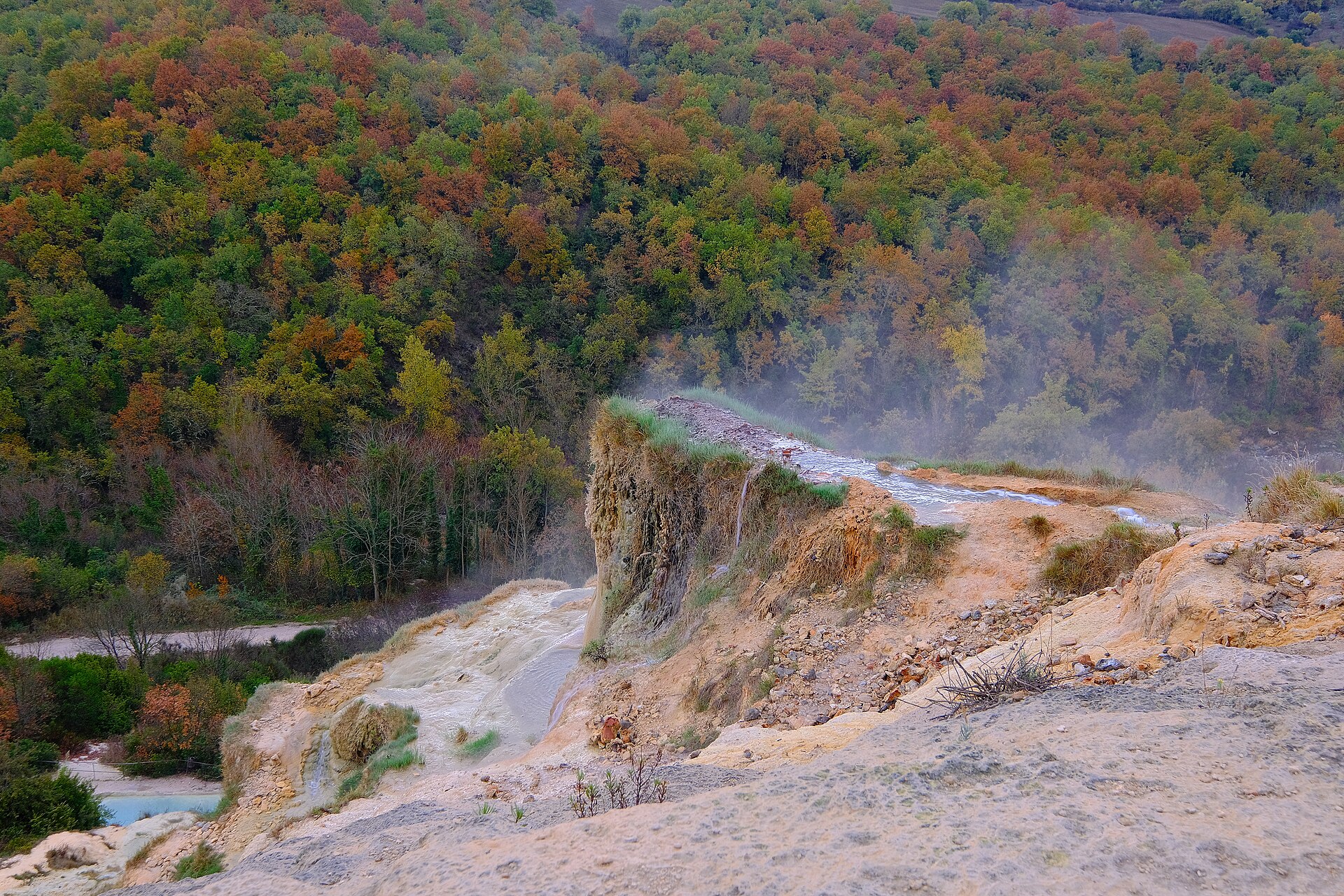
This is the part many visitors miss, and it’s the most interesting. At the edge of the square, the hot water spills over the lip of a travertine cliff and runs down toward the Orcia river. That cliff was formed by the water itself, as it dropped limestone over centuries.
Down the slope, four mills worked in sequence. Their names survive: il mulino disopra (the upper mill), il mulino buca, il mulino dimezzo (the middle mill), and il mulino da piedi (the mill at the foot). The reason they mattered is simple. River mills stopped when the rivers ran low in summer, but the spring’s flow never changed. So Bagno Vignoni’s mills could grind all year.
The engineering is clever. Because the cliff was too steep to build on, almost everything was cut into it “in negativo” (in negative space): mills, channels, holding basins, and access paths. The two upper mills are entirely underground. The two lower ones have grinding rooms in the open air, with the wheel chambers, called carcerai, dug below.
The mills used horizontal wheels, known locally as ritrecine. Water shot from basins higher up and turned the wheels, which drove the millstones directly through a vertical shaft. The work was hot and humid, because the water ran at around 50 °C. The millers also had to keep chipping away the limestone before it hardened on the machinery.
Near the river, only the supports survive of a single-arch bridge over the Orcia. The tourism office attributes it to the architect Baldassarre Peruzzi and says it collapsed in the early 1900s.
Why nobody swims here
The rules are clear. Bathing is forbidden in the square’s pool. Under municipal ordinance no. 22 of 31 March 2010, it is also forbidden anywhere in the Parco dei Mulini. The same ordinance bans leaving the marked paths, climbing on the structures, and taking rocks. Fines run from €25 to €500. The Comune publishes the rules on its Parco dei Mulini page.
Please respect them. The travertine formations and the old mill structures are fragile, and the park is a heritage site, not a free spa.
What we know vs. what’s repeated: Many English-language guides say you can soak in Bagno Vignoni’s square pool or in free “natural pools” below the village. You can’t. Bathing is forbidden in the pool and, under ordinance no. 22/2010, anywhere in the Parco dei Mulini, with fines of €25 to €500.
Where you can bathe
If you want to get into warm water, you have two good options. The village has private spa pools, which you pay to use. Or drive south toward Monte Amiata to Bagni San Filippo. There, a hot stream runs through the woods. Access is free at the time of writing, but the comune has long planned visitor management, so check locally before you go. Do not climb, touch, or bathe at the white “whale” formation.
Vignoni Alto: the hamlet above
Just above the village, the hamlet of Vignoni Alto feels a world away from the busy square. It is small and quiet, with a cassero (fortified tower) and a small Romanesque church. The church once depended on a parish church by the baths that no longer exists.
The tourism office traces Vignoni’s history back to around the year 1000, when it belonged to the Abbey of Sant’Antimo. Emperor Henry III confirmed that possession in 1051. The Sienese rebuilt the cassero in 1339, paying for it with revenue from Montalcino. In 1409 the castle passed to a woman of the Salimbeni family, the wife of the condottiero (mercenary captain) Attendolo Sforza. Later it belonged to the Amerighi counts and then the Chigi.
The views over the valley from up here are the real reward. The Via Francigena passes through, so you can walk up on the pilgrim route itself.
What we know vs. what’s repeated: Vignoni Alto’s tower is often called a “Salimbeni tower.” According to San Quirico’s official tourism site, the Sienese rebuilt the cassero in 1339. The Salimbeni connection is later ownership, from 1409.
Eating Like a Local
Bagno Vignoni is small, and it has no market of its own. San Quirico’s market, a short drive north, is held on the second and fourth Tuesday of the month.
What you’ll find on local menus is the food of the whole valley. Pici, thick hand-rolled strands of flour and water, are the signature pasta. The cheese is pecorino: the protected designation is Pecorino Toscano DOP, while Pienza’s barrique-aged pecorino is a regional traditional product. The local wine is Orcia DOC, a small appellation between Brunello di Montalcino and Vino Nobile di Montepulciano.
For products to take home, look to San Quirico. It has saffron growers, such as CrocusBrandi and Pura Crocus, and a historic olive mill documented by the Ecomuseo. In early December, the town’s Festa dell’Olio celebrates the new season’s oil.
Getting There and Getting Around
By car
Bagno Vignoni lies just south of San Quirico d’Orcia, a short drive away. The village is compact, and you’ll explore it on foot. The paths down through the Parco dei Mulini are uneven, so wear proper shoes.
By bus and train
Two Autolinee Toscane lines stop here. Line 54A runs from Siena through Buonconvento and San Quirico to Bagno Vignoni and on toward Amiata. Line 52A connects Arcidosso and San Quirico, with stops at Castiglione d’Orcia, Rocca d’Orcia, and Bagno Vignoni. Check the line pages for current timetables, which change with the school year.
The nearest working train stations are Buonconvento (Siena–Grosseto line) and Chiusi-Chianciano Terme (Florence–Rome line). From either, continue by bus. Torrenieri station, still suggested in some guides, has had no regular trains since 1994.
On foot
Stage 36 of the Via Francigena, from San Quirico d’Orcia to Radicofani, passes through Vignoni Alto and Bagno Vignoni. Walking just the first stretch from San Quirico is a good way to arrive. The full stage is 33 km and rated “very demanding.”
Nearby
- San Quirico d’Orcia (just north): a Medici-era garden, carved church portals, and the Festa del Barbarossa.
- Rocca d’Orcia (south): the tower of Tentennano, where Catherine of Siena stayed in 1377.
- Castiglione d’Orcia (south): two fortresses and a Simone Martini Madonna whose Child holds a swallow.
- Bagni San Filippo (toward Monte Amiata): a hot stream in the woods where you can get into the water.
- Radicofani (end of stage 36): a papal border fortress on a volcanic outcrop.
Information is provided in good faith and may change. Always confirm opening hours, prices, and event dates with the official source before you travel.