
Town · Monte Amiata
Santa Fiora
The Sforza Town Built Around a River’s Source
Last updated:
- Region
- Monte Amiata
- Province
- Province of Grosseto
- Best season
- Summer and autumn; 30 December for the Carboniere
- Time needed
- Half day to full day
- Difficulty
- easy
- Known for
- Andrea della Robbia terracottas, Peschiera and the Fiora springs, Sforza county, Carboniere fire rite, mercury mining museum
Where a River Begins
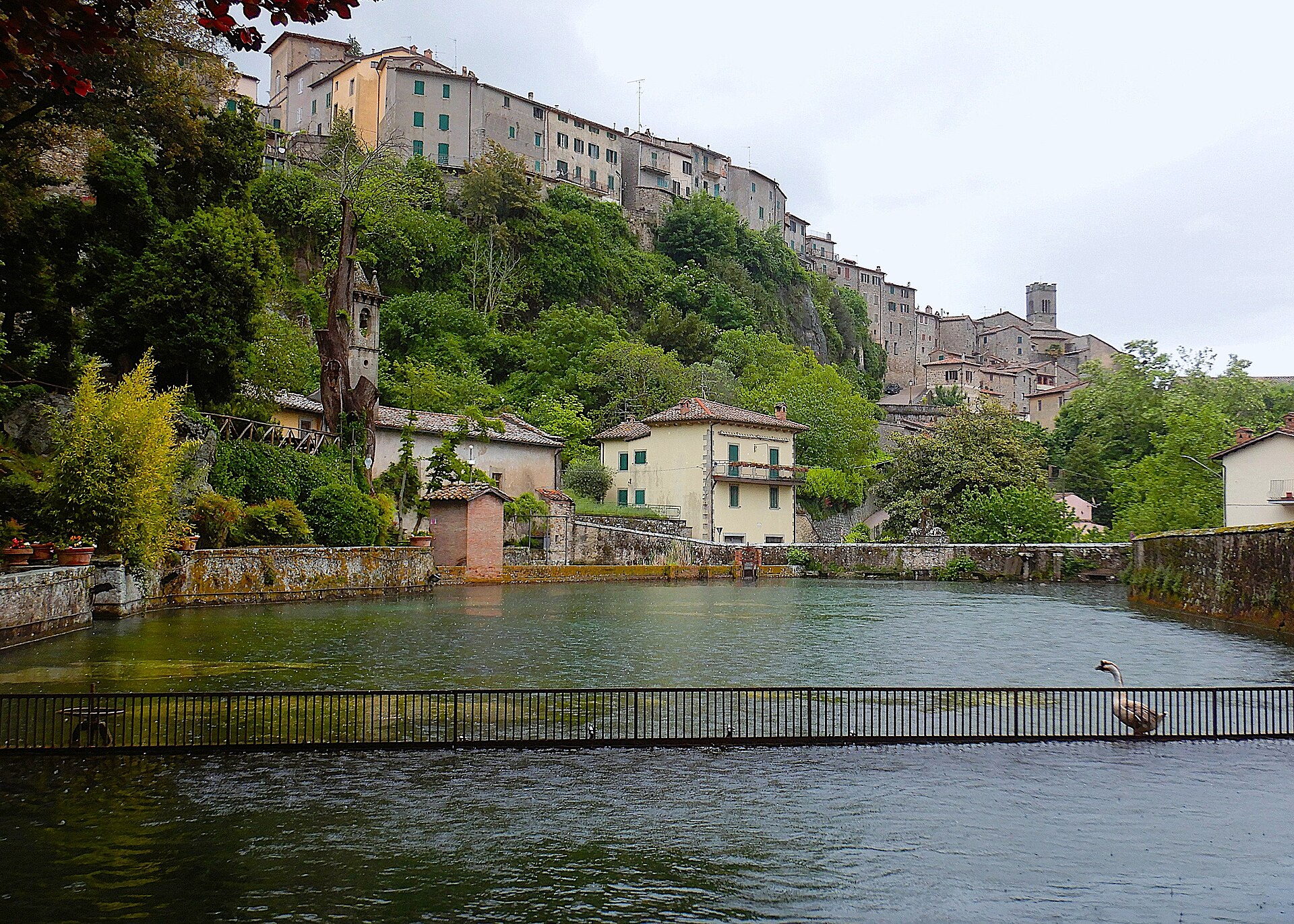
Many towns grow up beside a river. Santa Fiora grew up on top of one. The springs of the Fiora rise inside the town, at 687 m on the Grosseto side of Monte Amiata.
In the 16th century the Sforza, the town’s lords, enclosed those springs in a reservoir, the Peschiera. In a small church next to it, glass floor panels let you watch the water run beneath your feet.
That’s only one reason to come. Santa Fiora was the seat of a small state ruled by a branch of the Sforza family. Its parish church holds a remarkable group of glazed terracottas. And on 30 December the old town lights great wood pyres in a fire rite revived in 1977.
A Place Shaped by Time
Aldobrandeschi beginnings
According to Italian Wikipedia, Santa Fiora first appears in a document of 890. By 1141 it was a castle, and it became a stronghold of the Aldobrandeschi counts. Dante names it in the Purgatorio, Canto VI.
According to the same source, Dante mentions it because it was Ghibelline, on the side of the pro-imperial faction of medieval Italy. Under that allegiance it was one of the leading centers of southern Tuscany.
The Sforza county
In 1439 the Contea di Santa Fiora (County of Santa Fiora) passed from the Aldobrandeschi to the Sforza. The route was a marriage: Cecilia Aldobrandeschi wed Bosio Sforza.
The Sforza counts commissioned the della Robbia terracottas, and their palace still stands on Piazza Garibaldi. Italian Wikipedia dates the Palazzo Sforza Cesarini to 1575, built on the remains of the old fortress.
In 1633 Mario Sforza sold sovereignty to Ferdinando II de’ Medici and stayed on as feudatory. The Sforza Cesarini kept their feudal rights until the late 18th century.
Three districts
The town still divides into three terzieri (districts): Castello, Borgo, and Montecatino. Montecatino holds the Peschiera and the springs.
Mercury
In the 19th and 20th centuries Santa Fiora was an important center for mining cinnabar, the ore of mercury. Italian Wikipedia gives the Bagnore mine’s working life as 1920 to 1976. The local tourism site notes that the town still has a Miners’ Choir.
What to See and Do
The Pieve delle Sante Flora e Lucilla
The parish church is dedicated to Saints Flora and Lucilla. Italian Wikipedia dates it to 1142. It was enlarged in the 15th century with a Sforza chapel, which was remodeled in the 16th. It holds a group of glazed terracottas by Andrea della Robbia and his workshop. They date to the late 15th century and were commissioned by the Sforza counts.
Look for these pieces:
- the triptych of the Coronation of the Virgin with Saints Francis and Jerome
- the Baptism of Christ
- the Madonna della Cintola (the Virgin giving her girdle to St Thomas)
- the pulpit reliefs of the Last Supper, the Resurrection, and the Ascension
- the tabernacle for the holy oils
Andrea, not Luca
You may see these works credited to Luca della Robbia online. That’s wrong. Luca founded the family workshop. His nephew Andrea (1435–1525) took it over, and the Santa Fiora pieces are by Andrea and his workshop.
In 2025, from 4 to 24 August, the town marked 500 years since Andrea’s death with “Della Robbia 500”.
The Peschiera
The Peschiera is a 16th-century reservoir in the Montecatino district. It collects the springs of the Fiora. The Sforza laid out a park-garden around it, and it is still set in a park today.
The Fiora is one of four rivers that rise on Amiata, with the Albegna, the Paglia, and the Vivo. Its water travels far. The Acquedotto del Fiora runs water services for 55 comuni in the provinces of Grosseto and Siena. Amiata springs also supply parts of northern Lazio.
The Madonna della Neve
Next to the Peschiera stands the small church of the Madonna della Neve (Our Lady of the Snow). Glass panels set into its floor show the spring water running underneath. The town’s tourism site singles out the night of 5 August, the feast of the Madonna delle Nevi.
Sant’Agostino and the Suffragio
Two more churches fill out a walk through the old town. According to Italian Wikipedia, Sant’Agostino was begun in 1309 and remodeled in 1681. The Chiesa del Suffragio, also called the Misericordia, was built between 1716 and 1726.
The mercury mines museum
The Museo delle Miniere di Mercurio del Monte Amiata occupies the ground floor of the Palazzo Sforza Cesarini. According to the Amiata museum network, it has six rooms on the region’s mercury mining. They cover techniques, extraction methods, and mine sites around Santa Fiora and Castell’Azzara.
The museum also includes a reconstructed underground gallery. For hours, check museiamiata.it.
The Carboniere, 30 December
On the evening of 30 December, large wood pyres called carboniere burn around the old town. A torchlight procession passes through the streets where they burn. The first pyre is lit from miners’ acetylene lamps.
The rite was once held on Christmas Eve. It was revived in 1977 and moved to 30 December. Visit Tuscany links it to old fire rites held to purify the community and drive away evil. According to Visit Tuscany, the procession ends at the Palazzo Sforza Cesarini with a sweet chestnut polenta. See the Visit Tuscany fire events page for context.
It’s one of several Amiata fire rites late in the year: Roccalbegna‘s Focarazza burns on 24 November and Abbadia’s Fiaccole on 24 December.
The frazioni
Italian Wikipedia sums up Santa Fiora’s four frazioni (outlying villages):
- Bagnore: once a known spa, thanks to the iron-rich Acquaforte spring
- Bagnolo: a village that grew up in the 17th and 18th centuries in a place full of springs
- Marroneto: a hamlet among chestnut trees, east of Santa Fiora
- Selva: on Monte Calvo, near the 15th-century Convento della Trinità
Bagnore has a darker place in Amiata history. It is where David Lazzaretti was shot on 18 August 1878.
Geothermal Bagnore
Near Santa Fiora, Enel Green Power runs the Bagnore 3 and 4 geothermal plants, fitted with AMIS filters. The regional health agency ARS found higher male mortality in the area, falling in recent years. Its InVETTA study found no link to hydrogen sulfide and pointed to natural sources. Local groups still dispute the plants’ impact.
Eating Like a Local
The seasons on the plate
The town’s tourism site sets out its food by season. In spring it’s Amiata sheep’s-milk ricotta and the schiaccia di Pasqua (Easter cake). Summer brings the red onion of Selva and acquacotta, a vegetable soup with its own August festival.
Autumn means porcini and chestnuts, including the local Marrone Santafiorese. Winter is for polenta di castagne (chestnut-flour polenta) and pork. See the Santa Fiora food page for details.
Chestnuts and mushrooms
Amiata chestnuts are protected as Castagna del Monte Amiata IGP, registered since 2000. The varieties are Marrone, Bastarda Rossa, and Cecio. The town holds a Festa del Marrone in early November. The frazione of Bagnolo has a Sagra del Fungo (mushroom festival). Check the events calendar for dates.
To pick mushrooms yourself, you need a paid regional permit. The daily limit is 3 kg per person, and plastic bags and rakes are banned. Read the Regione Toscana rules.
Getting There and Getting Around
By car
A car is realistically needed for Amiata, especially if you plan to see several villages in a day. Santa Fiora is on the Grosseto side of the mountain, close to Arcidosso.
The ZTL
Santa Fiora’s historic center has a ZTL (limited-traffic zone). Park outside the center and walk in.
By bus
Autolinee Toscane runs buses on the Grosseto side; line 42A serves Arcidosso. Services are limited. Check current routes and times on at-bus.it.
Where to stay
Abbadia and Santa Fiora have the widest choice of places to stay on the mountain. That makes Santa Fiora a good base for the Grosseto side. Our 4 days on Monte Amiata itinerary uses it that way.
Nearby
- Arcidosso: the castle town of the prophet David Lazzaretti, with the Buddhist center of Merigar on Monte Labbro.
- Castel del Piano: the gateway to the Prato delle Macinaie and the summit, with its Palio on 8 September.
- Piancastagnaio: the Siena-side town of the August Palio and the Crastatone chestnut feast.
- Castell’Azzara and Selvena: the old Sforza lands to the south, with cinnabar mines and the Monte Penna reserve.
- Roccalbegna: a village with Ambrogio Lorenzetti panels and the Focarazza fire.
Information is provided in good faith and may change. Always confirm opening hours, prices, and event dates with the official source before you travel.