
Town · Monte Amiata
Campiglia d’Orcia
A Ring-Shaped Village on a Limestone Rock
Last updated:
- Region
- Monte Amiata
- Province
- Province of Siena
- Best season
- Autumn, especially the last Sunday of October for the Festa del Marrone; summer for walks
- Time needed
- 2-3 hours
- Difficulty
- Easy (village); moderate (walk to Campigliola)
- Known for
- Ring-shaped medieval plan, Visconti viscounts, Campigliola tower, Festa del Marrone, views over the Val d'Orcia
Four Rings of Stone Above the Orcia
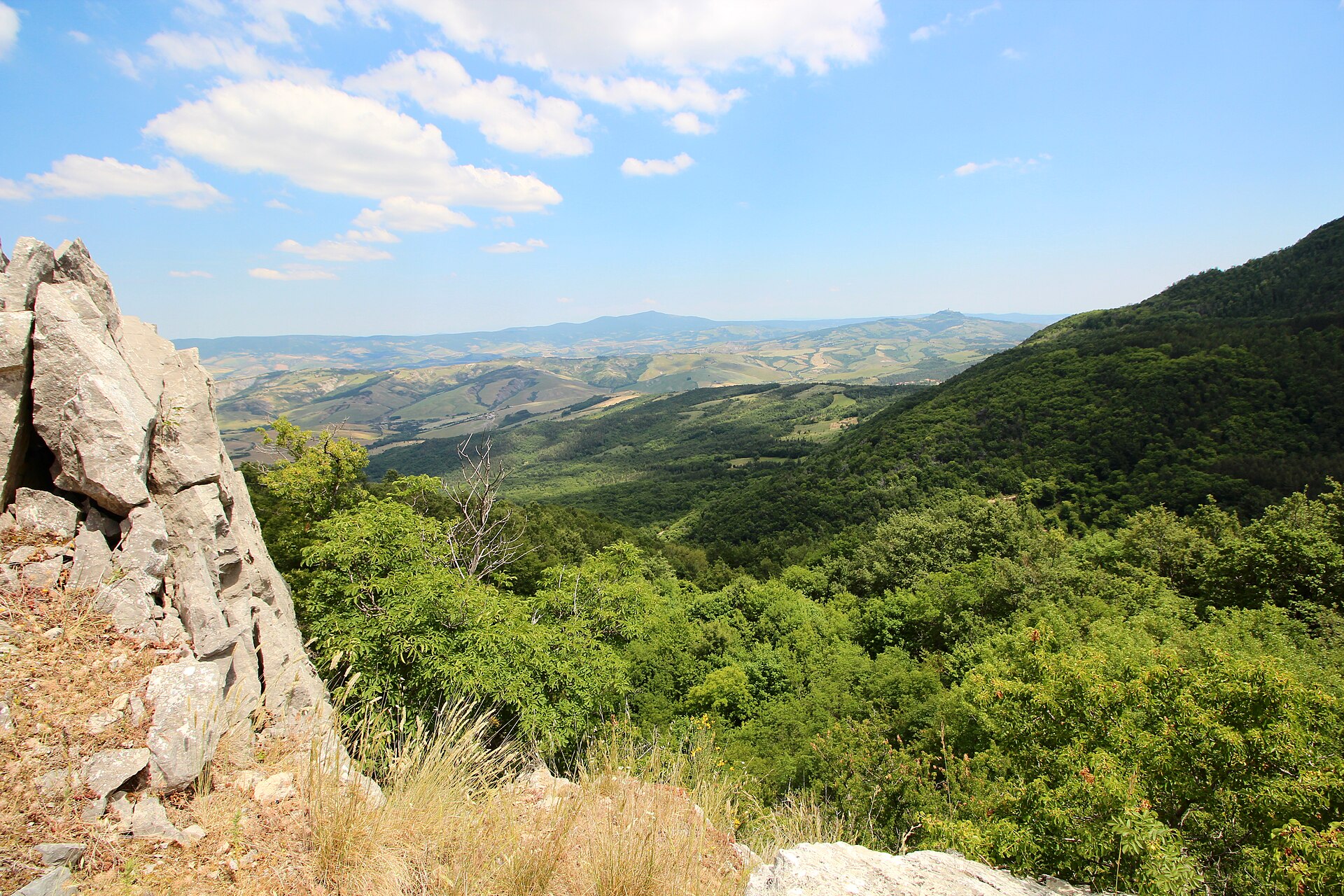
Campiglia d’Orcia stands at 810 m on a limestone outcrop at the foot of Monte Amiata. Below it, the Val d’Orcia opens out. Above it, the mountain begins. Like Vivo d’Orcia, it is a frazione (hamlet) of Castiglione d’Orcia.
What sets Campiglia apart is its shape. The village is laid out along four ring-shaped streets. According to the Pro Loco, this plan predates the year 1000, and the village has kept it ever since. The Pro Loco places the village between the Poggio dello Zoccolino and the Orcia valley. Walk the rings and you are following a medieval map.
The history here is not gentle. Campiglia was sold and bought back, pledged to Orvieto, burned by Siena, and resettled. Its lords, the Visconti, were not always loyal, and in 1234, after one of them changed sides, Siena burned their castle. Come for the views, but stay for the story.
A Place Shaped by Time
Limestone at the Foot of a Volcano
Monte Amiata is an extinct lava-dome volcano. Its main eruptions date to roughly 300,000 years ago, with a later lava flow about 240,000 years ago. It has not erupted in the Holocene, the current geological epoch.
Campiglia’s own rock is different. The village stands on a limestone outcrop rather than volcanic rock. From the top of that rock, where the bell tower stands, the Pro Loco notes wide views over the Val d’Orcia.
973: A Castle Changes Hands
Campiglia enters the record in 973. That year Lamberto, son of Ildebrando of the powerful Aldobrandeschi family, sold the curtis et rocca de Campelli. That is, the estate and the fortress of Campiglia.
The sale did not last. Lamberto’s widow, Ermengarda, later bought the property back. Even at the start, Campiglia was something worth owning.
The Viscounts of Campiglia
The Visconti who ruled Campiglia took their name from a job. They held the office of viscount for the Aldobrandeschi, and the title became the family name.
According to the Pro Loco, in the 12th century they kept a careful balance between Siena and Orvieto. It did not hold. In 1215 Visconte di Gentile pledged loyalty to Orvieto. In 1232 Pepo di Tancredi and his uncle made their submission.
1234: Siena Burns the Castle
Then Pepo switched sides. He changed allegiance on 6 March 1234. Later that year, Siena burned the castle.
The Visconti survived. In 1264 Campiglia submitted to Siena. In 1274 the Visconti divided their property among themselves. The Pro Loco notes that from the 14th century their power began to erode, and Campiglia fell under Siena.
From the Salimbeni to Siena
A marriage ended the Visconti era. In 1423 Rabba dei Salimbeni married Giovanni di Credi Visconti, and the fief passed to the Salimbeni.
Six years later, in 1429, Siena annexed Campiglia outright. In 1432 the Republic resettled it with families from the Val d’Arbia. The newcomers got tax exemptions, and Siena paid for new walls.
The Guicciardini Marquisate
Under the Medici, Campiglia became a marquisate. In 1604 it went to Piero Guicciardini. His family held it until 1766.
There is also a painted record of the village from before that time. According to the Pro Loco of nearby Gallina, a panel by the painter Sassetta, made between 1437 and 1444, depicts Campiglia.
A Story That Belongs Elsewhere
You may read online that the Visconti of Campiglia freed Arnaldo da Brescia in 1155. The Treccani biographical dictionary tells it differently.
Cardinal Odo seized Arnaldo near Briccole. It was the viscounts of Campagnatico, a different family, who then took him from the cardinal. Campiglia’s lords had plenty of drama of their own. This episode is not part of it.
What to See and Do
The Ring Streets
Start by simply walking. The four ring-shaped streets follow a plan that, according to the Pro Loco, dates from before the year 1000. Here the plan itself is the monument.
The Southern Gate
According to the Pro Loco, the southern gate of the old walls, with its round arch, still stands.
The Bell Tower on the Rock
The limestone outcrop that gives Campiglia its position also carries its bell tower. According to the Pro Loco, the tower sits on top of the rock, a footpath leads up, and the views take in the Val d’Orcia.
The Pieve di San Biagio
The parish church is dedicated to San Biagio (St Blaise). Its most interesting work is a painting by Sebastiano Folli, a Sienese artist who lived from 1569 to 1621.
It shows the Madonna standing, with the Christ Child handing the keys to St Peter.
Campigliola
Outside the village stand the ruins of Campigliola, a Visconti stronghold. Its tower watched over the Via Francigena, the medieval pilgrim road to Rome.
To get there, follow the unpaved road through the fields, then the restored dry-stone path. Local legend says that on June nights, fairies came to reap the wheat at Campigliola.
A Half-Day Plan
Campiglia is small, so it combines well with its neighbors. Start inside the village. Walk the rings, pass the southern gate, and stop in San Biagio for the Folli painting.
Then head out to Campigliola along the unpaved road and the dry-stone path. Wear shoes with grip.
In the afternoon, choose between water and history. Bagni San Filippo lies about 3 km away. Vivo d’Orcia, with its hermitage and Siena’s springs, is close by too.
The Festa del Marrone
Campiglia’s big day is the Festa del Marrone (Chestnut Festival), held on the last Sunday of October since 1978. It celebrates the Marrone, one of the three varieties of the Amiata chestnut.
The village’s three rioni (districts), Agitati, Borgassero, and Dentro, take part. According to the Pro Loco, they stage historical reenactments of chestnut growing and rural life. Check the Festa del Marrone page for this year’s program before you go.
Eating Like a Local
This is chestnut country. Castagna del Monte Amiata has been a registered IGP (protected geographical indication) since 2000. It covers three varieties: Marrone, Bastarda Rossa, and Cecio. The Marrone is the one Campiglia celebrates each October. The IGP association itself was founded in Arcidosso on 26 February 2000. New production rules in March 2026 extended the area to Castell’Azzara, Semproniano, and Sorano.
On Amiata, chestnuts were traditionally dried in a seccatoio, not a metato. The local guide That’s Amiata describes the method. The nuts lie on a slatted floor over a slow fire at about 30 °C for about 40 days.
Autumn also brings mushrooms to the woods above the village. If you want to pick your own, you need a paid regional permit. Non-residents pay by the day or the week. The limit is 3 kg per person per day, and plastic bags and rakes are banned. See the Regione Toscana page for the rules.
Getting There and Getting Around
A car is the practical choice, especially if you plan to combine Campiglia with other villages. The village is small, so explore it on foot.
By bus, Autolinee Toscane line FT9 links Chiusi station with Sarteano, Radicofani, Abbadia San Salvatore, and Piancastagnaio. Tiemme operates it for AT. The nearest stop is “Bagni S. Filippo – Bv. Campiglia”, at the turnoff rather than in the village. Check stops and times on at-bus.it.
The nearest station is Chiusi-Chianciano Terme on the Florence–Rome railway. Bagni San Filippo is about 3 km away. Autumn, with the chestnut harvest and the festa, is the best time to come. For the wider picture, see our Monte Amiata region guide.
Nearby
- Bagni San Filippo: the thermal village about 3 km away, covered in our full guide.
- Vivo d’Orcia: the sister frazione higher up, with its Camaldolese hermitage and the spring that supplies Siena.
- Castiglione d’Orcia: the comune’s main town, down toward the Val d’Orcia.
- Radicofani: a stage town on the Via Francigena, covered in our full guide.
- Abbadia San Salvatore: the old abbey town of Amiata, with its crypt and mercury-mining museum.
Information is provided in good faith and may change. Always confirm opening hours, prices, and event dates with the official source before you travel.