
Town · Monte Amiata
Roccalbegna
Lorenzetti Panels Beneath Two Fortresses
Last updated:
- Region
- Monte Amiata
- Province
- Province of Grosseto
- GPS
- 42.783, 11.500
- Best season
- Autumn (the Focarazza is on 24 November); spring
- Time needed
- Half day
- Difficulty
- moderate (steep paths up to the fortresses)
- Known for
- Ambrogio Lorenzetti panels, Rocca Aldobrandesca and Cassero Senese, Focarazza of Santa Caterina, biscotto salato
Great Sienese Painting in a Village Under the Rock
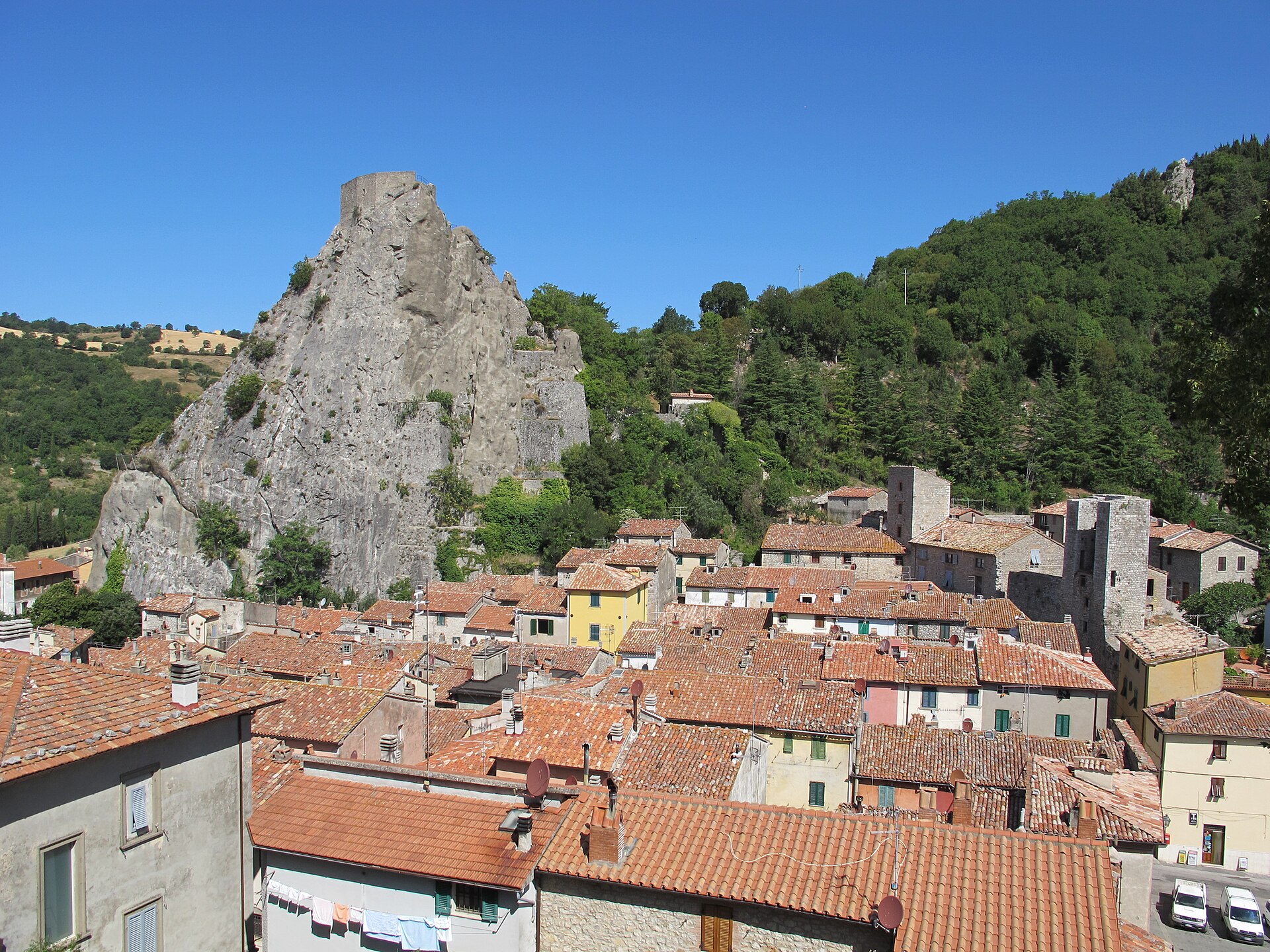
Roccalbegna stands at 522 m in the upper valley of the Albegna, on the southern edge of Monte Amiata. Two fortresses sit on the rock outcrops above the houses. Below them, in the parish church, are three panels by Ambrogio Lorenzetti.
That is the surprise. You do not expect a painter of Lorenzetti’s standing in a village this size. Yet his Madonna and Child stands at the high altar, flanked by St Peter and St Paul.
Come in late November and there is a second reason. In the hamlet of Santa Caterina, the Focarazza fire is lit on the evening of the 24th. It belongs with Amiata’s other winter fire rites, such as Abbadia’s Christmas Eve Fiaccole and Santa Fiora‘s Carboniere.
A Place Shaped by Time
Counts, Siena, and the Bichi
The Aldobrandeschi held Roccalbegna in the 13th century. By the end of that century it had passed to Siena, which kept it until the mid-16th century.
After the fall of the Sienese Republic, the Medici gave Roccalbegna to the County of Santa Fiora. In the second half of the 17th century it passed to the Bichi, a Sienese family. It later became a free comune of the Grand Duchy of Tuscany.
December 1943
Roccalbegna also carries a darker chapter, and it deserves to be told plainly. The Italian Wikipedia account of the town records that eight Jewish refugees, two of them children, were interned here between 1940 and 1943.
After the German occupation began in September 1943, all eight were arrested on 12 December 1943 and deported. According to the same account, all but one were killed at Auschwitz in the summer of 1944. Teresa Kapitz, who was taken to Bergen-Belsen, survived.
If you visit, it is worth pausing on this history. The eight refugees belong to the village’s story as much as its fortresses do.
What to See and Do
The Church of Santi Pietro e Paolo
The church is Gothic and was begun in 1296. Visit Tuscany notes its lopsided look: unstable ground has tilted the lintel over the door.
Inside, at the high altar, are three panels by Ambrogio Lorenzetti from around 1340. They show the Madonna and Child, St Peter, and St Paul. They once belonged to a larger polyptych that was later taken apart.
Take your time here. You see these panels in a working parish church rather than a gallery.
The Oratorio del Santissimo Crocifisso
Behind the church stands the Oratory of the Holy Crucifix, now a small museum. Its key piece is a painted Cross attributed to Luca di Tommè, from around 1360. According to Visit Tuscany, it also shows works by Francesco Nasini and Sebastiano Folli.
Opening times vary, so ask locally or check with the Comune before you plan around it.
The Rocca and the Cassero
Two fortifications stand on steep rock above the village. The Rocca Aldobrandesca recalls the counts who first held it. The Cassero Senese is the Sienese stronghold.
Steep paths lead up to them. Wear proper shoes, and allow extra time if you want to reach both.
The frazioni
The comune stretches well beyond the village. Triana is documented from 760, and its castle appears in the Aldobrandeschi division of 1216. The Cappella della Madonna di Loreto was the castle’s private chapel.
Cana is a medieval village above the Trasubbie valley, where the Aldobrandeschi built a fortress. Vallerona has Etruscan and Roman roots and grew as a farming settlement in the 16th century.
According to Visit Tuscany, the area also offers walks along the bed of the Albegna. Ask locally about routes before you set out.
The Focarazza of Santa Caterina
The Focarazza takes place on the evening of 24 November in Santa Caterina, a frazione (hamlet) of Roccalbegna. It is the vigil of the feast of St Catherine of Alexandria.
According to the Ministry of Culture’s intangible heritage institute, the day begins in the woods. In the morning the stollo, a long trunk of Turkey oak, is cut, and bundles of firewood are gathered. Through the day the wood is piled around the stollo.
In the evening the fire is blessed and lit. Then the men of the village compete for the stollo, in what is also called the Palio dello stollo. Each district tries to carry it home. The contest ends when the trunk is set on a house in the winning district.
According to the Italian Wikipedia account, the trunk is then cut into as many pieces as there were competitors. Each piece is burned in a home fireplace, and the ashes are scattered on fields and vegetable gardens. Santa Caterina also has a Museo della Focarazza.
Read the ICPI page on the Focarazza before you go, and confirm the evening’s program locally.
Eating Like a Local
The biscotto salato
Roccalbegna’s own bake is the biscotto salato (salted biscuit). It is made from flour, olive oil, anise seed, white wine, and salt, and shaped into a figure of eight.
The method is unusual. According to Agrodolce, the figure-eights are first boiled in salted water until they float, then baked. The result keeps well. It is listed as a PAT (prodotto agroalimentare tradizionale, a traditional agri-food product).
Buy a few to take home.
Oil and wine
Roccalbegna lies in both the Seggiano DOP olive oil area and the Montecucco wine zone. Seggiano DOP oil is made from at least 85% Olivastra Seggianese. Look for both on local menus and in local shops.
Getting There and Getting Around
By car
Roccalbegna sits in the upper Albegna valley, in the province of Grosseto. A car is realistically needed, especially if you want to add Santa Caterina or other villages in the same day.
By public transport
Autolinee Toscane runs the buses on the Grosseto side of Amiata. Services to small villages can be limited, so check the Autolinee Toscane timetables well ahead.
In the village itself, park and walk. The climb to the fortresses is on foot.
Nearby
- Semproniano: the neighboring village to the south, with the Templar legends of Rocchette di Fazio.
- Bosco dei Rocconi: a nature reserve of 371 ha along the Albegna, next to the hamlet of Rocchette di Fazio.
- Triana: a frazione of Roccalbegna, documented since 760, with a castle recorded by 1216.
- Santa Fiora: the old county town of the Sforza, known for its della Robbia terracottas and the December Carboniere fires.
- Castel del Piano: the Palio town, and the road up to the summit walks.
For a longer route, see 4 Days on Monte Amiata.
Information is provided in good faith and may change. Always confirm opening hours, prices, and event dates with the official source before you travel.