
Town · Monte Amiata
Castell’Azzara and Selvena
Dice, Cinnabar, and Karst Woods
Last updated:
- Region
- Monte Amiata
- Province
- Province of Grosseto
- GPS
- 42.767, 11.700
- Best season
- Summer and autumn (mine visits run on booked Saturdays)
- Time needed
- Full day
- Difficulty
- moderate (walking to the Rocca Silvana and mine)
- Known for
- Dice-game name, Villa Sforzesca, Selvena cinnabar mines, Rocca Silvana, Monte Penna nature reserve
A Town Won at Dice
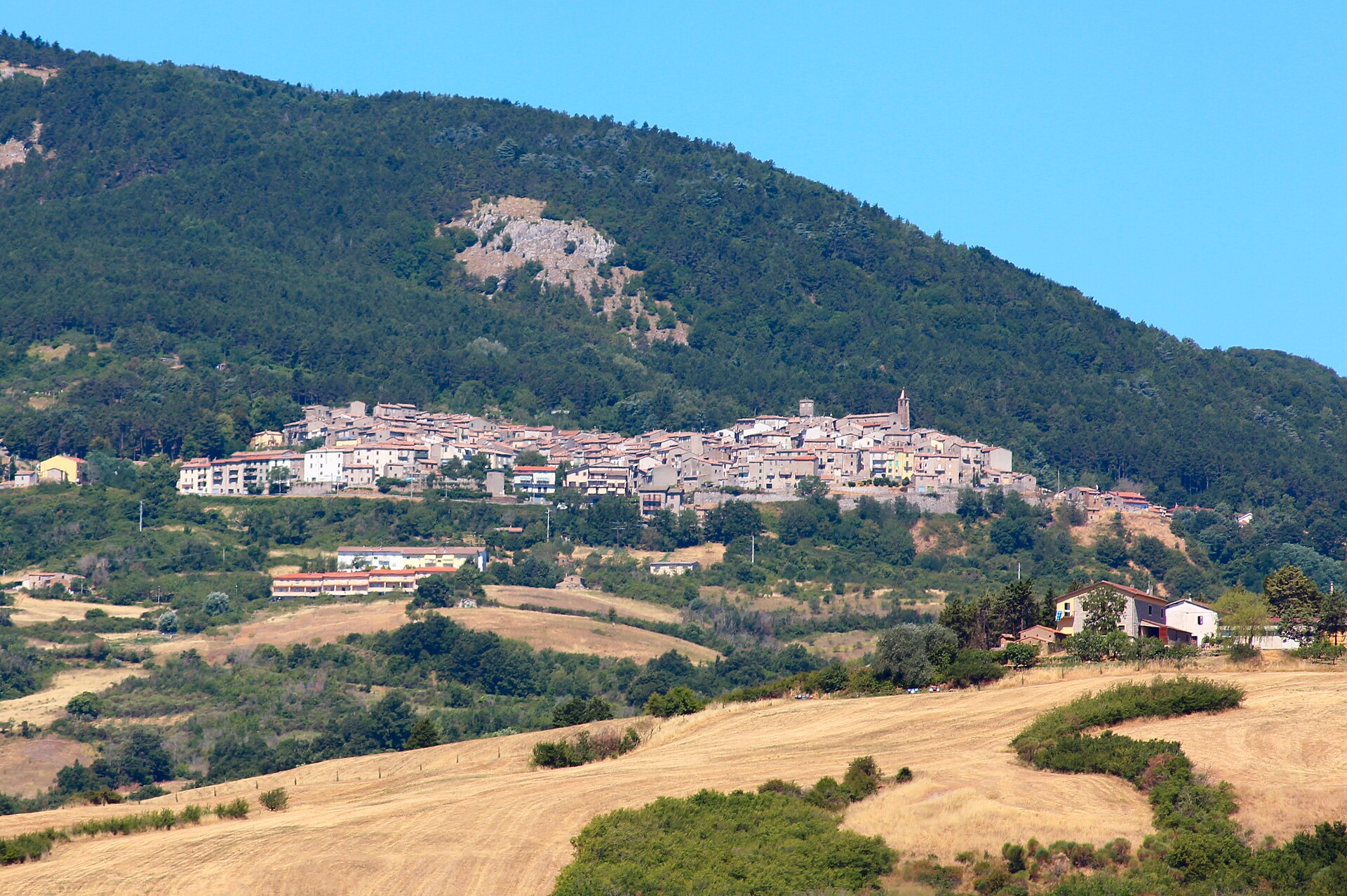
Castell’Azzara sits at 815 m on the slopes of Monte Amiata. It is the highest comune seat in the province of Grosseto. Its name, local tradition says, comes from a game of dice.
Within the same comune lies Selvena, a village built on cinnabar, the red ore of mercury. Here you can walk from a medieval castle to an abandoned mine with former miners as guides.
Between them rises the Riserva Naturale Monte Penna, a karst landscape of sinkholes and maple woods. Put the three together and you have a full day that has little to do with the Tuscany of the brochures.
A Place Shaped by Time
The game of zara
The Comune tells the story on its own website. Two Aldobrandeschi brothers disputed who owned the castle. They settled it with a game of zara, a medieval gambling game played with dice.
Whether or not it happened, the town has kept the story. Its coat of arms shows a red fortress with three towers, topped by three dice.
Aldobrandeschi, Baschi, and Sforza
The castle was founded in the 11th or 12th century. In 1216 it is recorded as part of the Aldobrandeschi lands.
In 1297 it passed to the Baschi, a family from Orvieto. It later returned to the Aldobrandeschi. In 1439 it went to the Sforza, through the marriage of Cecilia Aldobrandeschi and Bosio Sforza. That same marriage brought Santa Fiora to the Sforza.
A mining center
According to the Comune, Castell’Azzara was an important mining center in the 19th and 20th centuries. Cinnabar was the prize. The mines of the Selvena area closed in the early 1980s.
What to See and Do
Villa Sforzesca
At the locality of Sforzesca stands the Villa Sforzesca. According to the Comune, an inscription over the entrance dates it to 1576. It was built for Cardinal Alessandro Sforza. Tiberio Calcagni oversaw the work, and Giovanni Fontana took over after his death.
The villa has a rectangular plan around an inner courtyard, three floors, and a round-arched central doorway. It was restored around the year 2000. The Comune gives no visiting arrangements, so plan to see it from outside unless you confirm access locally.
Churches and the clock tower
In the town, the church of San Nicola di Bari is documented in 1276. It was rebuilt between 1841 and 1850. The Comune also lists the Torre dell’Orologio (clock tower) and the churches of the Madonna del Rosario and the Madonna della Pietraia.
In Selvena, the church of San Nicola da Tolentino was built in 1797 and consecrated in 1838. According to the Italian Wikipedia account, it replaced a pieve commissioned in 1238 by Countess Tomasia.
Selvena and its cinnabar
Selvena is a frazione (hamlet) of Castell’Azzara, and its story is mining. People worked cinnabar here in Etruscan and Roman times. In the modern era, the Morone and Siele mines were the big operations.
Both closed in the early 1980s, the Morone in 1981. According to the Italian Wikipedia account of Selvena, the closures caused a sharp fall in population.
The Rocca Silvana and the Morone mine
This is the visit to plan your day around. A guided walk links the Rocca Silvana with the Miniera del Morone (Morone mine) along the Sentiero del Cinabro (Cinnabar Trail).
The Rocca Silvana was an Aldobrandeschi castle, first recorded in the 9th century. According to Parco Amiata, its ruins still show massive walls and a tower.
At the Morone site you see the industrial remains, including the Spirek and Pacific furnaces of the old mercury works. According to the organizers, the site has been cleared of arsenic and mercury residues. The guides are trained environmental guides and former miners.
The visits run on Saturdays by booking, with a minimum group size. They are organized by the Amministrazione Separata Beni Uso Civico di Selvena. Book through the Parco Amiata page, which lists the current dates.
The Cornacchino galleries
Mining also shaped the Cornacchino area. Two of its galleries opened to the public in 2008. Ask locally about visits before you go.
Riserva Naturale Monte Penna
The Monte Penna reserve was set up in 1996 and covers 1,050 ha. Its high points are Monte Civitella at 1,107 m and Monte Penna at 1,086 m.
This is karst country. The Comune describes sinkholes, trench-like depressions, and some caves. There is an active sinkhole near Poggio della Vecchia, another name for Monte Penna.
The woods are mixed. The Bosco della Fonte holds a stand of four maple species. There are also beech, oak, and chestnut woods. Look up for the short-toed snake eagle, one of the reserve’s notable birds.
The Comune also mentions wild lilies. Mammals include roe deer, porcupines, and foxes.
Check the Comune’s reserve page before you go.
Palio dei Somari
Selvena holds a Palio dei Somari (donkey race) in mid-August. According to the Italian Wikipedia account, it takes place on 15 August between the village’s contrade, and the Gruppo Storico Casali Silbina has organized it since 2016. Confirm the program locally.
Eating Like a Local
Sweets of Castell’Azzara
The Comune lists three traditional sweets of the town: ciaramito, taglioli di Castell’Azzara, and topi di Castell’Azzara. Ask for them by name in local bakeries.
Oil and chestnuts
Part of the comune lies in the Seggiano DOP olive oil area. The oil is made from at least 85% Olivastra Seggianese. To meet one producer, read our profile of La Casina di Giannetto.
Castell’Azzara is also new to the Castagna del Monte Amiata IGP. New production rules in March 2026 added it to the protected chestnut area, with Semproniano and Sorano.
If you plan to pick mushrooms in the woods, you need a paid regional permit. The daily limit is 3 kg per person. Read the Regione Toscana rules first.
Getting There and Getting Around
By car
A car is realistically needed. You will want one to link Castell’Azzara, Selvena, the Monte Penna reserve, and the Villa Sforzesca in a single day.
By public transport
Autolinee Toscane runs the buses in the area, but services to small villages can be limited. Check the Autolinee Toscane timetables before you plan around them.
Nearby
- Santa Fiora: the Sforza county town, with its della Robbia terracottas and the springs of the Fiora.
- Piancastagnaio: across the Siena border, with its Rocca Aldobrandesca and August Palio.
- Semproniano: Rocchette di Fazio and October’s open cellars.
- Abbadia San Salvatore: the abbey town, with its own mining museum and tunnel.
For a longer route, see 4 Days on Monte Amiata.
Information is provided in good faith and may change. Always confirm opening hours, prices, and event dates with the official source before you travel.