
Town · Monte Amiata
Piancastagnaio
A Palio, a Rocca, and a Town Named for Chestnuts
Last updated:
- Region
- Monte Amiata
- Province
- Province of Siena
- Best season
- Summer for the Palio (August), autumn for chestnuts (around 1 November)
- Time needed
- Half day; a full evening on Palio or Crastatone dates
- Difficulty
- easy
- Known for
- Palio delle Contrade, Rocca Aldobrandesca, Crastatone chestnut festival, ricciolina tart, geothermal power
A Town With Chestnuts in Its Name
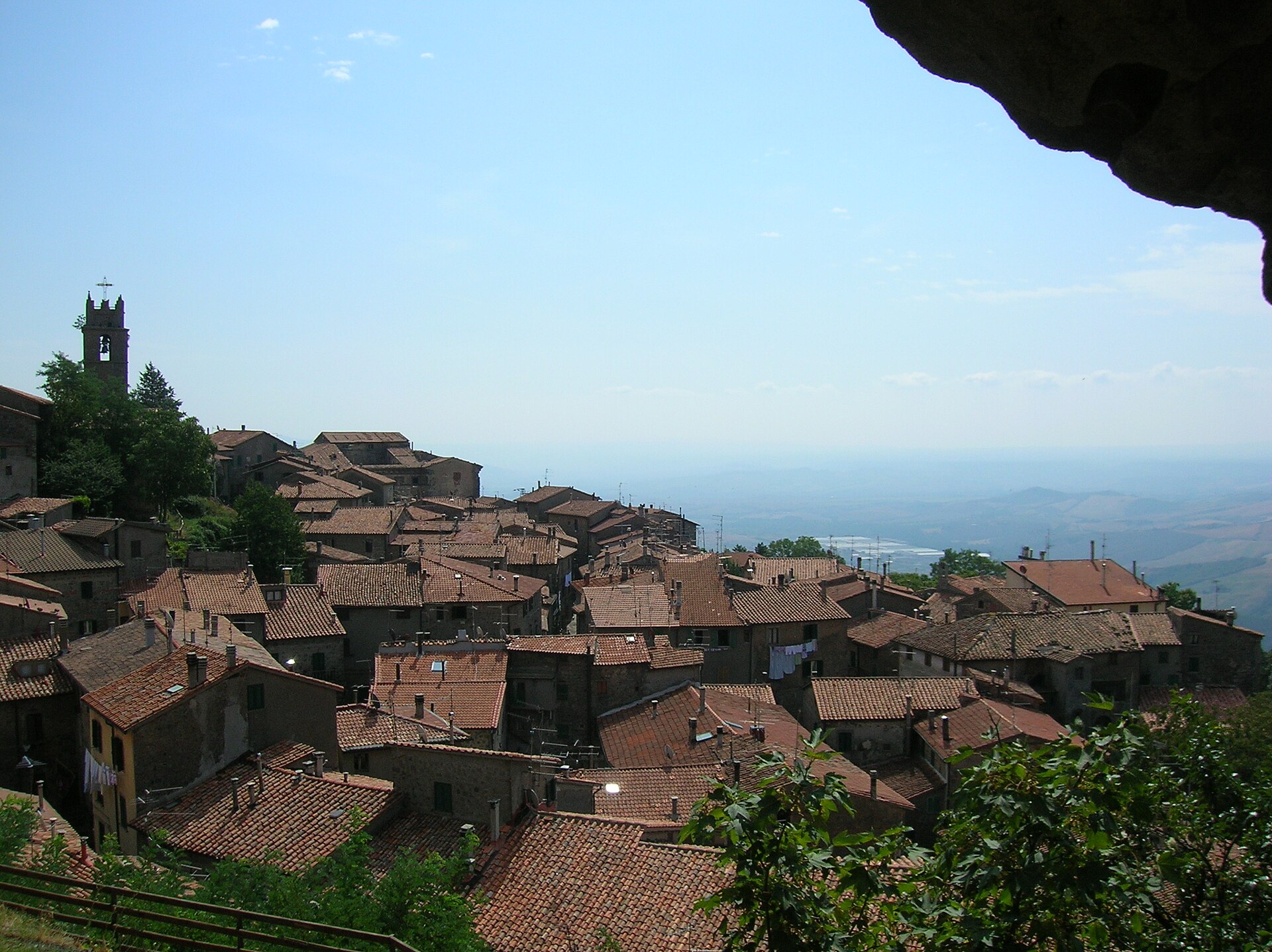
You can hear the Italian word castagna (chestnut) inside the name Piancastagnaio. That is a fair clue to what this town is about. It sits at 772 m on the Siena side of Monte Amiata, and its fortress overlooks the valley of the Paglia river.
It’s easy to treat Piancastagnaio as a stop on the way to the summit of Monte Amiata. That’s a mistake twice a year. In August, Piancastagnaio stages more than two weeks of Palio events that end in a bareback horse race. Around 1 November, it throws the Crastatone, a festival built entirely around the chestnut.
Outside those dates you still get a restored medieval fortress, a compact historic center, and a front-row view of Amiata’s modern economy: geothermal power. It’s a working town, not a showpiece, and that’s part of its interest.
A Place Shaped by Time
Abbey land, then the Aldobrandeschi
According to the Italian Wikipedia entry, the area belonged to the Abbey of San Salvatore from the 8th century. The abbey sat just up the hill in today’s Abbadia San Salvatore.
By the late 12th century Piancastagnaio already had a small fortified ring of walls. The Comune’s own history says that in the early 1200s the abbey granted the castle as a fief to Aldobrandino degli Aldobrandeschi. At that point it already had a small fortress, a tower, and a curtain wall.
According to Italian Wikipedia, Orvieto held sway here in the first half of the 14th century.
The statutes of 1416 and the Sienese century
In 1416 the town adopted its own statutes. It still remembers them every August with a Festa degli Statuti.
Piancastagnaio became part of the Republic of Siena in 1440. In the 1470s the Rocca was hardened against gunpowder. Work documented for 1471–1478 clad the lower part of the whole medieval building in a huge sloping base. The Comune calls it a kind of “jacket” (camicia).
The Bourbon del Monte marquisate
Siena itself fell to Florence in the 1550s. In 1601 the Grand Duke granted Piancastagnaio to Marquis Giovanni Battista Bourbon del Monte. According to Italian Wikipedia, the borders set then are still, in essence, the borders of today’s comune. The feudal arrangement ended in 1777.
The comune reaches well up the mountain. Its frazione of Saragiolo, for example, sits at 901 m, according to Italian Wikipedia.
Chestnuts, mercury, and steam
Amiata chestnuts are now protected as Castagna del Monte Amiata IGP, registered since 2000. The varieties are Marrone, Bastarda Rossa, and Cecio.
In the 20th century came mercury mining. Extraction wound down in the 1970s, and the Amiata concession ended in 1982. Then came geothermal energy. Enel Green Power runs the PC3, PC4, and PC5 plants at Piancastagnaio, fitted with AMIS filters. Enel has held open days at PC3.
The plants are debated locally, and we won’t pretend otherwise. The regional health agency ARS found higher male mortality in the area, falling in recent years. Its InVETTA study found no link to hydrogen sulfide and pointed to natural sources. Local groups still dispute the plants’ impact.
What to See and Do
The Rocca Aldobrandesca
The fortress stands in the historic center, above the Paglia valley. In 1962 Commendatore Gino Bigazzi bought it, intending to restore it.
The Comune’s account of that work is refreshingly honest. Workers built new floor slabs in the keep, reopened the castle’s entrance gate, and reused old wooden doors and iron grilles. They chose not to give the keep battlements.
Today the Rocca houses a museum and the town library. Opening times are limited, so check the Comune’s page on the Rocca before you go.
Palazzo Bourbon del Monte and the churches
According to Italian Wikipedia, the marquis built his palace here, the Palazzo Bourbon del Monte, crowned with gardens. The same source lists the convent of San Bartolomeo and the Santuario della Madonna di San Pietro. The sanctuary is one of the settings of the Palio procession.
Reading the old gates
The Comune also records how the medieval town worked. It had three entrances. “Lo stretto” on the west side served for refuse and funerals. The porta montanina faced south, and the porta di castello faced north. The tower beside the church of Santa Maria de Cuntaria served as both bell tower and defensive tower.
Knowing this changes a walk through the center. You start to see a defended village rather than a pretty one.
The Palio delle Contrade
Four contrade (districts) compete: Borgo, Castello, Coro, and Voltaia. The race usually runs on 18 August, bareback, for a painted banner called the cencio.
The race is only the end of a long build-up. According to the Ministry of Culture’s register of historical re-enactments, the season usually runs like this:
- 1 August: the Notte delle Bandiere (Night of the Flags)
- 10 August: the presentation of the Palio
- 12 August: the Festa degli Statuti, recalling the statutes of 1416
- 16 and 18 August: the historical procession
- 18 August: the race
The costumes draw on medieval and Renaissance Sienese imagery. The Ministry names Piazza Castello, Piazza Matteotti, and the Rocca as key settings, with processions reaching the Santuario della Madonna di San Pietro.
The prizes that aren’t the Palio
The race is not the only contest. The Cupello, a painted ceramic plate, goes to the contrada with the best overall showing in the historical procession. The “Asta e Bacchetta” rewards the best drummers and flag-bearers.
The modern Palio dates from 1954. For each year’s program, see the Ministry’s Palio page and the Magistrato delle Contrade.
The Crastatone
The Crastatone has run since 1967, around 1 November. It celebrates the chestnut in its local forms, each with its own name:
- Crastate: chestnuts scored and roasted
- Suggioli: chestnuts boiled
- Monne: chestnuts shelled and cooked with wild fennel
New production rules in March 2026 widened the IGP area to add Castell’Azzara, Semproniano, and Sorano.
Always check the Pro Loco’s Crastatone page before planning around it.
Eating Like a Local
Chestnuts, three ways
If you come for the Crastatone, learn the three words above. They’re the vocabulary of the whole festival.
Chestnuts for drying go into a seccatoio, the Amiata word for a drying house (elsewhere it’s a metato). That’s Amiata describes the method: chestnuts on a slatted floor over a slow fire, at about 30 °C, for about 40 days.
The ricciolina
The sweet to look for is the ricciolina. It’s a tart: shortcrust pastry, a chocolate-hazelnut cream, and meringue on top. It is linked to Piancastagnaio and neighboring Abbadia San Salvatore.
According to That’s Amiata, the ricciolina is a modern sweet born within the tradition. The site credits its creation to the Vinciarelli family of pastry chefs, from Abbadia and Piancastagnaio.
Mushrooms in the woods
Autumn is also mushroom season. If you want to pick your own, note the rules. Anyone picking in Tuscany needs a paid regional permit, and non-residents can buy one by the day or week. The daily limit is 3 kg per person, and plastic bags and rakes are banned. Read the Regione Toscana rules first.
Getting There and Getting Around
By car
A car is the realistic choice here, especially for a multi-village day. Piancastagnaio sits on the Siena side of the mountain, close to Abbadia San Salvatore. The Grosseto-side towns are reached around the mountain.
By train and bus
The nearest main-line station is Chiusi-Chianciano Terme, on the Florence–Rome line. From there, Autolinee Toscane line FT9 runs Chiusi Stazione–Sarteano–Radicofani–Abbadia/Piancastagnaio. Tiemme operates it for AT.
Services are limited, so plan carefully. Check current timetables on at-bus.it.
Where to stay
Abbadia and Santa Fiora have the widest choice of places to stay on the mountain. Both make a practical base for Piancastagnaio. Our 4 days on Monte Amiata itinerary shows how to combine the towns.
Nearby
- Abbadia San Salvatore: the abbey town next door, with its crypt, the Codex facsimile, and the Christmas Eve Fiaccole.
- Santa Fiora: the Sforza town on the Grosseto side, built around the springs of the Fiora.
- Campiglia d’Orcia: a limestone village of ring-shaped streets, with its own chestnut festival in late October.
- Radicofani: the Val d’Orcia fortress town on the FT9 bus route.
- Bagni San Filippo: the hot-spring hamlet about 3 km from Campiglia.
Information is provided in good faith and may change. Always confirm opening hours, prices, and event dates with the official source before you travel.