
Itinerary · 4 days · Monte Amiata
4 Days on Monte Amiata
A Chestnut-Season Loop Around the Volcano
Last updated:
- Duration
- 4 days
- Best season
- Autumn (October to early November, chestnut season)
- Budget
- mid-range
- Best for
- Couples, solo travelers, and small groups who like history, food, and walking
- Driving required
- yes
This route circles Monte Amiata clockwise, from the north on the Siena side to the olive slopes of the Grosseto side. It is built for autumn, when the chestnut festivals run from mid-October into early November. You will not catch every festival in one trip, so pick your dates and then check each Pro Loco page. The plan uses two bases: Abbadia San Salvatore for the first two nights, and Santa Fiora for the last two. You need a car.
Day 1: Campiglia d’Orcia and Vivo d’Orcia
Campiglia and the Campigliola Tower
Morning: Start in Campiglia d’Orcia, at 810 m on a limestone outcrop. Walk its four ring-shaped streets, which follow a plan older than the year 1000. Then step into the Pieve di San Biagio. It holds a standing Madonna with the Child giving the keys to St Peter. The painter was Sebastiano Folli of Siena (1569–1621).
From the village, a restored dry-stone path leads to the ruins of Campigliola. This tower was a Visconti stronghold that watched the Via Francigena. Local legend says fairies reaped the wheat here on June nights.
The history is lively. In 1234 Siena burned Campiglia’s castle after Pepo di Tancredi, one of its Visconti lords, changed sides. In 1432 Siena resettled the village with families from the Val d’Arbia and paid for new walls.
Lunch: If you are here on the last Sunday of October, stay for the Festa del Marrone (chestnut festival). It has run since 1978, and the village’s three rioni (districts), Agitati, Borgassero, and Dentro, take part. On other days, pack a picnic.
Vivo d’Orcia and the Eremo
Afternoon: Drive to Vivo d’Orcia, at around 900 m. The village began as the Eremo del Vivo (hermitage of the Vivo), first recorded in a papal bull of 1113. Tradition credits St Romuald as founder, but no document confirms it.
The hermitage had two sites. San Benedetto, above, is today’s Ermicciolo, a small single-nave Romanesque oratory. San Pietro stood below. When Pope Pius II came to see the source of the Vivo in late July 1462, he found both houses deserted.
In 1538 the empty monastery passed to Marcello Cervini. He became Pope Marcellus II in April 1555 and died after 22 days. Palazzo Cervini is still owned and lived in by the family, so you see it from outside. The church of San Marcello carries the Cervini arms on its façade.
Then follow the water. The Ermicciolo spring gives about 180 liters a second. In 1914 Vivo water reached Porta San Marco in Siena through about 63 km of cast-iron pipe. A riverside path links the Eremo and the Ermicciolo. The woods here also hold native silver fir. According to the Pro Loco, it is one of the few surviving native stands in Tuscany.
If you visit in mid-October, look for the Sagra del Fungo e della Castagna (mushroom and chestnut festival). It runs over two Sundays, with a woodcutters’ contest between the rioni Le Caselle and Il Pian delle Mura.
With extra time, the hot springs of Bagni San Filippo are about 3 km from Campiglia.
Dinner: Drive on to Abbadia San Salvatore.
Sleep: Abbadia San Salvatore. Abbadia and Santa Fiora have the widest choice of places to stay on the mountain.
Day 2: Abbadia San Salvatore and the Summit
The Abbey and Its Crypt
Morning: Begin at the Abbey of San Salvatore in Abbadia San Salvatore, at 822 m. Tradition says the Lombard Ratchis founded it in 742–743, beside a fir tree. Treccani considers the charters behind that story to be 11th-century forgeries. The abbey is documented from 762, and a Friulian noble called Erfo is regarded as its real founder.
The church was consecrated on 13 November 1035 under Abbot Winizo. Its façade stands between two towers: the left one crenellated, the right one unfinished. Inside, look for the late-12th-century wooden Christus Triumphans. The chapel frescoes are by Francesco Nasini and his brother Antonio Annibale, painted in 1652–53.
Go down into the crypt. It has more than thirty columns, and the capitals vary. One is carved as a Gordian knot.
The Codex Amiatinus
The abbey museum holds a full-size facsimile of the Codex Amiatinus, made in 1999–2000. The original was made at Wearmouth-Jarrow in England for Abbot Ceolfrith. It is generally regarded as the oldest surviving complete one-volume Latin Vulgate. Ceolfrith died at Langres in September 716, on his way to Rome.
By the 9th–10th century the book was on Amiata. Its dedication had been altered to “Petrus Langobardorum”. In 1888 G.B. de Rossi restored the original reading and proved it English. The Codex has more than 1,000 parchment leaves, each about 50 × 34 cm. It has been in the Biblioteca Medicea Laurenziana in Florence since 1785.
The museum also holds the chasuble of Pope St Mark and a Scoto-Irish reliquary of the 7th–8th century.
Lunch: Eat in Abbadia. For dessert, ask for ricciolina, a tart of shortcrust, chocolate-hazelnut cream, and meringue linked to Abbadia and Piancastagnaio.
Mercury and the Mountaintop
Afternoon: Book ahead for the Parco Museo Minerario (mining museum park), then give it the early afternoon. The first mercury furnace was lit here on 31 January 1899. According to the Pro Loco, the area produced about a quarter of the world’s mercury in 1900–1920. Extraction wound down in the 1970s, and the concession ended in 1982.
The documentary museum is in the Torre dell’Orologio. Miners’ trains take you about 250 m into the Galleria Livello VII tunnel. “I Luoghi del Mercurio” is a multimedia museum by Studio Azzurro, opened in 2016. Check the museum page for times and booking.
Later, take the paved road from Abbadia to the summit, at 1,738 m. The 22 m cross came from Luciano Zalaffi’s Siena workshops and was inaugurated on 18 September 1910. Retreating German troops brought it down on 17 June 1944. It was rebuilt and re-inaugurated in 1946.
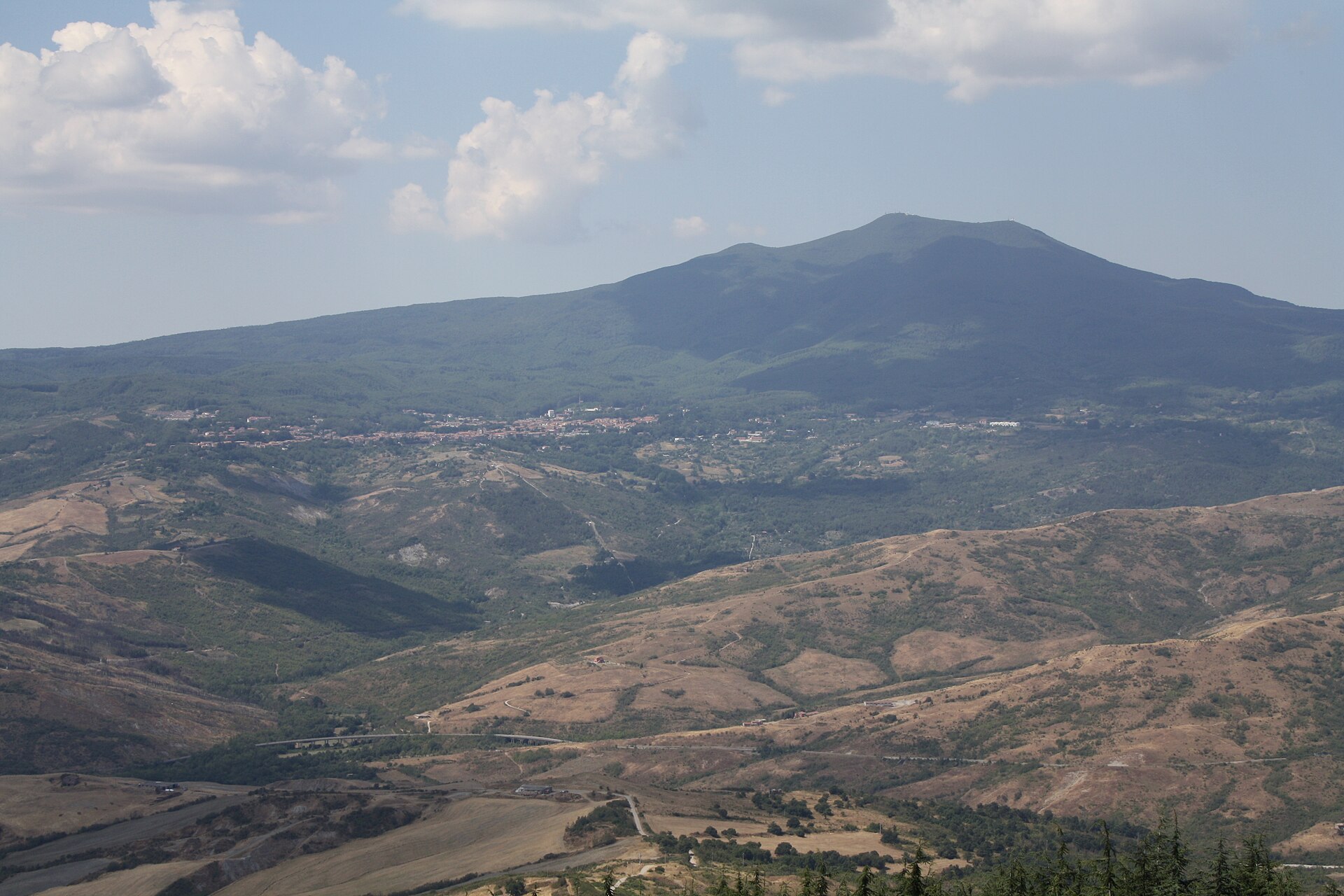
Up here you are standing on an extinct lava-dome volcano. Its main eruptions date to roughly 300,000 years ago.
Dinner: Back in Abbadia.
Sleep: Abbadia San Salvatore.
Day 3: Piancastagnaio and Santa Fiora
Piancastagnaio
Morning: Drive south to Piancastagnaio, at 772 m. Walk up to the Rocca Aldobrandesca, the fortress of the Aldobrandeschi counts.
Piancastagnaio is also a geothermal town. Enel Green Power runs the PC3–PC5 plants here, fitted with AMIS filters, and has held open days at PC3. Their impact is still debated locally, so our region hub sets out what the health studies found.
Lunch: Time your trip for the Crastatone if you can. This chestnut festival falls around 1 November and has run since 1967. Order crastate (scored, roasted chestnuts), suggioli (boiled chestnuts), and monne (shelled chestnuts cooked with wild fennel). Dates vary, so check the Pro Loco page.
Santa Fiora and Its Springs
Afternoon: Continue to Santa Fiora, at 687 m. The historic center has a limited-traffic zone, so park outside and walk in.
Santa Fiora was the seat of a county. It passed from the Aldobrandeschi to the Sforza in 1439, and in 1633 the Sforza sold sovereignty to the Medici. The town is still divided into three terzieri (districts): Castello, Borgo, and Montecatino.
Start at the Pieve delle Sante Flora e Lucilla. Its glazed terracottas are by Andrea della Robbia and workshop, from the late 15th century. They include a triptych of the Coronation of the Virgin, a Baptism of Christ, and a Madonna della Cintola. The pulpit reliefs show the Last Supper, the Resurrection, and the Ascension.
Then walk to the Montecatino district. The Peschiera is a 16th-century reservoir that collects the springs of the Fiora. In the nearby church of the Madonna della Neve, glass panels in the floor show the water running underneath.
If you are here in early November, Santa Fiora holds its own Festa del Marrone.
Dinner: Santa Fiora lists acquacotta and polenta di castagne (chestnut polenta) among its local foods. Look for them on menus.
Sleep: Santa Fiora.
Day 4: Arcidosso and Seggiano
Arcidosso, Monte Labbro, and Merigar
Morning: Drive to Arcidosso, at 679 m. Its castle, the Castello Aldobrandesco, houses MACO, the Museum of Oriental Art and Culture, opened in 2016.
Arcidosso was the home of David Lazzaretti, a carter born here in 1834. After a vision in 1868, he built a dry-stone tower on Monte Labbro (1,193 m) between 1869 and 1870. His followers formed a mutual-aid society from 1872. On 18 August 1878 police forces fired on his procession at Bagnore, and he was shot in the forehead. Three followers also died. In 1879 a Siena court acquitted all 23 followers on trial. A small community of about ten people still follows his teaching.
Head up Monte Labbro, now a nature reserve, to see the tower. Then look in at Merigar West, the Buddhist center founded in 1981 by Chögyal Namkhai Norbu. The Dalai Lama inaugurated its Gönpa (temple) in May 1990. The Great Stupa, built in 1998, has held Norbu’s remains since 2018. Most activities are open to everyone, but some retreats are restricted, so check Merigar’s site first.
In a 2019 profile, That’s Amiata described Angelo Frosolini of Montelaterone, a frazione of Arcidosso. He had kept a fire-dried chestnut seccatoio going for more than 40 years. The Castagna del Monte Amiata IGP association was founded in Arcidosso in 2000.
Lunch: Eat in Arcidosso before heading north.
Seggiano: Art and Olives
Afternoon: Drive on to Seggiano, at 491 m. Start at the Giardino di Daniel Spoerri, opened in 1997 on about 16 ha. It holds more than 110 works by about 55–60 artists. Look for Olivier Estoppey’s Dies Irae: 160 concrete geese driven by three masked drummers, each 3.5 m tall. Spoerri died in 2024, aged 94. Opening times vary by source, so check the garden’s site.
Seggiano’s Sanctuary and Olive Groves
Seggiano was founded in the early 10th century as a possession of the Abbey of San Salvatore, which you saw on Day 2. It was Sienese from the 13th century and stayed with the Republic of Siena until 1555. Today it is one of the seven comuni of the Montecucco wine zone.
In town, see the sanctuary of the Madonna della Carità. Builders from Lugano raised it in 1588–1603 after a vow to end a famine.
End with the olives. Seggiano DOP oil must be at least 85% Olivastra Seggianese. Our profile of La Casina di Giannetto introduces one family grower. The farm takes its name from Giannetto, a small donkey, and its groves between Seggiano and Montegiovi include centuries-old trees. According to That’s Amiata, the harvest runs from about 20 October to 20 November, right in chestnut season. To ask about their oil, use the contact form on their website.
Dinner: Back in Santa Fiora, or at your next stop if you are moving on.
Sleep: Santa Fiora.
Other Seasons
Winter: The Fire Festivals
Late November and December bring fire to the mountain. On the evening of 24 November, the Focarazza burns at Santa Caterina, a frazione of Roccalbegna. A bonfire is built around an oak trunk, the stollo, and the districts then compete to carry it home.
On 24 December Abbadia lights the Fiaccole. More than 30 wood pyramids, up to 7 m high, are built from around 8 December. After the blessing of the fire, the first is lit at 18:00 in front of the Palazzo Comunale. People sing pastorelle (shepherds’ songs). The vigil is meatless, with vin brûlé and anise biscuits, and meat comes after midnight Mass.
On 30 December Santa Fiora holds the Carboniere. Wood pyres burn around the old town, and the first is lit from miners’ acetylene lamps. The rite was revived in 1977.
Skiing is possible, but snow is unreliable, and lifts stayed shut in some recent winters. Check I.S.A. or Amiata Impianti Senese before you plan a ski day.
Summer: Palios and the Ring Trail
On 18 August Piancastagnaio’s four contrade race bareback for the painted cencio. The race closes a month of events that begins with the Notte delle Bandiere on 1 August. On 12 August the town recalls its statutes of 1416. See the Palio page.
On 8 September Castel del Piano runs its own Palio on the Marian patronal feast. The bareback race is run in Piazza Garibaldi, on a course built in imitation of Siena’s Piazza del Campo. Its first documented race was on 7 July 1771.
In summer you can also walk the Anello del Monte Amiata, CAI trail 601. It runs about 29 km, mostly at 1,000–1,300 m, through chestnut and beech woods. Allow 6–8 hours and carry everything, since there are no services on the way. Abbadia is one access point. See the trail page.
Practical Tips for This Route
Driving and Public Transport
You realistically need a car for this route. Buses can reach single towns, but not several in a day.
If you arrive by train, the nearest stations are Chiusi-Chianciano Terme, on the Florence–Rome line, and Buonconvento, on the Siena–Grosseto line. Autolinee Toscane runs the buses. Line FT9 links Chiusi station with Abbadia and Piancastagnaio via Sarteano and Radicofani. Line 54A links Abbadia with Siena via Castiglione d’Orcia. Line 42A serves Arcidosso. Check the AT timetables.
Bookings and Rules
- Book the mining museum in Abbadia in advance.
- Park outside Santa Fiora’s limited-traffic zone.
- Buy a regional permit before picking mushrooms. The daily limit is 3 kg per person, and plastic bags and rakes are banned. See the Regione Toscana rules.
- Check each Pro Loco page for festival dates before you fix your trip.
Adapting the Route
If you have a fifth day, add the southern Grosseto side. Visit Semproniano and Castell’Azzara and Selvena, where guided visits link the Rocca Silvana with the old Morone cinnabar mine. Coming from the Val d’Orcia? Our Val d’Orcia hub covers the valley you will cross first.
Information is provided in good faith and may change. Always confirm opening hours, prices, and event dates with the official source before you travel.