
Town · Lunigiana
Podenzana, Casola, and Zeri
Three Villages Where One Tradition Defines Everything
Last updated:
- Region
- Lunigiana
- Province
- Province of Massa-Carrara
- GPS
- Various (see individual sections)
- Best season
- August for Podenzana's sagra; autumn for Casola's chestnut harvest; spring and summer for Zeri's mountain pastures
- Time needed
- Each village: 1–2 hours. All three in a day: a long but rewarding circuit
- Difficulty
- easy
- Known for
- Panigacci (Podenzana), Marocca di Casola bread (Casola), Zerasca lamb (Zeri) — three Slow Food traditions in three small villages
Some villages in Lunigiana have castles and Baroque palaces. These three have something harder to find: a single food tradition so specific, so rooted in the exact conditions of the place, that it defines the village entirely. Podenzana is panigacci. Casola is a bread made of chestnuts and potatoes. Zeri is a near-extinct sheep whose lamb tastes of mountain herbs. Each tradition depends on a small number of people — in Casola’s case, literally one man — and each exists because of geography, stubbornness, and the particular Lunigianese refusal to let useful things die.
Podenzana: the panigacci village
Population ~2,100 | Elevation 312 m | GPS: 44.2064, 9.9181
Podenzana is a small town on a ridge above the lower Magra, and its identity is entirely inseparable from panigacci — unleavened flatbreads cooked between stacked terracotta discs (testi) heated over wood fire. The technique is ancient and specific: the batter (flour, water, salt) is poured into the concave discs, the discs are stacked into a column, the column is placed on embers, and the heat radiates through the terracotta to cook the bread simultaneously in every layer. The result — thin, slightly charred, faintly smoky — is served hot with stracchino cheese and cured meats, or boiled and dressed with pesto in the Ligurian manner.
The distinction from testaroli matters: panigacci use terracotta testi rather than cast-iron, and the result is denser and thinner — a flatbread rather than a pasta. The Panigaccio di Podenzana is listed in Slow Food’s Ark of Taste, recognizing its cultural and culinary value.
The Sagra del Panigaccio is held every August; check the dates with the Pro Loco each year. In 2020 it received the national “Sagra di Qualità” mark from UNPLI, the Italian Pro Loco union — a mark of authenticity in a country where food festivals range from genuine to commercial. During the sagra, Podenzana fills with visitors eating panigacci at communal tables, and the stacking and firing of testi becomes a public spectacle.
La Gavarina D’Oro restaurant is the most celebrated panigacci destination year-round — not just in Podenzana but in all of Lunigiana.
For centuries, millet and chestnut flour were the staples of this mountain diet, and panigacci belong to that tradition of poor, practical food. That history strips the tradition of any nostalgia: panigacci are not quaint. They are survival food refined into something worth traveling for.
Casola in Lunigiana: the bread that one man keeps alive
Population ~900 | Elevation 328 m | GPS: 44.2003, 10.1731
Casola in Lunigiana sits at the gateway to the Apuan Alps — a village of roughly 900 people at 328 meters, surrounded by chestnut forests that once fed the entire mountain population. Its identity has contracted to a single extraordinary fact: the Marocca di Casola — a dense, dark bread made from chestnut flour, wheat flour, and boiled potatoes, leavened with sourdough and baked in a wood oven — is a Slow Food Presidium produced by a single baker.
Fabio Bertolucci of Il Forno di Canoàra, in the Casola countryside, is the sole producer. He revived the recipe, he bakes the bread, and if he stops, the Marocca stops. This is not marketing drama; it is the literal situation. The bread itself is unlike anything in the standard Italian repertoire — dense, naturally sweet from the chestnut flour, moist from the potato, with a dark crust from the wood oven. It keeps for several days and improves with age, which was the point: mountain populations needed bread that would last.
The chestnut flour that goes into Marocca is part of the broader Farina di Castagne della Lunigiana DOP tradition — chestnuts dried in stone gradili for at least 25 days over slow chestnut-wood fires, then stone-milled. But the Marocca adds the potato and the specific baking technique that make it unique to Casola.
Beyond the bread, Casola is the most direct access point from Lunigiana into the Apuan Alps Regional Park (UNESCO Global Geopark). The mountains above the village are serious hiking territory — marble peaks, karst formations, and alpine flora at surprisingly southern latitudes. The nearby Val di Lucido, above Equi Terme, is one of the most scenic approaches.
The village itself is modest — stone houses, a parish church, the particular quiet of a depopulated mountain settlement. Come for the bread, come for the hiking access, and understand that both are expressions of the same thing: a mountain village that has always had to make do with what the landscape provides.
Zeri: the shepherdess and the last flock
Population ~900 | Elevation 750 m | GPS: 44.3547, 9.7725
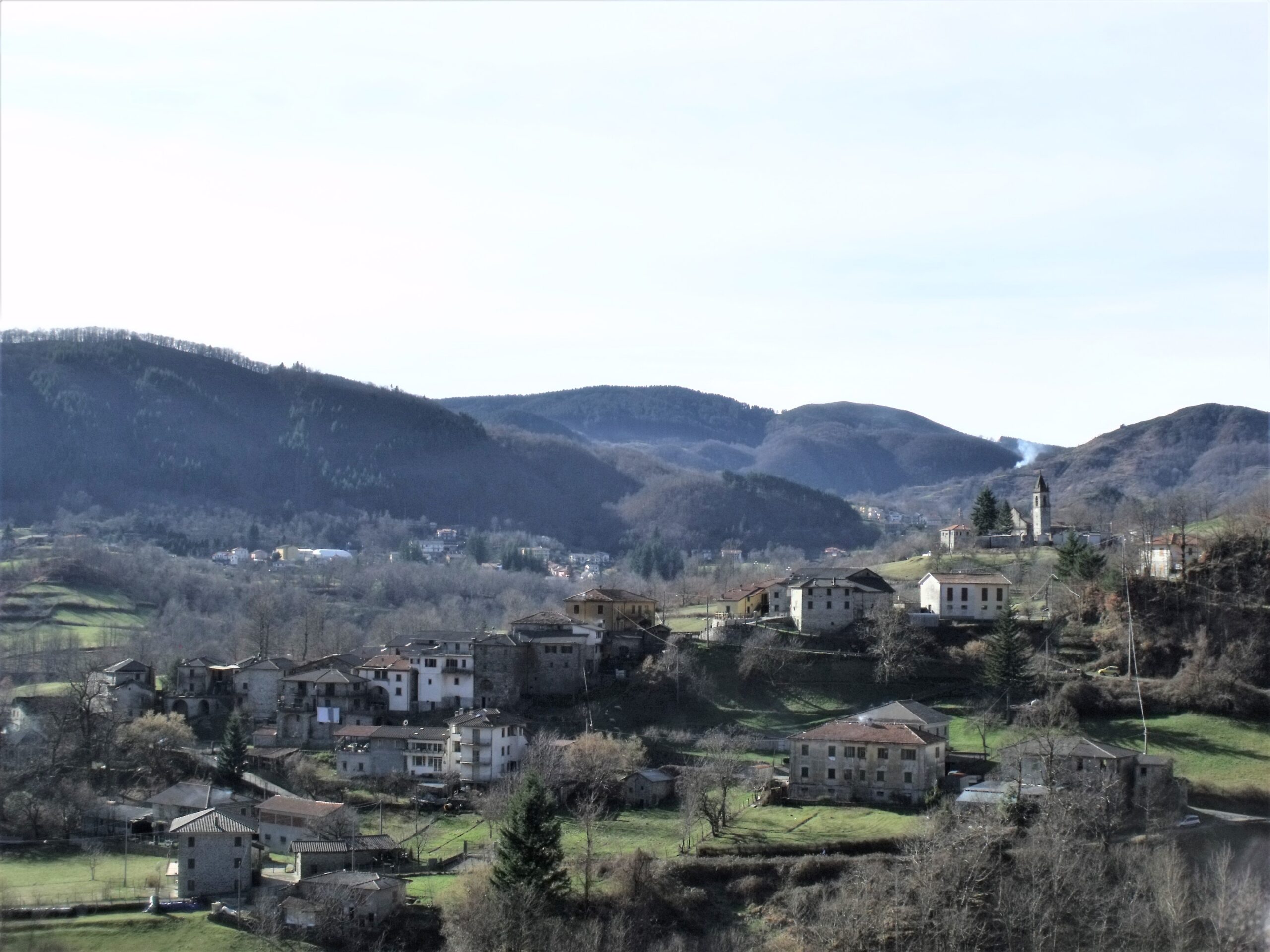
Zeri is Tuscany’s westernmost municipality — a spread of mountain pastures, forests, and tiny hamlets at 750 meters and above, where the Ligurian Apennines push the border with Liguria to its narrowest point. It is also the home of the Zerasca sheep, an endangered breed — only around 380 head were counted in 2023 — adapted over centuries to the specific conditions of these high pastures: thin soils, harsh winters, limited shelter.
The Agnello di Zeri (Zeri lamb) is a Slow Food Presidium. The lambs are raised on their mothers’ milk and on mountain pastures, mostly above 800 meters, and their meat is prized for its tenderness and delicate flavor. The flavor comes instead from the wild herbs of the mountain meadows — a direct expression of altitude and terrain.
The consortium protecting the breed, founded in 2001, is chaired by Cinzia Angiolini, a shepherdess whose flock includes more than a hundred Zerasca ewes. The Zerasca is still at risk; the breed survives because a handful of people — Angiolini chief among them — decided it was worth the work of maintaining an animal that produces less than industrial breeds but belongs to this specific landscape in a way no imported sheep ever will.
Zeri is also, improbably, a ski destination. The Zum Zeri ski area (1,300–1,600 m, 6 runs, 8 km of pistes, 3 lifts) is tiny by Alpine standards but offers something no Alpine resort can: skiing with sea views. On clear days, the Ligurian Sea is visible from the upper slopes. It is a small area that works largely as a big ski school, and its season depends on snowfall, so check conditions before driving up.
Beyond skiing and sheep, Zeri is simply one of the most remote and atmospheric municipalities in Tuscany. The mountain pastures above the hamlets, the chestnut forests below, the near-total absence of tourism infrastructure — this is Lunigiana at its most elemental. Come to eat lamb, to ski with a sea view, or simply to experience the edge of Tuscany that most maps forget.
Practical information for all three
Podenzana: Reached from the A15 (Aulla exit), about 15 minutes uphill. No train. Come for lunch at La Gavarina D’Oro, or time your visit for the mid-August sagra.
Casola: Reached from Aulla via mountain road, about 25 minutes. The Aulla–Lucca railway passes through nearby stations but Casola itself requires a car. Buy the Marocca from Il Forno di Canoàra, which also sells in Regnano on set days — call ahead to confirm the baking schedule.
Zeri: Reached from Pontremoli via winding mountain road, about 40 minutes. No public transport. This is the most remote of the three and requires commitment — but the mountain landscape and the sense of genuine isolation reward the drive.
As a circuit: Podenzana, Casola, and Zeri can be combined in a long day trip from either Aulla or Pontremoli. Start with Podenzana (closest to the valley floor), drive to Casola (moving into the mountains), then Zeri (deepest into the highlands). Each stop is 1–2 hours. The driving itself is part of the experience — narrow roads through chestnut forests, valley views opening and closing, the gradual transition from river plain to mountain pasture.
Nearby (from any of the three)
Aulla — The transport hub connecting to Cinque Terre and the coast. Fifteen minutes from Podenzana, twenty-five from Casola.
Fivizzano — The Florence of Lunigiana. Twenty minutes from Casola.
Pontremoli — The cultural capital. Forty minutes from Zeri, twenty from Podenzana.
Equi Terme — Caves, thermal springs, and the Solco di Equi gorge. Twenty minutes from Casola.
Information is provided in good faith and may change. Always confirm opening hours, prices, and event dates with the official source before you travel.