
Town · Monte Amiata
Semproniano
Templar Legends and Open Cellars in Southern Amiata
Last updated:
- Region
- Monte Amiata
- Province
- Province of Grosseto
- GPS
- 42.717, 11.533
- Best season
- Autumn (open cellars in October); spring
- Time needed
- Half day to full day with the frazioni
- Difficulty
- easy
- Known for
- Rocchette di Fazio, Templar legends, Il Risveglio delle Cantine, centuries-old olive trees, Bosco dei Rocconi
Where Amiata Turns Toward the Maremma
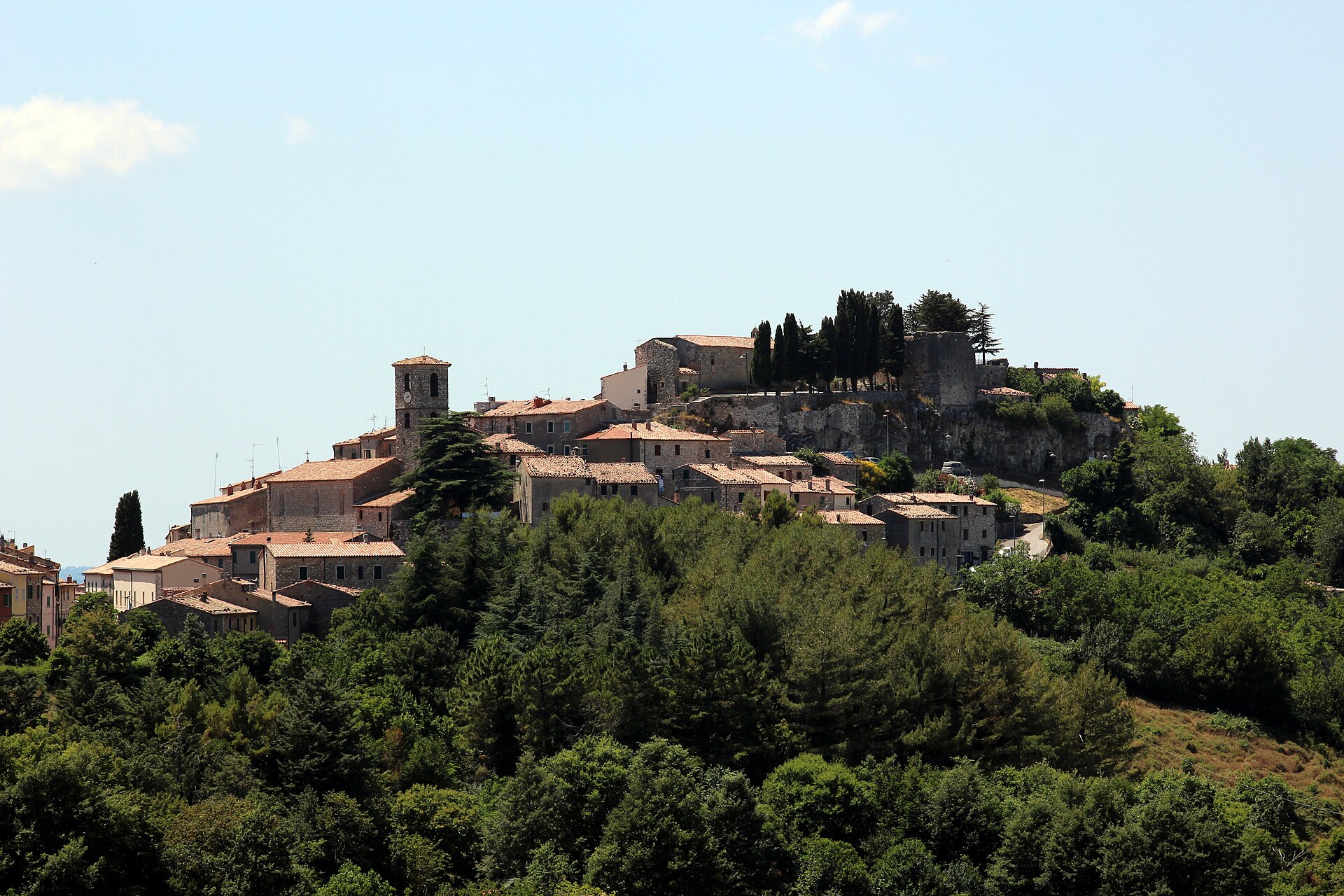
Semproniano stands at about 622 m on the southern edge of Monte Amiata. South of here, the land drops toward Pitigliano, Manciano, and the Maremma.
The village itself is small. Its real draw is the territory around it. Think of the hamlet of Rocchette di Fazio on its limestone spur, the castle of Catabbio, and the Bosco dei Rocconi reserve along the Albegna.
Come in October and you can add the Risveglio delle Cantine, when local cellars open their doors. Come any time and you can see the olive trees that a new project is trying to save.
A Place Shaped by Time
A Roman name and a medieval county
Tradition links the name Semproniano to the Roman gens Sempronia, a Roman family. It is a tradition, not a proven fact. Remains of an Etruscan farm have been found near Rocchette di Fazio, so the area was lived in long before the Middle Ages.
Records of Semproniano go back to before the year 1000, when it was an Aldobrandeschi possession. It submitted to Siena in the mid-14th century.
Decline and a comune again
After a brief Spanish conquest in the 16th century, the village became part of the Grand Duchy of Tuscany. A long period of decline followed.
For a time Semproniano was absorbed into Roccalbegna. It became its own comune again on 29 January 1963.
What to See and Do
The village center
Start at the Pieve dei Santi Vincenzo e Anastasio. It was built in the 13th century and restored in the 16th.
The church of Santa Croce is medieval, with a neo-Gothic restoration from the 20th century. Nearby stand the Palazzo del Vicario Mediceo (Palace of the Medici Vicar) and the ruins of the Rocca aldobrandesca (the Aldobrandeschi fortress).
Rocchette di Fazio
Rocchette di Fazio is the reason to linger. It lies about 3 km west of Semproniano on a limestone spur. Before the year 1000 it was called simply “Rocchetta”. It later took its name from Fazio Cacciaconti.
The Aldobrandeschi held it in the 13th century. In the 14th it passed through the hands of the Baschi and Orsini families, and in the 15th it came under Siena.
The Pieve di Santa Cristina dates from the 13th century and is no longer used for worship. Above its door is a cross carved in relief. Local tradition links it to the Knights Templar.
The Palazzo dell’Ospedaletto is a medieval building. According to the Italian Wikipedia account of the hamlet, it may have served as a Templar outpost. Carvings on its walls are read as Templar symbols. Treat this as legend. It is still a good story.
Walk through the medieval castle gate and around the Aldobrandeschi castle. A restoration of the historic center was completed in 1998.
The Bosco dei Rocconi
Right beside Rocchette di Fazio is the Bosco dei Rocconi nature reserve. It covers 371 ha along the Albegna. Part of it is a WWF oasis.
Check the reserve’s access rules locally before you set out, and stay on marked paths.
Catabbio, Cellena, and Petricci
Catabbio lies near the fork where one road leads to Pitigliano and the other to Manciano. The village grew up near an Aldobrandeschi castle built after the year 1000.
Cellena is a small farming village below the Ripa di Cellena. At 881 m, the ripa is the main high point of the comune.
Petricci is a recent settlement, though the history of its land goes back to the 9th century.
Il Risveglio delle Cantine
The Risveglio delle Cantine (the Awakening of the Cellars) is organized by the Pro Loco of Semproniano. It runs over three days in October in the historic center.
Local cellars open for wine tastings, with roaming musicians in the streets. There are also craft stalls and guided walks through the village. On the Sunday, the best local cellar is named.
Dates change each year, so check the event listing and the Pro Loco before you go.
Eating Like a Local
Adotta un Olivone
Semproniano’s old olive trees are the subject of “Adotta un Olivone” (Adopt a Big Olive Tree). According to Il Giunco, the project is promoted by Slow Food Grosseto. It aims to recover the village’s centuries-old olive trees, support local farmers, and stop the groves from falling into neglect.
The project was presented at Terra Madre in 2026. If you want to take part, follow the project through Slow Food Grosseto.
Oil and chestnuts
Semproniano lies within the Seggiano DOP olive oil area. The oil is made from at least 85% Olivastra Seggianese, a local variety. To meet one producer, read our profile of La Casina di Giannetto.
Semproniano is also newly part of the Castagna del Monte Amiata IGP. New production rules in March 2026 added it to the protected chestnut area, together with Castell’Azzara and Sorano.
If you plan to pick mushrooms, you need a paid regional permit. The daily limit is 3 kg per person. Read the Regione Toscana rules first.
Getting There and Getting Around
By car
A car is realistically needed here. Semproniano links Amiata with the tufa towns to the south, so it fits well into a day that also takes in Pitigliano or Sorano.
By public transport
Autolinee Toscane runs the local buses, but services to small villages can be limited. Check the Autolinee Toscane timetables before you plan around them.
Nearby
- Roccalbegna: three panels by Ambrogio Lorenzetti and the Focarazza fire of 24 November.
- Rocchette di Fazio: the limestone-perched hamlet with its Templar legends, about 3 km west.
- Castell’Azzara and Selvena: cinnabar mines, the Rocca Silvana, and the Monte Penna reserve.
- Santa Fiora: the Sforza county town at the springs of the Fiora.
- Pitigliano: the tufa town to the south, in the Maremma.
For a longer route, see 4 Days on Monte Amiata.
Information is provided in good faith and may change. Always confirm opening hours, prices, and event dates with the official source before you travel.