
Town · Monte Amiata
Vivo d’Orcia
Hermits, a 22-Day Pope, and Siena’s Water
Last updated:
- Region
- Monte Amiata
- Province
- Province of Siena
- GPS
- 42.934, 11.638
- Best season
- Summer for cool woods; mid-October for the Sagra del Fungo e della Castagna
- Time needed
- Half day
- Difficulty
- Easy (village); moderate (riverside path)
- Known for
- Ermicciolo spring, Camaldolese hermitage, Palazzo Cervini, Pope Marcellus II, native silver fir
The Village That Waters Siena
Vivo d’Orcia sits at around 900 m on the northern slopes of Monte Amiata, above the Val d’Orcia. It is a frazione (hamlet) of Castiglione d’Orcia, and almost everything about it comes back to water.
According to the local community cooperative, the name probably comes from the Vivo stream. Its water was “living” (viva): it kept flowing even in droughts and kept the area’s grain mills turning.
Three stories run through this small place. Camaldolese hermits settled by the springs in the Middle Ages. A cardinal who later reigned as pope for just 22 days built a villa on the old monastery. And in 1914 the water of the Ermicciolo spring reached Siena through about 63 km of cast-iron pipe. You can see traces of all three in an afternoon.
A Place Shaped by Time
Hermits by the Springs
Tradition credits St Romuald, founder of the Camaldolese monks, with a hermitage here in the early 11th century. No document confirms it. The first written mention comes in a papal bull of 1113. It lists the Vivo among the religious houses confirmed to the monastery of Camaldoli.
A text written between 1127 and 1144 tells a more human story. Lamberto of Briccole and two companions withdrew to the Vivo to live as hermits. According to the Ecomuseo of the Siena lands, they later joined Camaldoli and came back to found a community. Slowly, the hermitage became a monastery.
The popes kept confirming it. Honorius II named it in 1125. In 1136 Innocent II called it monasterium Sancti Petri in Vivo Montis Amiati (the monastery of St Peter at the Vivo of Monte Amiata). By the middle of the century, says the Ecomuseo, it had authority over four other monasteries.
Relations with Camaldoli were not always smooth. Bulls of Celestine II in 1144 and Eugene III in 1147 settled disputes between the Vivo and Camaldoli.
Two Houses, One Valley
The community used two sites on the same stream. Up by the springs stood San Benedetto, today called the Ermicciolo. This was the hermitage.
Lower down stood San Pietro, the monastery. The church of San Marcello, in the village, was later rebuilt on the ruins of its church.
The Pull of the City
In the end, Siena won. In 1181 the monks received the Sienese chapel of Santa Cristina. By 1216 their chapter was meeting at Santa Mustiola, inside the city. In 1259 Pope Alexander IV gave them leave to move there.
Pius II saw the result. The humanist pope went to see the source of the Vivo in late July 1462. In his Commentarii (Commentaries) he recorded that both houses stood deserted.
The Cervini and a 22-Day Pope
On 1 March 1538 the Farnese ceded the empty monastery to Marcello Cervini. Building began in 1541. The design was in all probability by Antonio da Sangallo the Younger. His drawings U828A and U829A survive at the Uffizi in Florence.
After Sangallo died, Jacopo Barozzi da Vignola drew an alternative project for a fortified villa. It ran to 21 sheets, and nine survive. In the end, the Ecomuseo says, the cardinal scaled down Sangallo’s scheme.
The money came from the valley itself. According to the Ecomuseo, Marcello’s half-brother Romolo oversaw the works and paid for them with profits from an ironworks on the Vivo. The villa was still unfinished in 1555.
That spring Cervini became pope. He was elected on 9 April 1555, took the name Marcellus II, and was crowned the next day. He died on the night of 30 April to 1 May. He had reigned for 22 days.
The family stayed on. In 1555 Cosimo I de’ Medici made the Vivo a signoria (lordship) for Alessandro Cervini. In 1701 Cosimo III confirmed it to the family as a county. The Ecomuseo says the palazzo was more or less completed toward the end of the 16th century, probably under the cardinal’s nephew Antonio.
Water at Work
The Cervini did not only build a villa. Their complex included mills and a paper mill on the Vivo. The Comune notes that the waters saw their heaviest use in the 18th century, when workshops flourished along the stream.
The stream kept working into the modern age. Around 1920 a hydroelectric plant went up on the Vivo.
The Aqueduct to Siena
The biggest change came from Siena. The city’s Comune commissioned the engineer Luciano Conti to bring the Vivo’s water to town. Work began in 1908 and ended in 1914.
That year the water arrived at Porta San Marco, one of Siena’s city gates. It had traveled about 63 km through cast-iron pipe, across the Val d’Orcia and the Val d’Arbia. At the source, Conti’s team built the intake right where the water leaves hard trachytic rock. The aim, says the Acquedotto del Fiora, was to keep it fresh and pure.
The Ermicciolo spring gives about 180 liters a second. Today the Acquedotto del Fiora runs water services for 55 comuni in the provinces of Grosseto and Siena.
What to See and Do
Palazzo Cervini
The palazzo rises over four floors and is still owned and lived in by the Cervini family. It is private, so you see it from the outside.
It still repays a look. According to the Comune, you reach it over a stone bridge with the Vivo running below, and a late-18th-century Italian garden adjoins it. Inside, according to the Ecomuseo, the portals and some fireplaces show traits typical of Sangallo.
The Church of San Marcello
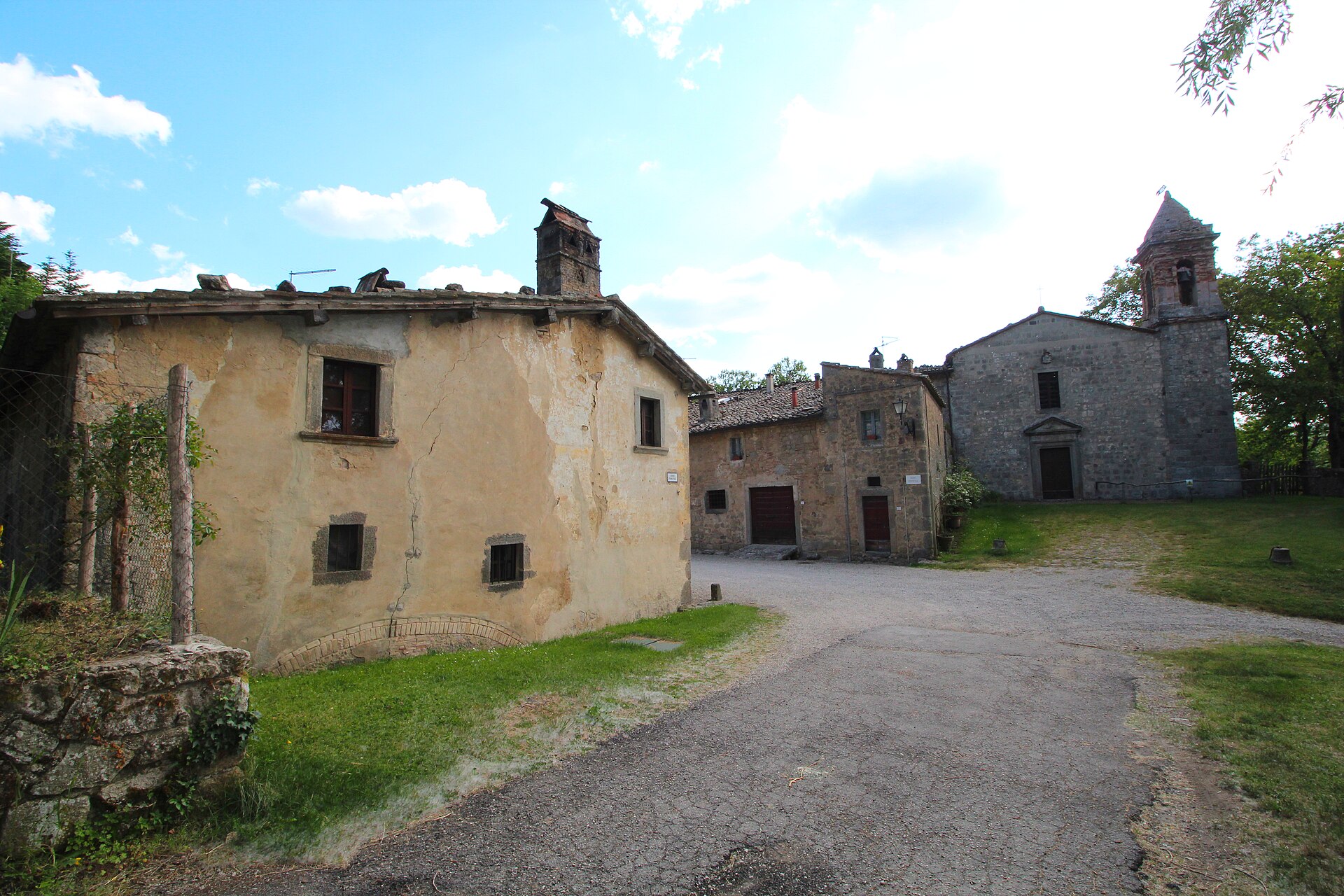
San Marcello stands on the site of the lower monastery. According to the Ecomuseo, it was rebuilt on the ruins of the monastic church of San Pietro, with 16th-century changes. The Cervini arms mark its façade.
Walk around to the right side. The Comune points out relief decoration there, the trace of the church’s alterations.
The Ermicciolo
The oratory of San Benedetto marks the upper of the two religious sites. It is a small Romanesque church with a single nave and a semicircular apse decorated with small hanging arches. Beside the door, the Ecomuseo notes two simple panels with a checkerboard pattern made from different shades of volcanic stone.
The springs rise close by, in the Ermicciolo spring park. This is where the chestnut woods give way to beech. Old chestnut-drying houses stand nearby; the community cooperative dates them to the 18th century.
The Riverside Path
A woodland path follows the Vivo between the old hermitage and the Ermicciolo. It ties the village’s stories together. The Pro Loco notes traces of old paper mills and water mills along the way.
The community cooperative describes waterfalls, a small dam, and caves on the route. It says the caves served as a refuge for partisans during the Second World War. Wear proper shoes, and check the state of the path with the Pro Loco before you set out.
The Silver Firs
Look up as well as down. The woods around Vivo hold silver fir (Abies alba). The Pro Loco, citing the Italian Botanical Society and the CNR, calls it one of the few surviving native stands in Tuscany.
The Sagra and the Palio del Boscaiolo
Vivo’s big event is the Sagra del Fungo e della Castagna (Mushroom and Chestnut Festival). It usually runs over two Sundays in mid-October. The Pro Loco serves dishes built around porcini.
The Palio del Boscaiolo (woodcutters’ contest) pits the village’s two rioni (districts), Le Caselle and Il Pian delle Mura, against each other. Dates change each year, so check the Pro Loco Vivo site before you go.
Eating Like a Local
Autumn on this side of the mountain means mushrooms and chestnuts. Porcini are the headline at the sagra. Chestnuts come from the woods around the village.
Castagna del Monte Amiata has been a registered IGP (protected geographical indication) since 2000. It covers three varieties: Marrone, Bastarda Rossa, and Cecio. On Amiata, the drying house is called a seccatoio, not a metato. The local guide That’s Amiata describes the old method. The chestnuts lie on a slatted floor over a slow fire at about 30 °C for about 40 days.
If you plan to pick mushrooms yourself, read the rules first. Anyone picking in Tuscany needs a paid regional permit. Non-residents pay by the day or the week. The limit is 3 kg per person per day, and plastic bags and rakes are banned. The Regione Toscana page has the details.
Getting There and Getting Around
Realistically, you need a car. Vivo lies on the mountain above Castiglione d’Orcia. The village is small, so park once and explore on foot.
Autolinee Toscane line 54A runs between Abbadia San Salvatore and Siena via Castiglione d’Orcia, San Quirico d’Orcia, and Torrenieri. Check stops and times on at-bus.it. The nearest train stations are Chiusi-Chianciano Terme on the Florence–Rome line and Buonconvento on the Siena–Grosseto line.
Come in summer, when the woods stay cool, or in mid-October for the sagra. For a longer stay on the mountain, see our Monte Amiata region guide.
Nearby
- Campiglia d’Orcia: the other Amiata frazione of Castiglione d’Orcia, a ring-shaped medieval village on a limestone outcrop.
- Castiglione d’Orcia: the comune’s main town, down toward the Val d’Orcia.
- Bagni San Filippo: the thermal village in the same comune, covered in our full guide.
- Abbadia San Salvatore: a medieval abbey with a crypt of more than thirty columns, plus the mercury-mining museum.
- The summit (1,738 m): the top of Monte Amiata, with its 22 m cross, first inaugurated in 1910.
Information is provided in good faith and may change. Always confirm opening hours, prices, and event dates with the official source before you travel.