
Town · Lunigiana
Bagnone
The Borgo That Sounds Like Water
Last updated:
- Region
- Lunigiana
- Province
- Province of Massa-Carrara
- GPS
- 44.3153, 9.9958
- Best season
- Spring through autumn; summer for the natural swimming pools
- Time needed
- 2–3 hours (longer if swimming in the gorge or exploring the surrounding hamlets)
- Difficulty
- moderate
- Known for
- Fairy-tale borgo, Bandiera Arancione, Malaspina castle, medieval bridge, river gorge swimming
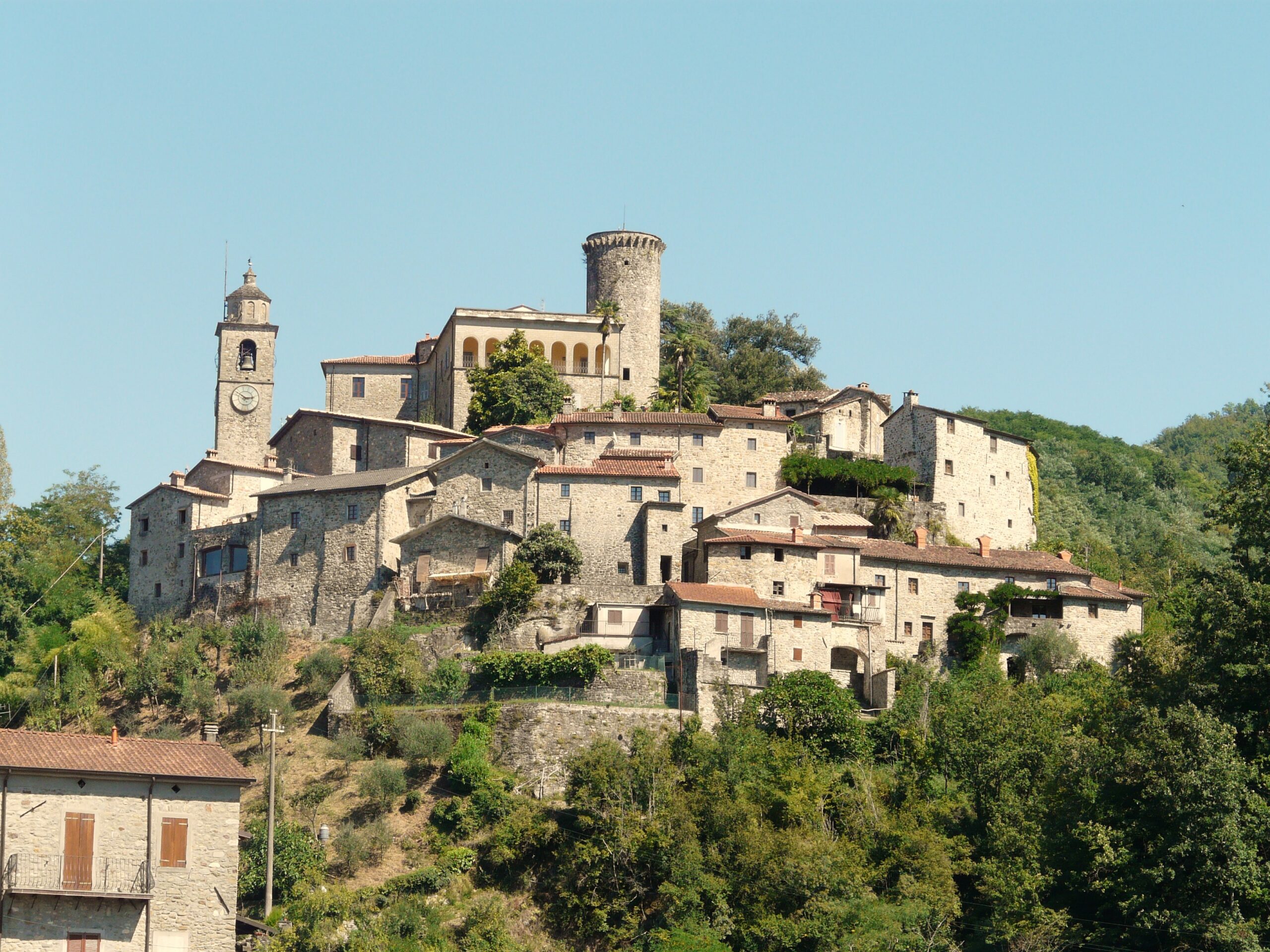
You hear Bagnone before you understand it. The sound of the Bagnone torrent — tumbling over rocks in the gorge below the village — rises to meet you as you approach through Porta di Santa Caterina, the medieval gate that frames your first view of a borgo that seems to have been composed rather than built. Stone houses climb in concentric rings from the river to the castle on top, connected by narrow lanes, covered passages, and stone staircases worn smooth by centuries of feet. The whole thing cascades down the hillside like a frozen waterfall of architecture.
Bagnone’s population is roughly 1,700 — small enough that you will meet the same faces twice in an hour’s walk. In 2024, the Touring Club Italiano awarded it the Bandiera Arancione (Orange Flag), the quality certification for small inland towns that manage to balance heritage preservation with genuine hospitality. The recognition was overdue. Bagnone has the kind of visual coherence that larger, more famous towns spend millions trying to achieve: every building is stone, every roofline fits, the torrent provides a natural soundtrack, and the Malaspina castle tower closes the composition at the top.
A Place Shaped by Time
Bagnone’s story is Lunigiana‘s story in miniature — Malaspina control, castle-building, the slow layering of medieval fabric that the centuries have polished rather than replaced. The Malaspina castle at the summit, with its surviving circular tower, dates to the period of maximum feudal fragmentation when every branch of the dynasty needed its own fortress. The tower is the most distinctive element — round rather than square, suggesting a later construction date when military engineers had learned that circular towers better deflected projectiles.
The borgo grew below the castle in the typical pattern of Lunigiana settlements: a defensive core on high ground, with houses gradually extending downhill toward the water source. The medieval bridge that crosses the Bagnone torrent is the town’s structural heart — the point where the two halves of the settlement connect, and the spot where the relationship between architecture and landscape becomes most dramatic.
Bagnone’s hamlets — Treschietto, Compione, Pastina, Vico — spread through the surrounding hills and valleys, each with its own micro-identity. Treschietto is the most storied: its circular-towered castle ruins are haunted by the legend of “il Mostro” Giovan Gasparo Malaspina (d. 1678), a sadistic marquis whose documented atrocities included kidnapping village women and lowering a father alive into a church ossuary. Local tradition holds that the Cipolla di Treschietto — a sweet pink onion prized by cooks across the region — keeps his ghost imprisoned.
What to See and Do
The essential experience in Bagnone is the walk through the borgo itself — enter through Porta di Santa Caterina, cross the medieval bridge, and climb through the narrow lanes toward the castle at the top. The route takes perhaps thirty minutes if you stop to look at everything, which you should. The architecture is remarkably consistent — almost entirely stone, with the overhanging upper stories that are characteristic of Lunigiana‘s borghi creating narrow, shaded passages even in summer.
The Malaspina castle and its circular tower are the visual summit. The views from the top extend across the Bagnone Valley to the surrounding Apennine ridges.
Below the borgo, the river gorge offers natural swimming pools in summer — clear, cold water in rock pools surrounded by vegetation. This is not a manicured beach but a wild swimming spot that locals have used for generations. Bring shoes that can get wet; the rocks can be slippery.
The Sagra della Cipolla in nearby Treschietto celebrates the local pink onion — a sweet, mild variety that works raw in salads or cooked in the local torta d’erbi.
Bagnone is also a practical starting point for walks into the surrounding chestnut forests, which supplied the raw material for the DOP chestnut flour that is central to Lunigiana‘s food identity.
Eating Like a Local
Bagnone shares the full Lunigiana repertoire — testaroli, panigacci, torta d’erbi, chestnut flour preparations — with the mountain emphasis that comes from its elevation and its proximity to chestnut forests. The Cipolla di Treschietto appears in local cooking throughout the summer and autumn. Restaurants in the center are small and traditional, operating on the assumption that you know what Lunigianese food is (or are willing to find out). Agriturismi in the surrounding hamlets often provide the most memorable meals — farm-table cooking where the ingredients come from the same hillside you’re looking at.
The connection to Villafranca is close — the two towns share a train station (Villafranca-Bagnone) and many of the same food traditions. The Ethnographic Museum in Villafranca provides context for the agricultural and pastoral practices that shaped this food.
Getting There and Getting Around
By car: From the A15 motorway, exit at Pontremoli or Aulla and follow local roads — Bagnone is roughly equidistant between the two, about 20 minutes from either. From Pontremoli, the road follows the Magra Valley south. Parking is available at the base of the borgo; the center is pedestrian territory.
By train: The Villafranca-Bagnone station on the Pontremolese line (Parma–La Spezia) serves both towns. The station is below Bagnone — you’ll need to walk or drive uphill to reach the borgo itself.
Timing: The borgo is compact enough to cover in 2–3 hours, including the castle walk and time at the river. Early morning and late afternoon light are best for photography — the narrow lanes create dramatic shadow play. In summer, combine with a swim in the river gorge.
Nearby
Treschietto — The hamlet with the circular Malaspina tower ruins, the “Monster” legend, and the sweet pink onion. Ten minutes uphill from Bagnone.
Villafranca in Lunigiana — The Ethnographic Museum in restored watermills and the walled village of Filetto. Fifteen minutes south.
Pontremoli — The stele museum, Baroque palaces, and Caffè degli Svizzeri. Twenty minutes north.
Filattiera — Byzantine origins and the Romanesque Pieve di Sorano on the Via Francigena. Fifteen minutes south.
Licciana Nardi — The Castello di Monti (still in Malaspina family hands) and the Bastia castle. Twenty minutes southeast.
Information is provided in good faith and may change. Always confirm opening hours, prices, and event dates with the official source before you travel.