
Town · Monte Amiata
Castel del Piano
Palio Town on Amiata’s Western Slope
Last updated:
- Region
- Monte Amiata
- Province
- Province of Grosseto
- GPS
- 42.891, 11.539
- Best season
- Late summer for the Palio; summer and autumn for walking
- Time needed
- Full day
- Difficulty
- easy
- Known for
- Palio of 8 September, Prato delle Macinaie, summit walks, Montecucco wine, Seggiano DOP oil
A Horse Race, a Mountain, and a Wine Zone
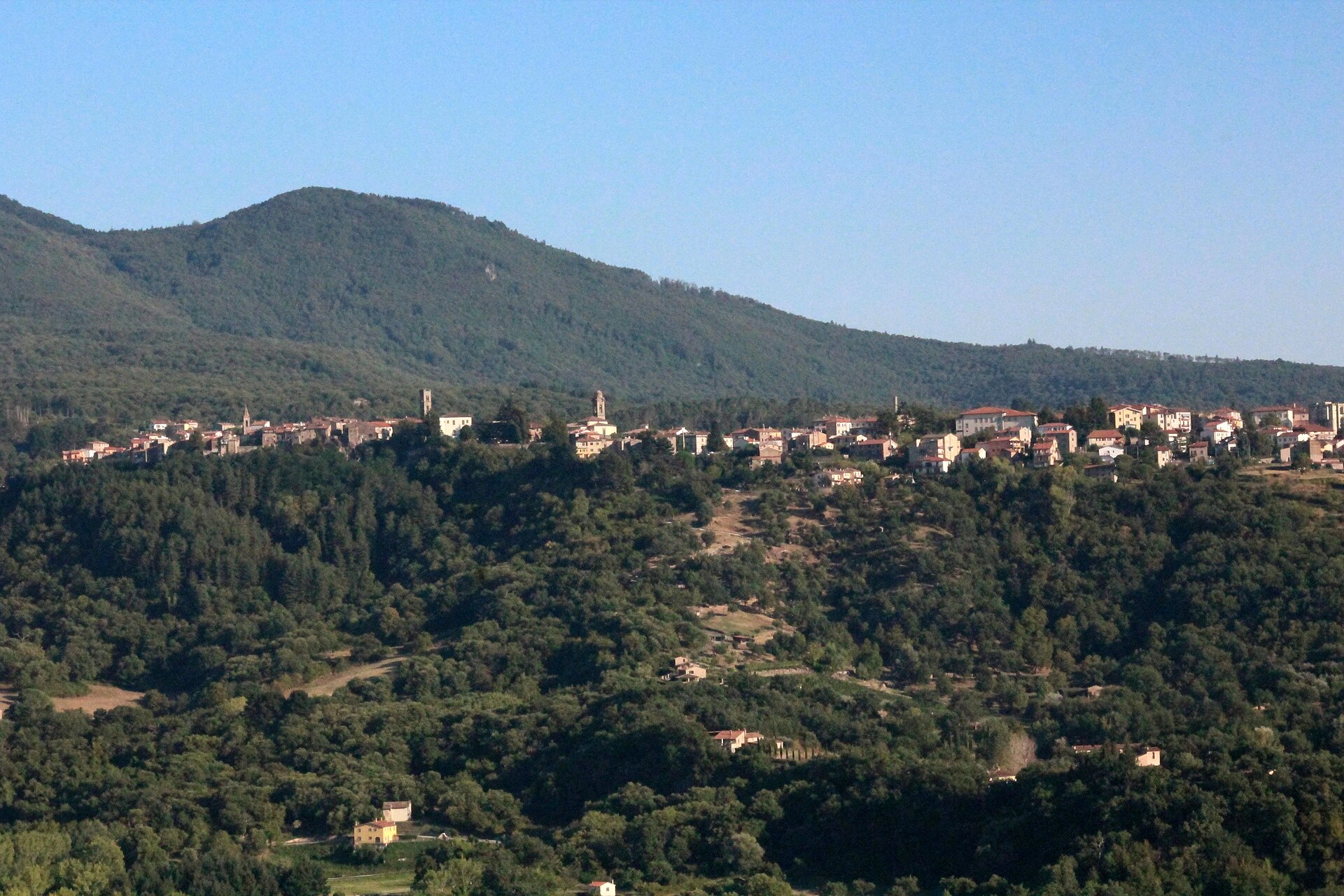
Castel del Piano sits at 637 m on the western, Grosseto side of Monte Amiata. It is a working town, not a postcard. Yet it gives you three good reasons to stop.
The first is the Palio, a bareback horse race run every 8 September. The second is the road up to the Prato delle Macinaie, a mountain meadow and starting point for a summit walk. The third is wine: the town lies inside the Montecucco zone.
It also works as a base. The villages of the Monte Amiata ring are a short drive in either direction. The summit, at 1,738 m, is a half-day walk from the Macinaie.
Be honest with yourself about one thing. The ski slopes above town depend on snow that may not come. Plan around the Palio, the walking, and the wine, and treat skiing as a bonus.
A Place Shaped by Time
From “Casale Plana” to Sienese outpost
The town first appears in 890 as “Casale Plana” in the records of the Abbey of San Salvatore, today’s Abbadia San Salvatore. By 1175 it had become a castle, the castrum plani, under the Aldobrandeschi counts.
Then Siena moved in. In 1331 a Sienese siege led by Guidoriccio da Fogliano took the town for good. In 1559 it became part of the Grand Duchy of Tuscany.
Industry on the mountain
Castel del Piano has not lived by farming alone. According to the Italian Wikipedia account of the town, it had a tannin-extraction works that closed in 1965. Fossil flour, a diatomaceous earth, was worked by the Winkelmann-Crida company from 1929 to 1978. The biscuit and bakery firm Corsini was founded here in 1921.
Tourism came next. The first ski lifts opened at the Macinaie in 1958.
The Palio: legend and record
Local tradition dates the Palio to 1431. The story goes that four soldiers from Castel del Piano, fighting alongside Siena near Sorano, were saved by the Virgin. They carried an image of the Madonna home from an oratory there.
The written record starts later. According to the Ministry of Culture, the church of the Madonna delle Grazie set up a prize for a horse race in 1765. The first documented race followed on 7 July 1771.
The race is held on 8 September, the town’s Marian patronal feast. Four contrade (town districts) compete: Borgo, Monumento, Poggio, and Storte. The contrade system dates from 1967, and the modern Palio from 1968.
What to See and Do
Palio week
The Ministry’s page describes the shape of the festival. Heats and the drawing of the horses take place on 6 and 7 September. On the evening of the 7th, each contrada holds its own dinner. On the 8th come the historical procession, the blessing of the Palio, the race, and fireworks.
The race itself is run bareback in Piazza Garibaldi, on a course modeled on Siena’s Piazza del Campo. The horses are mixed-breed, which the Ministry notes are better suited to tight turns than thoroughbreds. The winning contrada takes home the drappellone (painted banner), also called the palio or cencio.
On 9 September a traditional market and livestock fair follows. The Ministry traces it to a fair held since 1402.
The program can change from year to year, so check the Ministry of Culture page before you go.
The historic center
Give yourself an hour to walk the old town. The church of San Leonardo is documented between 1188 and 1198 and holds an altarpiece of St Jerome by Francesco Nasini. Palazzo Nerucci dates from 1564 and has housed an art collection and a music school since 2004.
Look for the 13th-century walls on the south side, with gates including the Porta dell’Orologio and the Porta Amiata. In Piazza Garibaldi, the Palio square, stands the Fontana Grande, a monumental round basin of trachyte (a volcanic stone) with a fluted central column.
The church of the Madonna delle Grazie was built on the site of a chapel from 1504. It holds Francesco Nasini’s Madonna del Carmine (1652).
Prato delle Macinaie and the skiing question
The Prato delle Macinaie lies at about 1,370 m, above the town. It is the base of the Grosseto-side ski area run by I.S.A. (Contessa–Macinaie). A second operator, Amiata Impianti Senese, works the Siena side.
Here is the honest part. Snow on Amiata is unreliable, and in some recent winters the lifts stayed shut for lack of it. Check I.S.A. or Amiata Impianti before you drive up.
In summer, I.S.A.’s site also lists activities beyond skiing, so check what is running before you go.
The summit loop from the Macinaie
This is the walk to do. The loop from the Prato delle Macinaie climbs via Rifugio Cantore to the summit and back. According to l’Appenninista, it gains about 410 m and takes 3 to 3.5 hours, graded E, the standard hiking grade on the Italian CAI scale.
The route crosses beech woods and the rocky summit ridge. Near the top you pass the Madonna degli Scout, a statue put up by Grosseto’s Scouts in 1961.
The summit cross is 22 m high and was made in Luciano Zalaffi’s Siena workshops. It was inaugurated on 18 September 1910. Retreating German troops brought it down on 17 June 1944, and it was rebuilt and re-inaugurated in 1946.
Carry water and an extra layer, even in summer.
Eating Like a Local
Montecucco wine
Castel del Piano is one of seven comuni in the Montecucco wine zone. The others are Arcidosso, Campagnatico, Cinigiano, Civitella Paganico, Roccalbegna, and Seggiano.
Montecucco became a DOC on 30 July 1998. Montecucco Sangiovese was raised to DOCG on 9 September 2011. Order a Montecucco Sangiovese with dinner and you are drinking wine from the slopes around you.
Oil, chestnuts, and mushrooms
The town also lies in the production area of Seggiano DOP olive oil. It is made from at least 85% Olivastra Seggianese, a local variety. To meet one of the producers, read our profile of La Casina di Giannetto.
Autumn on Amiata means chestnuts. The Castagna del Monte Amiata IGP has been registered since 2000, covering the Marrone, Bastarda Rossa, and Cecio varieties.
If you plan to pick mushrooms, you need a paid regional permit. The daily limit is 3 kg per person, and plastic bags and rakes are banned. Read the Regione Toscana rules first.
Getting There and Getting Around
By car
A car is realistically needed if you want to see more than one village a day. A road climbs from town to the Prato delle Macinaie, the starting point of the summit loop.
By public transport
The nearest main-line stations used for Amiata are Buonconvento, on the Siena–Grosseto line, and Chiusi-Chianciano Terme, on the Florence–Rome line. From there, buses run by Autolinee Toscane serve the mountain. Check the Autolinee Toscane timetables before you rely on a connection.
Nearby
- Arcidosso: the next town along the slope, with its Aldobrandeschi castle and the story of David Lazzaretti.
- Seggiano: the home of Seggiano DOP oil and Daniel Spoerri’s sculpture garden.
- Santa Fiora: the old Sforza county town, with its Andrea della Robbia terracottas and the springs of the Fiora.
- Roccalbegna: a fortified village with three panels by Ambrogio Lorenzetti.
- Montegiovi: a medieval hilltop village in Amiata’s western foothills, a frazione (hamlet) of Castel del Piano.
For a full route, see 4 Days on Monte Amiata.
Information is provided in good faith and may change. Always confirm opening hours, prices, and event dates with the official source before you travel.