
Town · Val d'Orcia
Rocca d’Orcia
The Salimbeni Stronghold Where Saint Catherine Stayed
Last updated:
- Region
- Val d'Orcia
- Province
- Province of Siena
- GPS
- 43.0108, 11.6142
- Best season
- spring and autumn; the fortress opens seasonally, roughly April to early November
- Time needed
- half day, with Castiglione d'Orcia
- Difficulty
- moderate (a short, steep footpath to the fortress; sloping lanes)
- Known for
- Rocca a Tentennano, the Salimbeni, Saint Catherine of Siena, Piazza della Cisterna, the castle of Ripa d'Orcia
A Banker’s Fortress Above the Pilgrim Road
Many fortresses in the Val d’Orcia guarded the frontier of the Sienese state. The one above Rocca d’Orcia also served a family. In the 14th and 15th centuries it belonged to the Salimbeni, Siena’s rich banking dynasty, who used it as a base for their own affairs, often against Siena itself.
From up here, the Rocca a Tentennano watched the Via Francigena, the medieval road that carried pilgrims to Rome. Below it, a small stone village fans out around a square with an old cistern. Across the gorges of the Orcia stands another Salimbeni castle, Ripa d’Orcia, still lived in and still private.
Then there is the saint. In 1377 Catherine of Siena came to stay at Tentennano. Tradition says that here, at a castle belonging to feuding bankers, she received the gift of writing. That combination of money, power, and faith is why this place deserves more than a quick photo stop.
A Place Shaped by Time
An Etruscan name, perhaps, and a road to guard
The place is old. The Fondazione Musei Senesi says the site is recorded as early as 853, when it belonged to the abbey on Monte Amiata. Italian Wikipedia connects the old name, Tintinnano, with Tetena, an Etruscan family name. Treat that as a theory, not a certainty.
The village itself was long known as Rocca a Tentennano or Rocca di Tintinnano. According to Italian Wikipedia, its first fortifications date from the 11th and 12th centuries, built by the Tignosi, vassals of the powerful Aldobrandeschi counts.
Why fortify it? Because of the road. The Via Francigena ran along this stretch of the valley, and whoever held the rock could see who passed. Tentennano, Castiglione, Radicofani, and Campiglia were all fortified to control the pilgrim road at the southern edge of the Sienese state.
How the Salimbeni got their castles
Siena acquired the fortress in 1251, Italian Wikipedia records. The city soon had debts to pay. In 1274, according to the Ecomuseo of the Terre di Siena, Siena ceded nearby Ripa d’Orcia to the Salimbeni to settle what it owed them. Italian Wikipedia says Tentennano went to them in the same year, for debts run up paying the army that won the battle of Montaperti.
So Siena’s bankers became lords of both sides of the gorge. Over the next century and more, the family used these castles as a private power base. The most notorious of them was Cocco Salimbeni. From Tentennano he raided neighboring villages, including Castelmuzio. Siena finally defeated him in 1418.
Catherine at Tentennano, 1377
Catherine of Siena came here in 1377. According to her entry in Treccani’s Dizionario Biografico degli Italiani, she came to make peace between the heads of two rival branches of the Salimbeni family. Her stay made Siena’s government suspicious that she was mixed up in politics.
A story grew from that stay. The Fondazione Musei Senesi records that, “secondo la tradizione” (according to tradition), she received the gift of writing here. It is a tradition, not a documented fact. It is still worth knowing as you climb to the tower.
A quieter afterlife
The village declined from the 16th century on. In the 18th century it was absorbed into the comune of Castiglione d’Orcia. In the 1970s the tower’s owners, the Aggravi-Scotto family, donated it to the Italian state. Italian Wikipedia dates the start of its restoration to 1975.
What to See and Do
Rocca a Tentennano
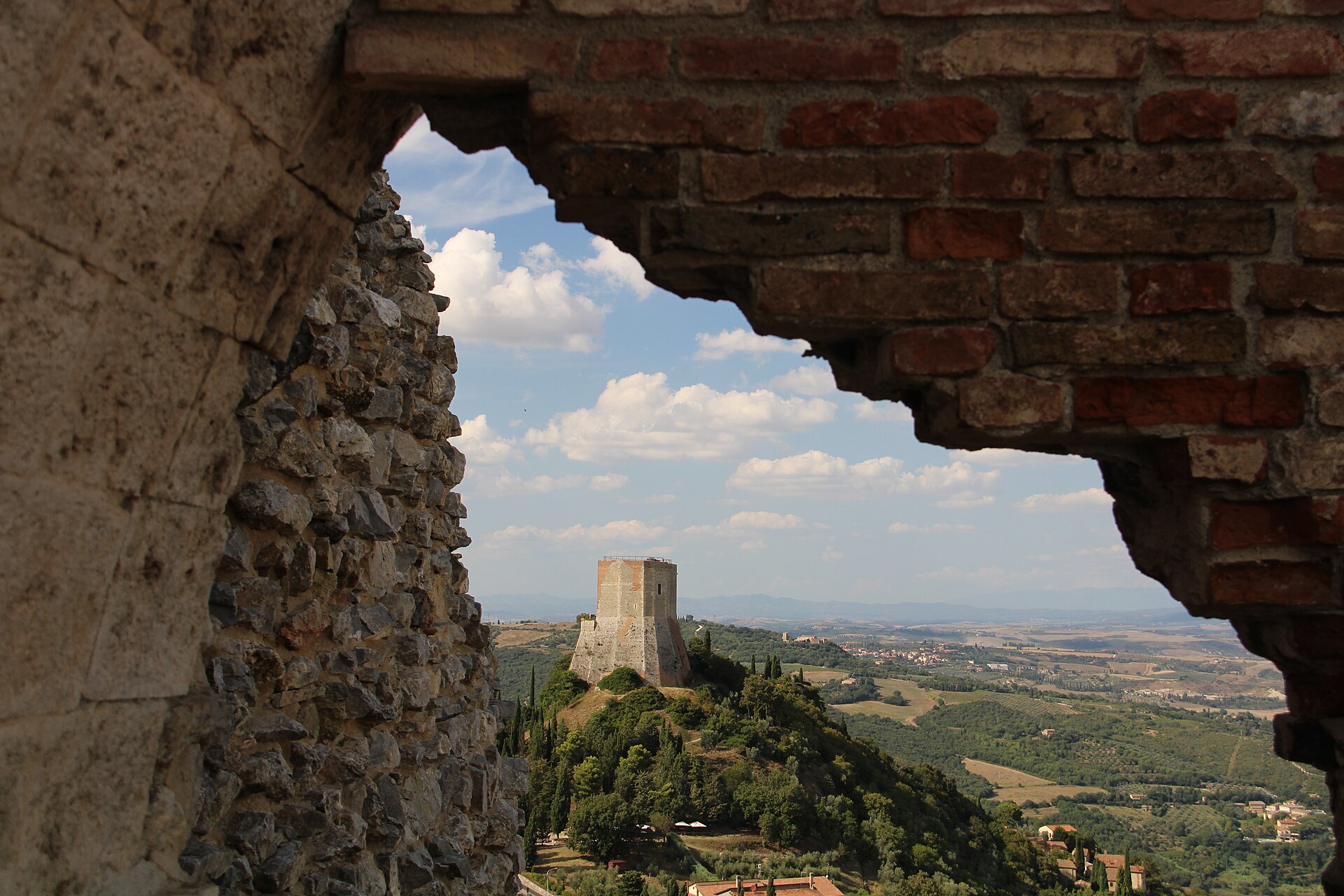
The Rocca a Tentennano stands on a limestone outcrop above the village. Its keep is an irregular polygon, more than 20 m high, and Italian Wikipedia describes several rings of walls around it. A footpath of about 300 m leads up to the tower. It is short, but it climbs, so take water on a hot day.
Inside, a staircase takes you up to a terrace. The Fondazione Musei Senesi describes the view as running “dal Monte Amiata al Monte Cetona, fino alle prime propaggini dell’Appennino” (from Monte Amiata to Monte Cetona, as far as the first foothills of the Apennines). This is the view the Salimbeni paid for. The rooms have also been used for contemporary art exhibitions.
The fortress opens seasonally, roughly April to early November. One ticket covers Tentennano, the Rocca Aldobrandesca in Castiglione d’Orcia, and Castiglione’s small gallery, the Sala d’Arte San Giovanni. Check the current season on the Fondazione Musei Senesi page. Castiglione’s center is about a kilometer away, so plan both on the same morning.
Piazza della Cisterna and the village lanes
Back in the village, head for Piazza della Cisterna, the square of the cistern. Italian Wikipedia describes its well carved with coats of arms, with a small linden tree beside it. It is the natural place to sit down and look at the stone houses around you.
The village spreads around its limestone promontory in three small districts: the Rocca at the center, the Rocchetta to the west, and the Rocchettina to the east. Parts of the old walls still enclose them. Wander the lanes rather than hunting for a checklist.
Three churches
The church of San Simeone has a Romanesque façade and, according to Italian Wikipedia, frescoes from the 14th and 15th centuries. The Madonna delle Grazie di Manno dates from the 16th century. The church of San Sebastiano has a 17th-century façade with a curved pediment. None of these demands a long visit. Together, they show how much faith a very small place invested in stone.
Ripa d’Orcia, seen from the outside
Ripa d’Orcia is a castle-hamlet above the river, and it has a remarkable ownership story. After Siena ceded it to the Salimbeni in 1274, Giovanni “Bottone” Salimbeni fortified it. It passed to the Sforza after 1368. Since 1484 it has belonged to the Piccolomini Carli, whose will of 1605 made it inalienable. The Ecomuseo says it was restored in the 19th century and “has always been inhabited.”
The Ecomuseo describes it as rising among wooded gorges “in faccia a Tentennano” (facing Tentennano), a sentinel over the Orcia. Its walls enclose two small streets, a few houses, and the church of Santa Maria delle Nevi. The fortress itself combines a tall square tower, a triangular porticoed courtyard, and a lower residential wing.
Ripa d’Orcia is privately owned. Admire it from the surrounding roads and paths, and do not expect to go inside.
Eating Like a Local
Oil from the growers’ cooperative
The best food address near Rocca d’Orcia is an olive mill. The Oleificio Val d’Orcia, the valley’s growers’ cooperative, is at Loc. La Fonte in the comune of Castiglione d’Orcia. By its own account it has more than half a century of experience, and it offers mill visits and other experiences. Autumn, when the new oil is pressed, is the time to go.
Pici, saffron, and chestnuts
At the table, look for a trattoria serving pici, the thick hand-rolled pasta of the Val d’Orcia. Castiglione d’Orcia is also one of the five comuni where Zafferano della Val d’Orcia (Val d’Orcia saffron) may be grown. The crocus flowers and is harvested in October and November.
Higher up, toward Monte Amiata, the food culture turns to chestnuts. Campiglia d’Orcia, also in this comune, holds its Festa del Marrone (Chestnut Festival) on the last Sunday of October.
For wine, the local appellation is Orcia DOC, a small zone of family cellars squeezed between Brunello di Montalcino and Vino Nobile di Montepulciano.
Getting There and Getting Around
Rocca d’Orcia is one of the easier small villages to reach without a car. Autolinee Toscane lines 54A and 52A both stop here. Line 54A runs from Siena, and line 52A links Arcidosso with San Quirico d’Orcia. Check the line pages for current times, which change with the school year.
The nearest working railway stations are Buonconvento, on the Siena–Grosseto line, and Chiusi-Chianciano Terme, on the Florence–Rome line. From either, continue by bus or car. Don’t plan on Torrenieri: it has had no regular trains since 1994.
On foot, the Via Francigena’s stage 36, from San Quirico d’Orcia to Radicofani, passes Vignoni Alto and Bagno Vignoni and offers an optional detour to Castiglione d’Orcia. Once in Rocca d’Orcia, everything is walkable, including the path to the tower.
What we know vs. what’s repeated: Some English sources suggest you can stay at the castle of Ripa d’Orcia. It is a private castle-hamlet. The Ecomuseo describes it as always inhabited, owned by the same family since 1484. Do not plan a stay or a visit inside. Enjoy it from the roads and paths around it.
Nearby
- Castiglione d’Orcia: the comune’s main village, with the Rocca Aldobrandesca and a Simone Martini Madonna holding a swallow, on the same ticket as Tentennano.
- Bagno Vignoni: a village whose square is a pool of hot spring water, where Saint Catherine also prayed.
- San Quirico d’Orcia: the start of Francigena stage 36, with a Medici garden and the Barbarossa festival.
- Campiglia d’Orcia: a Visconti-era village on the Amiata slopes, known for its chestnut festival.
- Bagni San Filippo: a free hot stream on the lower slopes of Monte Amiata, with rules worth reading first.
Information is provided in good faith and may change. Always confirm opening hours, prices, and event dates with the official source before you travel.