
Town · Val d'Orcia
Bagni San Filippo
A Free Hot Stream and Its Rules
Last updated:
- Region
- Val d'Orcia
- Province
- Province of Siena
- Best season
- spring, autumn
- Time needed
- 2–3 hours
- Difficulty
- moderate (dirt track and uneven ground; the Comune states the site is not accessible for people with disabilities)
- Known for
- Fosso Bianco hot stream, Balena Bianca limestone formation, Grotta di San Filippo Benizi, Medici-era baths, Monte Amiata edge
Hot Water in the Woods, and Everyone Wants In
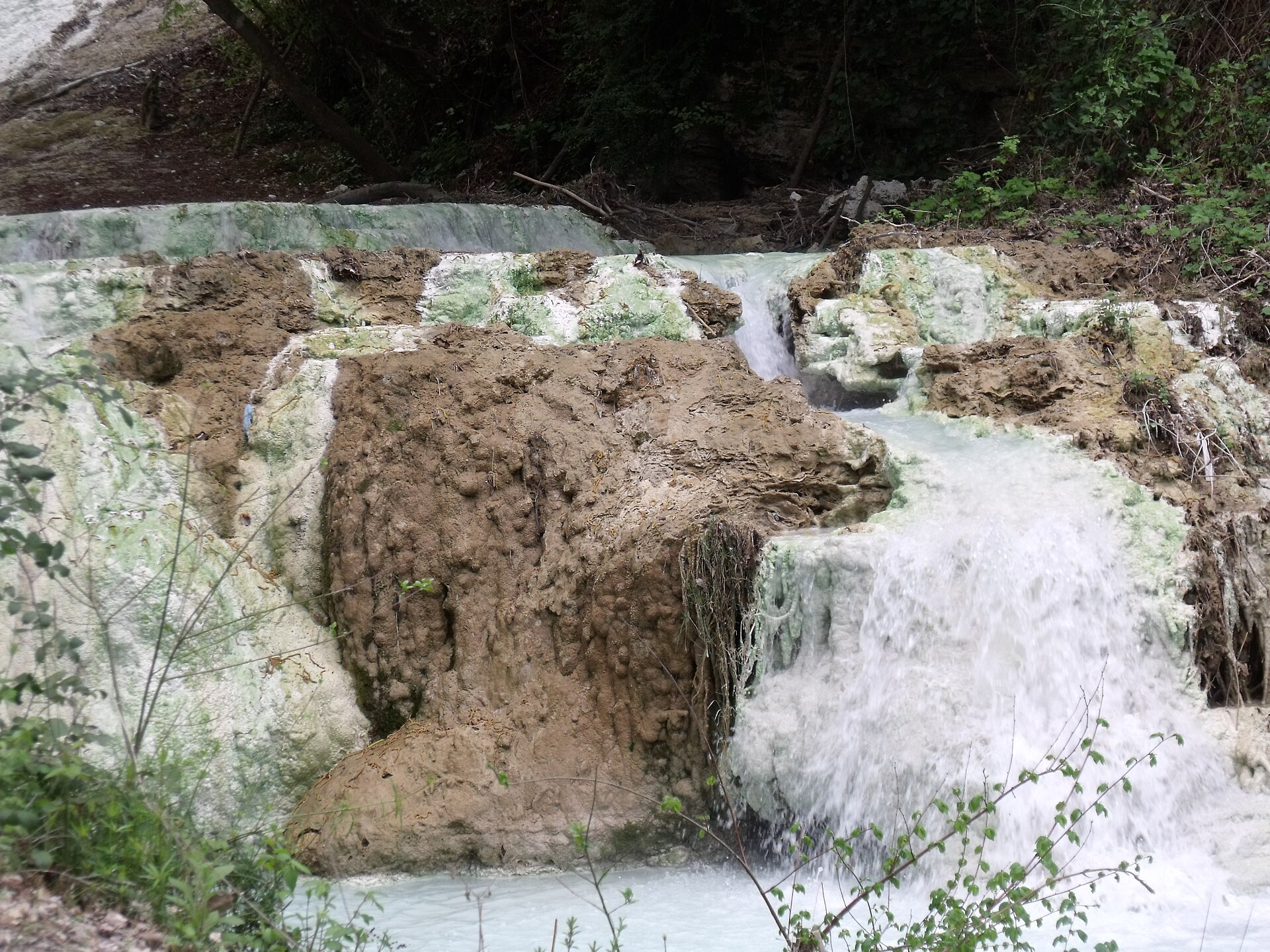
At the southern edge of the Val d’Orcia, where the land starts climbing toward Monte Amiata, there is a small village with a big draw. Just outside Bagni San Filippo, a dirt track leads into the woods to the Fosso Bianco (the White Ditch). It is a stream fed by hot springs. The water runs over white limestone, pools in natural basins, and builds strange shapes as it goes.
Some of the formations have names, such as “la balena bianca” (the white whale) and “il ghiacciaio” (the glacier). The Comune di Castiglione d’Orcia describes entry to the area as “libero e gratuito” (open and free). According to Visit Tuscany, the water gushes out of the spring at 48 °C.
Free, hot, and beautiful is a combination that brings crowds. For years, this stream has been argued over in council meetings and local newspapers. Who gets in, how many, and at what price? That story is part of the place, and knowing it will make your visit better. So will knowing the rules.
A Place Shaped by Time
Roman springs and Medici bathers
People have come here for the water for a very long time. The Comune says the springs were known in the Roman period. Later they drew Florence’s rulers. Cosimo I de’ Medici restructured the baths in 1566, and Grand Duke Ferdinando II came in the 17th century.
In the 18th century an architect found a new use for the minerals. Leonardo De Vegni of Chianciano promoted the so-called “plastica dei tartari” at Bagni San Filippo. The technique used the thermal water’s limestone deposits to make decorative bas-reliefs. In other words, the stream’s habit of coating everything in white stone became an art technique.
A saint who hid from the papacy
The village takes its name from Filippo Benizi, a friar of the Servite order. According to tradition, he hid in a grotto here in 1267 to avoid being elected pope. It is a story told locally, not a documented event, but the grotto is real and you can visit it (see below).
The saint also gives his name to the village church. The original Gothic church was abandoned because of damp from the sulfur springs. A new church was built in the center, reusing the old stones. Inside are stucco statues of three St Philips: Philip Neri, Philip the Apostle, and Philip Benizi.
Years of arguments over access
The modern story starts with popularity. As the stream’s fame spread, visitor numbers grew, and so did the problems: climbing, litter, crowding.
In July 2020, La Nazione reported that the comune had capped the number of people allowed in at one time. The reasons were COVID-19 rules and environmental protection. A coach carrying about 30 tourists was turned away because the group was too large. The area was kept under watch throughout the day.
In summer 2023 the comune tried a different tool: money. According to La Nazione (August 2023), visitors received a wristband at the entrance, managed by a local community cooperative. Entry cost €1, or €2 if you didn’t hand the wristband back. There was no fixed limit on numbers. Later that month, the paper reported more than 600 entries a day.
In July 2024 a new mayor dropped the ticket, and a planned cap on numbers was postponed. The earlier ordinance’s rules stayed in force, La Nazione reported. By February 2026 the comune was working on a visitor-management plan. It identified four access points and spoke of limits at peak times. But, as La Nazione noted, the comune owns none of the land beside the stream, and that has to change before any plan can go ahead.
So where does that leave you? Access to the stream is free at the time of writing, but the comune has long planned visitor management; check locally before you go. Do not climb, touch, or bathe at the white “whale” formation.
What we know vs. what’s repeated: Some English guides say Bagni San Filippo has a fixed entry ticket and a cap of 125 people. The ticket applied only in 2023. Access has been free since 2024, with rules in force and visitor management planned, according to La Nazione.
What to See and Do
The Fosso Bianco
The stream is the reason you are here. Walk down the dirt track from the village and follow the water. The Comune describes a string of “pozze” (pools) like natural swimming pools, where several hot springs meet, among white limestone shelves. FAI, the Italian National Trust, describes the water’s high calcium carbonate content as giving it a white-blue color.
Wear shoes with grip. The rock is slippery, and the ground is uneven. Bring a towel and swimwear, and expect a sulfur smell. If you want space, come early in the day or outside summer weekends.
The Balena Bianca: look, don’t touch
The white whale is the photo everyone wants, and it is also the most fragile thing here. FAI explains why the rules are strict. The oils on human skin darken the white surface and permanently change its color. So you must not bathe at it, walk on it, or touch it.
Photograph it from the path, then find a pool elsewhere along the stream. Every climber leaves a mark that the next visitor sees.
The Grotta di San Filippo Benizi
The grotto is cut into a large block of limestone, on the way down from Campiglia d’Orcia. This is where, by tradition, Filippo Benizi hid in 1267. It is a short, quiet stop and a good contrast to the busy stream.
The church of the three St Philips
Before you leave, look into the village church. Its stones come from the older Gothic church that the sulfur damp made unusable. The three stucco St Philips inside are a small local curiosity, and they tie the village’s name to its story.
The closed spa hotel
In the village you will notice the Hotel Terme San Filippo. The historic spa hotel has been closed for years and is the subject of a redevelopment plan.
Eating Like a Local
Bagni San Filippo sits on the lower slopes of Monte Amiata, and the food changes with the altitude. Here the key ingredient is the chestnut. The best place to taste that culture is up the road at Campiglia d’Orcia on the last Sunday of October. Its Festa del Marrone (Chestnut Festival) has run since 1978. The three rioni (neighborhoods) stage scenes of peasant and chestnut life, and there are roast chestnuts and local food. Check the Pro Loco Campiglia d’Orcia for the current year.
From the valley below come pici, the thick hand-rolled pasta of the Val d’Orcia, and pecorino. For wine, Cantina Campotondo at Campiglia d’Orcia was founded in 2000 by Paolo Salviucci and his family. Its aim was to revive Campiglia’s tradition of peasant mountain wine, and it welcomes visits and tastings (cantinacampotondo.it). Its range includes an Orcia Sangiovese Riserva DOC, from the valley’s own appellation.
Getting There and Getting Around
By car. Most visitors drive. Bagni San Filippo lies on the southern edge of the Val d’Orcia, below Campiglia d’Orcia. It makes a natural pair with Radicofani or Castiglione d’Orcia in the same day.
By bus. Autolinee Toscane lines 54A (Siena–Abbadia San Salvatore/Piancastagnaio) and FT9 (Chiusi–Sarteano–Radicofani–Abbadia San Salvatore) serve Bagni San Filippo. Timetables change with the school year, so check the 54A and FT9 pages before you plan. The AT information line is 800 14 24 24.
By train. The nearest working stations are Buonconvento on the Siena–Grosseto line, and Chiusi-Chianciano Terme on the Florence–Rome line. Continue by bus: 54A from the Siena side, FT9 from Chiusi.
On site. The stream is reached on foot by a dirt track from the village. The Comune states that the site is not accessible for people with disabilities. Access rules can change, so check the Comune di Castiglione d’Orcia page and ask locally before you go.
Nearby
- Campiglia d’Orcia: the Visconti-era village above, with its Festa del Marrone on the last Sunday of October.
- Radicofani: the papal border fortress, blown up on purpose in 1735, with a Medici posthouse below.
- Castiglione d’Orcia: two fortresses and a Simone Martini Madonna with a swallow.
- Bagno Vignoni: the other hot-water village, where the rule is the opposite: look, don’t bathe.
- Monte Amiata: the volcanic mountain whose geology feeds the stream, with fir woods and chestnut villages on its slopes.
Information is provided in good faith and may change. Always confirm opening hours, prices, and event dates with the official source before you travel.