
Town · Monte Amiata
Arcidosso
A Castle Town and Its Two Prophets
Last updated:
- Region
- Monte Amiata
- Province
- Province of Grosseto
- Best season
- Spring to autumn; autumn for chestnuts
- Time needed
- Full day, including Monte Labbro
- Difficulty
- easy (town); moderate (Monte Labbro on foot)
- Known for
- David Lazzaretti and the Torre Giurisdavidica, Merigar West Buddhist center, Castello Aldobrandesco and MACO, chestnut seccatoi, Monte Labbro
Two Visionaries, One Mountain
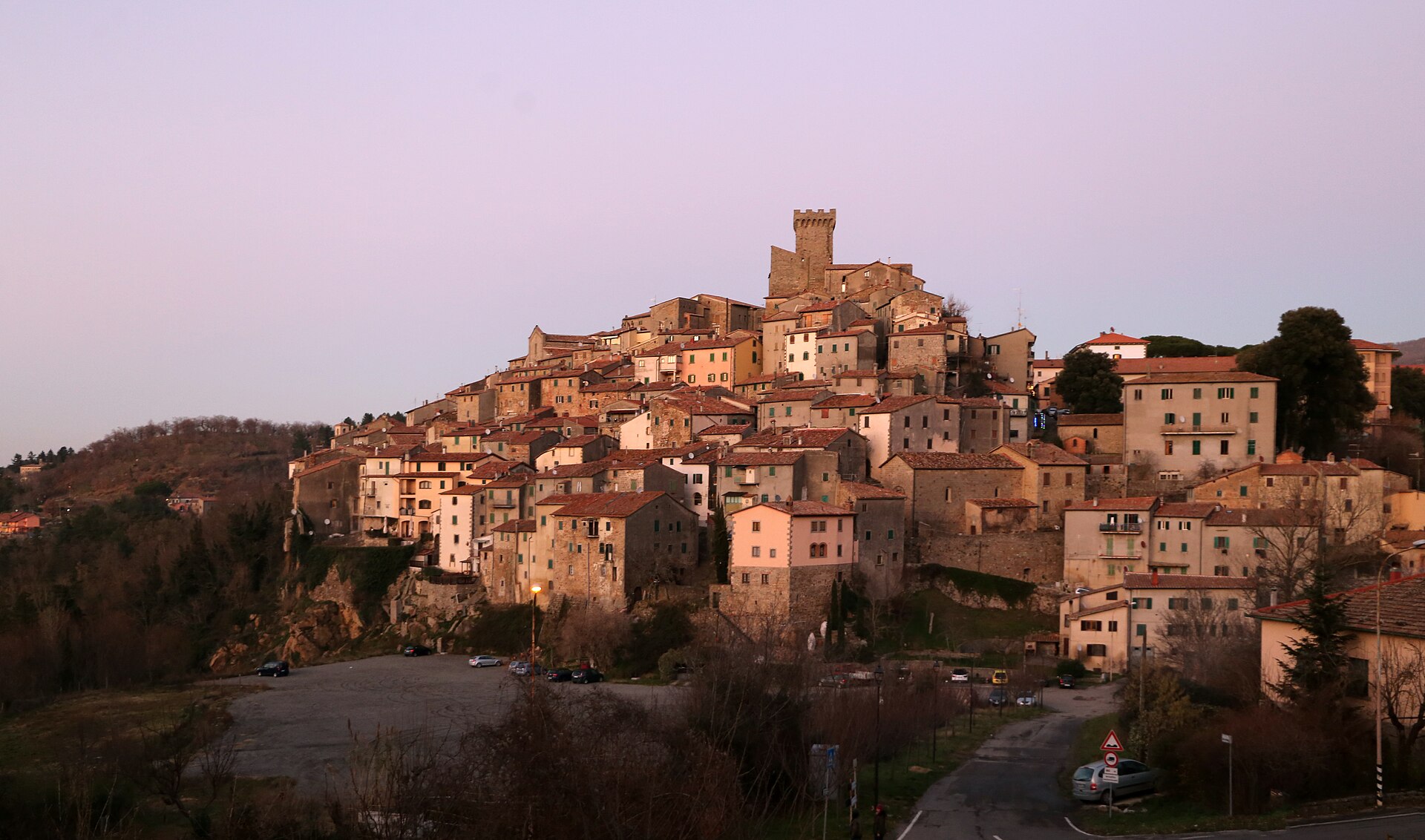
Arcidosso sits at 679 m on the Grosseto side of Monte Amiata, gathered around its castle. At first sight it’s a handsome hill town. Its real story is stranger.
Twice in about a century, a religious visionary put down roots on the mountains around Arcidosso. The first was David Lazzaretti, a local carter who built a religious movement on Monte Labbro in the 1870s. He was shot dead by a police officer in 1878. The second was Chögyal Namkhai Norbu, a Tibetan master whose Buddhist community settled here in 1981.
Both left something you can visit. There’s a ruined stone tower on the summit of Monte Labbro. Where the two mountains meet stands a Tibetan temple, with a museum of Himalayan art in the town castle. Add the chestnut drying houses of the frazione Montelaterone, and Arcidosso fills a full day.
A Place Shaped by Time
The Aldobrandeschi stronghold
Arcidosso was an Aldobrandeschi stronghold from the 12th to the 14th century. According to Italian Wikipedia, the Aldobrandeschi counts fortified it and began the castle and its main tower.
In 1331 the castle and town passed to the Republic of Siena. Italian Wikipedia calls the siege one of the longest the Sienese army ever mounted, under the commander Guidoriccio da Fogliano. When the Sienese republic ended in 1559, Arcidosso passed to the Medici.
Before the Aldobrandeschi
The castle’s own story starts earlier. The Amiata museum network links Marquis Ugo of Tuscany (970–1001) to the fortress. It dates the castle’s main phases from the 10th to the 14th century.
Under the Medici
Under the Grand Duchy, according to Italian Wikipedia, Arcidosso became the administrative “capital” of Monte Amiata. The same source records visits from Grand Duke Cosimo II in 1612 and Leopold II in 1842. The town’s Porta di Mezzo took the name Porta dell’Orologio (Clock Gate) after a rebuilding between 1834 and 1851.
David Lazzaretti, the prophet of Monte Labbro
David Lazzaretti was born in Arcidosso on 6 November 1834. He worked as a carter, hauling Siena earth (a pigment clay) as far as Siena and Rome. According to the Treccani biographical dictionary, he first saw a vision of an old friar in 1848, at 14.
His decisive vision came on 25 April 1868. It sent him toward Rome and a convent near Montorio Romano. There, in the Sabina hills, he spent a long Lenten retreat shut inside an abandoned convent known as the grotto of Sant’Angelo. Treccani also records a spell as a hermit on the island of Montecristo, and a trip to France in 1873.
A church on the mountain
Back on Amiata, Lazzaretti renamed Monte Labbro “Monte Labaro”. On its 1,193 m summit his followers built a dry-stone tower, from July 1869 to August 1870. A chapel and a hermitage followed. The first mass on the mountain was said on 29 September 1875.
He built an organization to match. Treccani lists a social and charitable brotherhood, the Santa Lega, founded in 1870, and an order of penitent hermits.
From 1872 his Società delle famiglie cristiane (Society of Christian Families) ran a communal, mutual-aid economy. Treccani connects it to the “communism” of the early Church, with shared goods and organized labor. The Holy Office condemned his doctrines as heretical in 1878. On 21 January 1878 his writings were put on the Index of forbidden books.
18 August 1878
On 18 August 1878, Lazzaretti led his followers down from Monte Labbro in procession. At Bagnore, police forces fired on the procession. Lazzaretti was shot in the forehead and died. Three followers also died, and dozens were wounded.
Twenty-three followers were tried for sedition before the court of assizes in Siena. In 1879 the jury acquitted all of them.
A tiny Giurisdavidic community, about ten people, still meets. Its last priest, Turpino Chiappini, died in 2002.
Namkhai Norbu and Merigar
Chögyal Namkhai Norbu was born in Derge on 8 December 1938. He taught Dzogchen, which Merigar describes as one of the oldest teachings of the Tibetan spiritual tradition. In 1981 his community settled at Merigar West, where the slopes of Monte Amiata meet those of Monte Labbro. According to Merigar, the name means “residence of the mountain of fire” in Tibetan.
He died in Arcidosso on 27 September 2018. On 27 September 2026 the town renamed Via Tibet as Via Maestro Norbu.
What to See and Do
The Torre Giurisdavidica on Monte Labbro
The ruined tower stands on the summit of Monte Labbro. According to Italian Wikipedia, the tower soon gave way under the weight of its roof. Consolidation followed in 1995, and a restoration in 2003–04. The remains of the chapel and hermitage are there too.
The mountain is protected as the Monte Labbro nature reserve. Wear proper shoes if you plan to walk up. According to Visit Tuscany, on the night of 14–15 August his followers gather to remember the events that led to his death. A fire then burns on the tower, visible from the valleys around.
Merigar West
The Dalai Lama inaugurated Merigar’s octagonal Gönpa (temple) in May 1990. The Great Stupa, built in 1998, has held Namkhai Norbu’s remains since 3 October 2018.
Merigar is a working community, not a sight. It says most of its activities are open to everyone. Some courses and retreats are restricted to people who have received teachings from Namkhai Norbu or his son, Namkhai Yeshi. Check merigar.it before you visit, and respect closed events.
The Castello Aldobrandesco
The castle crowns the old town. Its tower, the Torre Aldobrandesca, is 28 m high, according to Visit Tuscany. Inside, the castle complex holds several museums.
Visit Tuscany lists a section on the life and movement of David Lazzaretti, with panels, objects, and documents. It also lists the Emo Mecheroni collection of about 175 weapons, from the Middle Ages to the 20th century.
The second floor holds a gallery of the medieval landscape, based on research by the University of Florence’s medieval archaeology team. Visit Tuscany says it covers fortifications across Amiata and the Maremma. It also shows finds from Castel Vaiolo, a 10th-century site. The Amiata museum network calls its lot of excavated ancient chestnuts the most important found in Tuscany to date.
MACO, the museum of Oriental art
The castle complex also houses MACO, the Museo di Arte e Cultura Orientale (Museum of Oriental Art and Culture). It opened in 2016 in the Palazzo della Cancelleria, the 18th-century former registry building, which is part of the castle.
According to the Amiata museum network, Namkhai Norbu conceived the museum. Visit Tuscany describes it as a “living museum” with more than 5,000 objects, plus multimedia and soundscapes. Its core is the Namkhai Collection, gathered with his family: art, crafts, costumes, and votive objects from the Himalayas and Central Asia. Rooms cover nomadic culture, language, music and dance, medicine and astrology, and Tibetan Buddhism. See the Amiata museums page for opening times.
The churches
Italian Wikipedia gives the dates. San Niccolò, documented from 1144, is the town’s oldest church, and San Leonardo is recorded from 1188. The sanctuary of the Madonna Incoronata was built in thanks for the end of the 1348 plague. Outside town, the Pieve di Santa Maria a Lamula received privileges from Pope Gregory V in 996.
Eating Like a Local
Chestnuts and the seccatoio
Arcidosso matters to Amiata chestnuts. The association for the Castagna del Monte Amiata IGP was founded here on 26 February 2000. The protected varieties are Marrone, Bastarda Rossa, and Cecio.
Chestnuts are dried in a seccatoio, the Amiata word for a drying house. That’s Amiata describes the process: chestnuts on a slatted floor over a slow fire, at about 30 °C, for about 40 days.
In the frazione Montelaterone, That’s Amiata profiled Angelo Frosolini in 2019. At the time, according to that article, he had run a fire-dried seccatoio for more than 40 years.
Oil and wine
Arcidosso lies inside two protected production areas. It is one of the comuni of Seggiano DOP olive oil, made mainly from the Olivastra Seggianese olive. It is also one of the seven comuni of Montecucco, a DOC since 1998 with a Sangiovese DOCG since 2011.
Mushrooms
If you want to forage, get the paid regional permit first. The daily limit is 3 kg per person; plastic bags and rakes are banned. See the Regione Toscana rules.
Getting There and Getting Around
By car
A car is realistically needed for Monte Labbro and Merigar, and for any multi-village day. Arcidosso lies on the Grosseto side of the mountain, next to Castel del Piano.
By bus and train
Autolinee Toscane line 42A serves Arcidosso. The Siena–Grosseto railway stops at Buonconvento, but you’ll need onward transport from there. Check timetables on at-bus.it.
Where to stay
Abbadia and Santa Fiora have the widest choice of places to stay on the mountain. Our 4 days on Monte Amiata itinerary shows how to fit Arcidosso in.
Nearby
- Castel del Piano: Arcidosso’s neighbor, with its 8 September Palio and the road to the Macinaie.
- Santa Fiora: the Sforza town at the springs of the Fiora; Bagnore, where Lazzaretti died, is one of its frazioni.
- Seggiano: olive country, with the Daniel Spoerri sculpture garden.
- Roccalbegna: a village with Ambrogio Lorenzetti panels and the Focarazza fire rite.
Information is provided in good faith and may change. Always confirm opening hours, prices, and event dates with the official source before you travel.