
Town · Monte Amiata
Abbadia San Salvatore
An Abbey, a Mine, and Christmas Fires
Last updated:
- Region
- Monte Amiata
- Province
- Province of Siena
- Best season
- Year-round; 24 December for the Fiaccole; summer for the summit and trails
- Time needed
- Full day
- Difficulty
- Easy
- Known for
- Abbey of San Salvatore and crypt, Codex Amiatinus, mercury mining museum, Fiaccole di Natale, Monte Amiata summit
The Town That Grew Around an Abbey
Abbadia San Salvatore takes its name from its abbey: the Abbadia (abbey) of San Salvatore (the Holy Savior). At 822 m on Monte Amiata, the town grew up around the monastery. Much later, it grew again around a mercury mine.
Those two stories give Abbadia a different feel from the smaller villages on the mountain. It has a church with a long and partly legendary past. It also has an industrial heritage that shaped life across the mountain. The summit cross also stands within its comune.
Then there is Christmas Eve. On 24 December the town lights more than 30 wooden pyramids in its streets and squares. If you can be here for one night of the year, make it that one.
A Place Shaped by Time
A King, a Fir Tree, and a Forged Charter
Local tradition gives the abbey a royal founder. The story ties it to Ratchis, the Lombard ruler, in 742–743, and to a fir tree on the spot. The abbey’s own site still cites a decree of Ratchis dated 15 May 742.
Here is the twist. The Treccani encyclopedia regards the founding charters of Ratchis and Astolfo as forgeries. In its view, the monks themselves produced them in the 11th century.
The documented history starts in 762. The real founder is regarded as Erfo, a Lombard noble from Friuli, with his brothers Marco and Anto. Ratchis also came from that world. He was Duke of Friuli before he became King of the Lombards, from 744 to 749.
Consecration and the Cistercians
The abbey church you see was consecrated on 13 November 1035, under Abbot Winizo. The crypt beneath it belongs to that church.
The Benedictines did not stay forever. In 1228 Cistercians took over. The abbey was suppressed in 1782, and the Cistercians returned in 1939.
For centuries the abbot was a feudal lord as well as a churchman. According to the abbey’s site, inscriptions on the portals record his powers of justice, including cases involving widows and orphans, and civil appeals. Those powers lasted until the reforms of Grand Duke Leopold.
An English Bible on an Italian Mountain
The abbey’s most famous possession left long ago. The Codex Amiatinus was made at Wearmouth-Jarrow, in northern England, for Abbot Ceolfrith. It was one of three pandects (complete Bibles) he commissioned from 692. It is generally regarded as the oldest surviving complete one-volume Latin Vulgate.
Ceolfrith set out for Rome, but died on the way, at Langres, in September 716. The book reached Amiata by the 9th or 10th century, and certainly before 1035. Somewhere along the way, someone altered the dedication to name a “Petrus Langobardorum”, a Lombard called Peter.
In 1888 the scholar G.B. de Rossi restored the original reading and proved the codex was English.
From Amiata to Rome to Florence
The codex also did scholarly service. It went to Rome in 1587 for the revision that produced the Sixtine Vulgate of 1590 and the Clementine Vulgate of 1592. It came back to the abbey in 1591 or 1592.
In 1785 it left for good, for the Biblioteca Medicea Laurenziana in Florence. It is still there, as shelfmark Amiatino 1. It has more than 1,000 parchment leaves, each about 50 × 34 cm.
The Mercury Century
The second founding of Abbadia came from underground. The mountain holds cinnabar, the ore of mercury. The first furnace at Abbadia was lit on 31 January 1899.
According to the Pro Loco, the area produced about a quarter of the world’s mercury between 1900 and 1920. Extraction wound down in the 1970s. The Amiata concession ended in 1982.
The town’s mining museum frames this as a global story. According to Musei Senesi, it follows mercury’s journey “from alchemical product to strategic world resource.”
What to See and Do
The Abbey Church
Start outside. The entrance, framed by heavy rusticated stone, was built in 1581 by Abbot Pietro Rocca. The façade stands between two towers. The left one is crenellated; the abbey’s site gives its height as 24 m. The right one was never finished.
The abbey describes this front as a Westwerk, a monumental west front in the Carolingian and Ottonian tradition. It calls it the only example in Tuscany.
Inside, look for the wooden Christus Triumphans, a crucifix from the late 12th century. The Christ is shown alive and triumphant rather than suffering. The Nasini chapel holds frescoes by Francesco Nasini and his brother Antonio Annibale, painted in 1652–53 for Abbot Orazio Adami.
The Crypt
The crypt holds more than thirty columns, and the capitals vary widely. According to the abbey, most are chalice or basket shapes, carved with palm or lotus leaves, animals, and symbols.
Take your time with the details. One capital carries a Gordian knot. Another has eight bovine heads. One shows a vine with a ram’s head, a lamb, and a sheep’s head. Another has a fox holding a bird in its fangs.
The abbey also points to a “historic” capital with four figures. It suggests they may include King Ratchis and Queen Tassia. Given what Treccani says about the charters, enjoy that as tradition.
The Abbey Museum
The museum holds a full-size facsimile of the Codex Amiatinus, made in 1999–2000. It lets you see the scale of the book that left for Florence in 1785.
The other pieces are just as remarkable. There is a chasuble of Pope St Mark and a Scoto-Irish reliquary from the 7th–8th century. There is also a gilded bronze and enamel reliquary bust of St Mark from 1381.
The Parco Museo Minerario
The mining museum tells the town’s second story in three parts. The documentary museum sits in the Torre dell’Orologio (Clock Tower). The former workshop houses “I Luoghi del Mercurio”, a multimedia route by Studio Azzurro that opened in 2016.
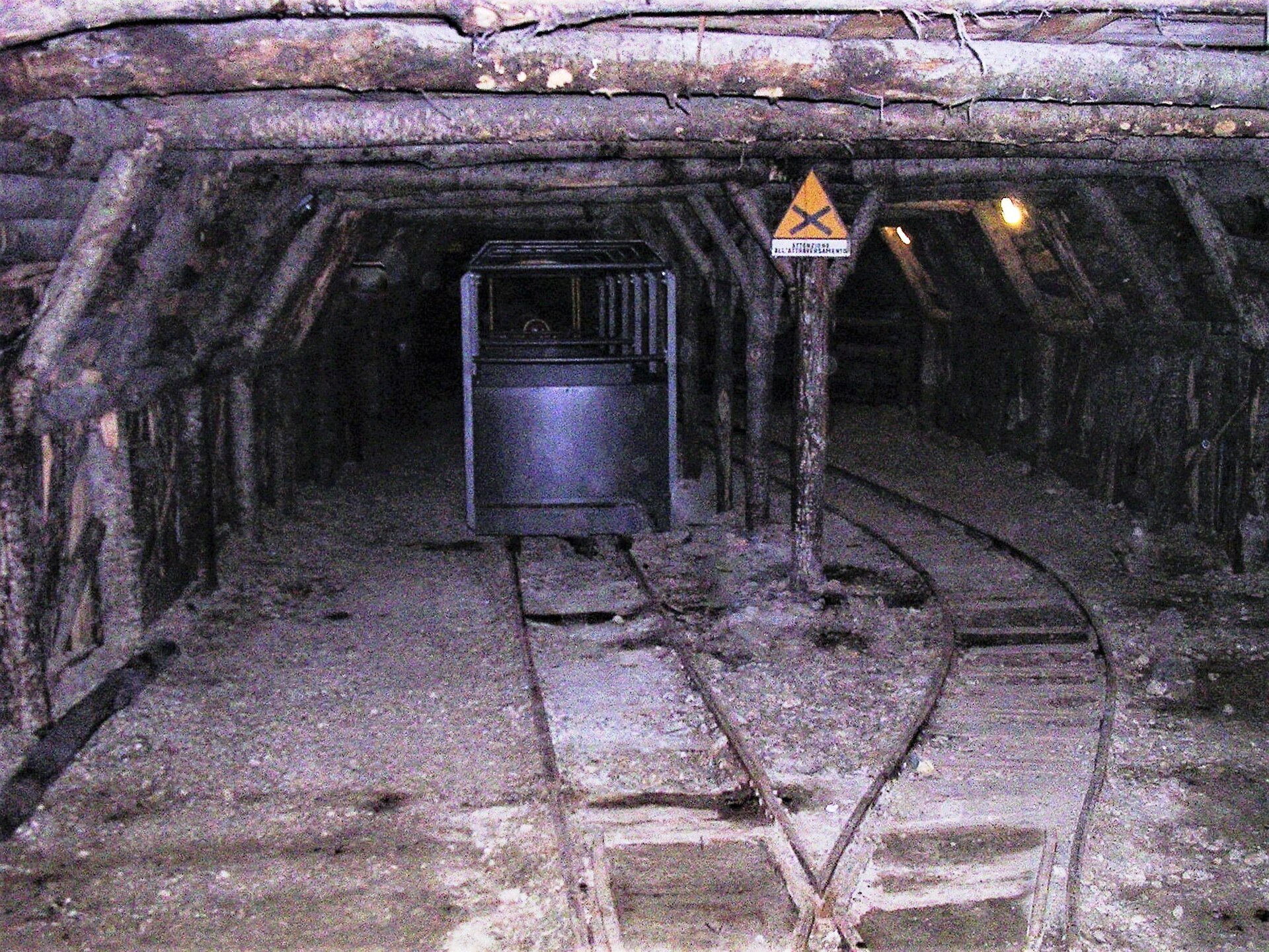
The third part goes underground. A miners’ train takes you into the Galleria Livello VII tunnel, about 250 m long. According to Musei Senesi, it recreates five excavation settings, with original machinery, and traces how work changed from the 1920s to the 1950s.
The route also uses iron cabinets holding audio, video, clothing, tools, and miners’ good-luck charms. They tell of hard, dangerous work, solidarity, and the struggle for workers’ rights. Booking is required. Check the museum’s hours and booking page before you go.
The Fiaccole di Natale
The Fiaccole (Christmas torches) are Abbadia’s great night. Work starts on 8 December, when groups of young and old lay a blessed log. On it they build pyramids of wood, up to 7 m high. There are more than 30 of them.
On 24 December, after the blessing of the fire, the first is lit at 18:00 in front of the Palazzo Comunale (Town Hall). According to the Pro Loco, the others then light up the town through the night. People sing pastorelle, traditional Christmas songs.
The vigil is meatless. According to the Pro Loco, people share sweets, vin brûlé, and anise biscuits in small shelters. Meat comes after midnight Mass. The Pro Loco traces the custom back to pagan rites of the winter solstice.
The town put the Fiaccole forward for UNESCO in 2022, but the Ministry of Culture turned the bid down. See the Pro Loco’s Fiaccole page and the Città delle Fiaccole site for this year’s details.
The Summit and Its Cross
The summit of Monte Amiata rises to 1,738 m, and its cross stands in the comune of Abbadia. The 22 m cross came from Luciano Zalaffi’s workshops in Siena. It was inaugurated on 18 September 1910.
On 17 June 1944 retreating German troops brought it down. It was rebuilt and re-inaugurated in 1946. On 24 August that year, Pope Pius XII switched on its lights by radio.
The mountain is an extinct lava-dome volcano, with its main eruptions roughly 300,000–200,000 years ago. For a long walk, try the Anello del Monte Amiata (CAI trail 601). It runs about 29 km around the mountain, mostly at 1,000–1,300 m. It takes 6–8 hours, with no services on the way, and Abbadia is one access point.
Winter sport is possible but not guaranteed. Amiata Impianti Senese runs the lifts on this side. Snow is unreliable, and in some recent winters the lifts stayed shut. Check amiataimpianti.it before you go.
Eating Like a Local
The local sweet to know is ricciolina, a tart of shortcrust, chocolate-hazelnut cream, and meringue, linked to Abbadia and neighboring Piancastagnaio. That’s Amiata publishes a version of the recipe.
Autumn belongs to chestnuts and mushrooms. Castagna del Monte Amiata has been a registered IGP since 2000, with three varieties: Marrone, Bastarda Rossa, and Cecio. If you pick mushrooms, you need a paid regional permit, and the limit is 3 kg per person per day. Read the Regione Toscana rules first.
Getting There and Getting Around
Abbadia has direct bus links to Siena and to Chiusi station. Autolinee Toscane line 54A runs to Siena via Castiglione d’Orcia, San Quirico d’Orcia, and Torrenieri. Line FT9 links Abbadia and Piancastagnaio with Radicofani, Sarteano, and Chiusi station; Tiemme operates it for AT. Check at-bus.it for times.
The nearest main-line station is Chiusi-Chianciano Terme, on the Florence–Rome railway. For days that take in several villages, you realistically need a car.
Abbadia and Santa Fiora have the widest choice of places to stay on the mountain. That makes Abbadia a sensible base for the Siena side. Our 4 days on Monte Amiata itinerary and Monte Amiata region guide show how it fits with the rest.
Nearby
- Piancastagnaio: the neighboring town, known for its Rocca Aldobrandesca and its August Palio.
- The summit (1,738 m): the top of Monte Amiata and its 22 m cross.
- Vivo d’Orcia: the village of the Camaldolese hermits and the spring that supplies Siena.
- Campiglia d’Orcia: a ring-shaped medieval village on a limestone outcrop.
- Radicofani: the Via Francigena town on the FT9 bus route toward Chiusi.
Information is provided in good faith and may change. Always confirm opening hours, prices, and event dates with the official source before you travel.