
Region guide · Province of Siena
Val d’Orcia
The Landscape Siena Designed
Last updated:
- Province
- Province of Siena
- Main town
- No single capital. San Quirico d'Orcia sits at the heart of the Via Francigena line; Pienza and Montalcino are the best-known names.
- Best season
- Late April to June, and September to October.
- Known for
- UNESCO cultural landscape, Via Francigena, hot springs, Pecorino Toscano and Pienza's aged pecorino, Orcia DOC wine, revived saffron, the villagers' theater of Monticchiello.
- Getting there
- Approximate road distances to San Quirico d'Orcia: Perugia airport about 100 km, Florence about 120–125 km, Pisa about 160 km, Rome Fiumicino about 210–220 km. Working rail stations: Buonconvento (Siena–Grosseto line) and Chiusi-Chianciano Terme (Florence–Rome line), then an Autolinee Toscane bus. Torrenieri, still listed in some guides, has had no regular trains since 1994.
A View That Was Built on Purpose
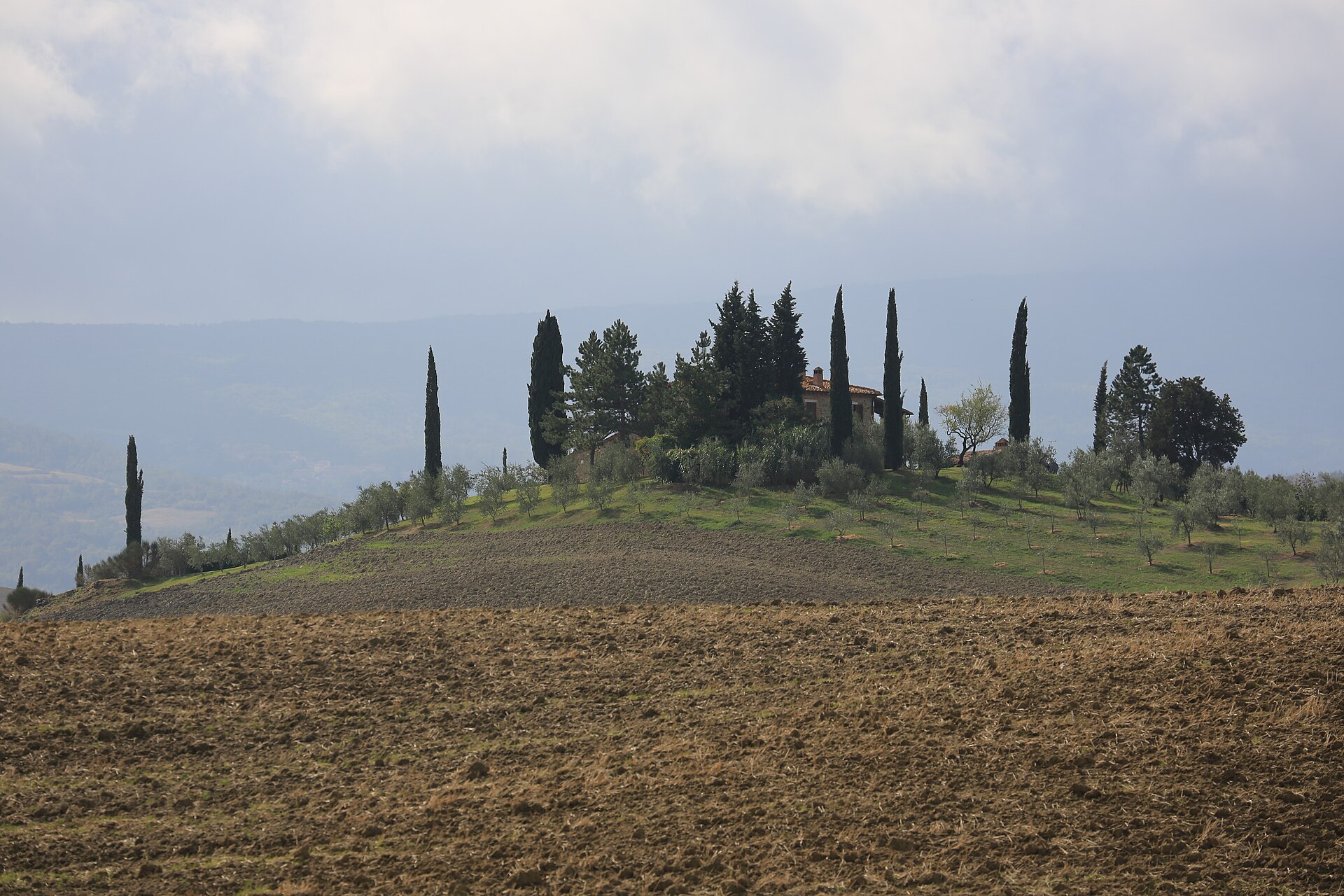
You have probably seen the Val d’Orcia before you arrive. It is the Tuscan view on calendars, screensavers, and film posters. What most of those images don’t tell you is that the view was designed.
When UNESCO inscribed the Val d’Orcia on the World Heritage List in 2004, it did not list a set of monuments. It listed a cultural landscape. In UNESCO’s words, the valley is “an exceptional reflection of the way the landscape was re-written in Renaissance times to reflect the ideals of good governance and to create an aesthetically pleasing picture.” The redesign came when the valley became part of Siena’s territory in the 14th and 15th centuries. A second criterion notes that the landscape was celebrated by the painters of the Sienese School.
So the “perfect” Tuscan view is a political and economic artifact. It was made by a state and the people who farmed for it, not left untouched by nature. Once you know that, the valley reads differently. The farmhouses on the ridges and the castles on the hilltops stop looking like scenery and start looking like decisions.
The listing also includes the Via Francigena, the medieval pilgrim road to Rome, with its abbeys, inns, shrines, and bridges. The protected core covers 61,188 hectares across five comuni. Pienza’s historic center has its own, separate World Heritage listing from 1996, as a Renaissance planned town.
Clay below, volcano to the south
The shapes of the valley come from its ground. The Regione Toscana landscape plan describes the Crete as Pliocene blue clays. Their erosion leaves calanchi (sharp-ridged badland gullies) and biancane (small, rounded white clay domes). To the south, the ground turns volcanic. Monte Amiata‘s geology is the reason hot water rises at Bagno Vignoni and Bagni San Filippo.
The road that fortified every hilltop
The Via Francigena explains why so many hilltops here carry a castle. The fortresses of Tentennano, Castiglione, Radicofani, and Campiglia controlled the road at the southern edge of the Sienese state. Radicofani is recorded in 973 “with its castle.” In 1153 Pope Eugenius III bought it to control the pilgrim road against Frederick Barbarossa. From 1154, Adrian IV, the only English pope, built a major fortification there.
Siena’s great banking family, the Salimbeni, built its own power base along this road. Siena ceded Ripa d’Orcia to them in 1274 to settle debts. From Rocca a Tentennano, Cocco Salimbeni raided neighboring villages until Siena defeated him in 1418. The castles you see today are the leftovers of that long argument over who controlled the road.
Sharecroppers who left, shepherds who came
The second story is about who worked the land. For centuries the valley ran on mezzadria (sharecropping), a system in which peasant families farmed land for an owner and split the harvest. That system shaped the landscape UNESCO protects. Its collapse after World War II emptied it.
In Monticchiello the population halved. In 1967 the villagers answered by writing a play about themselves and staging it in the square. They have done it every summer since.
On the empty farms, a new group arrived. From the 1960s, Sardinian shepherd families settled with their flocks. The Caseificio Cugusi, on the Pienza road but in Montepulciano‘s territory, was founded in 1962 by Raffaele and Maria Cugusi, who came from Sardinia. The Pecorino Toscano DOP consortium tells the story of Pasquale Putzulu, a Sardinian former sharecropper who founded the dairy now known as Caseificio Pienza SOLP. This is a large part of why Pienza is still a cheese town today: the peasants who left, and the shepherds who came.
Which valley?
“Val d’Orcia” gets stretched in English. On this site it means the five comuni of the UNESCO site and the park: Castiglione d’Orcia, Montalcino, Pienza, Radicofani, and San Quirico d’Orcia. A few places sit on the edges, and we label them.
Castelmuzio overlooks the valley but belongs to the comune of Trequanda. It moved from Pienza to Trequanda in 1833, which is why it sits outside today’s UNESCO area. Bagni San Filippo and Campiglia d’Orcia are inside the comune of Castiglione d’Orcia, but they face Monte Amiata: Bagni San Filippo stands on its lower slopes, and Campiglia’s chestnut culture is Amiata’s. Vivo d’Orcia, higher up among fir and chestnut woods, belongs with Amiata and has its own profile in our Monte Amiata guide.
What we know vs. what’s repeated: Three claims meet most visitors first. You can’t bathe in Bagno Vignoni’s square pool, and under municipal ordinance no. 22 of 2010 you can’t bathe anywhere in the Parco dei Mulini below it either. The Cappella di Vitaleta is not the Gladiator chapel. Italy’s national tourism portal says the chapel was not used as a filming location; the wheat-field scene was shot on the Terrapille estate near the Pieve di Corsignano. “Pecorino di Pienza DOP” does not exist. The protected cheese is Pecorino Toscano, a DOP since 1996; “Pecorino di Pienza stagionato in barriques” is a regional traditional product (PAT).
The Towns and Villages
The valley’s places fall into three groups. The first follows the pilgrim road. The second clusters around Pienza. The third climbs toward Monte Amiata.
The Francigena line
San Quirico d’Orcia is where Via Francigena stage 35 ends and stage 36 begins. Its Collegiata has two carved portals, one attributed to Giovanni Pisano. Behind the walls, the Horti Leonini is a Medici-era garden laid out around 1580. In 1155 Frederick Barbarossa met papal envoys here, which the town still celebrates every June.
Bagno Vignoni is a village whose main square is a thermal pool, 49 m long and 29 m wide. Catherine of Siena prayed in the chapel under its loggia. Below the village, hot water once turned four mills in a row, which could grind in summer when river mills stopped. You look here; you don’t swim.
Rocca d’Orcia sits under Rocca a Tentennano, a polygonal keep that watched the road and served the Salimbeni against Siena. Catherine of Siena stayed there in 1377. Nearby Ripa d’Orcia is a privately owned castle-hamlet, held by the Piccolomini Carli family since 1484; admire it from the surrounding roads and paths.
Castiglione d’Orcia is about a kilometer from Tentennano and has its own fortress, the Rocca Aldobrandesca. One ticket covers both fortresses and the small Sala d’Arte San Giovanni. The gallery’s prize is a Madonna and Child by Simone Martini and workshop, in which the Child holds a swallow.
Radicofani is the papal border fortress on a volcanic outcrop, at 896 m. The Medici turned it into a bastioned citadel in the 1560s. On 14 September 1735 a man set fire to two powder magazines and destroyed much of it. Below the village stands La Posta, a Medici post station. Radicofani is also the stage of Ghino di Tacco, the gentleman-bandit of Dante and Boccaccio: a figure of literature and legend rather than documented history.
The Pienza side
Pienza needs little introduction, and we keep it brief. Its planned Renaissance center has its own UNESCO listing. The angle worth your time is the cheese, and the Sardinian families who made it.
Monticchiello is a walled village in the comune of Pienza. Since 1967 its villagers have written and performed a new autodramma (a collective play about their own lives) every summer. Their cooperative, the Teatro Povero, also runs two restaurants in the village and a small museum of popular theater.
Castelmuzio is our edge village. It is in the comune of Trequanda, outside the UNESCO area, looking over the valley from the clay country. Its museum of sacred art sits in the oratory of a religious confraternity. At the gate, a stone on which San Bernardino of Siena is said to have rested is set into the war memorial.
The Amiata edge
Campiglia d’Orcia belonged to the Visconti, a Sienese family, until Siena absorbed it in 1429. Their Visconti-era tower, the Campigliola, stands roofless in the woods above the village and is privately owned. On the last Sunday of October the village holds its chestnut festival.
Bagni San Filippo has a free hot stream, the Fosso Bianco, with natural pools and white limestone formations. Tradition says the Servite friar Filippo Benizi hid in a grotto here in 1267 to avoid being elected pope. The stream’s popularity has made access a local political issue for years.
Vivo d’Orcia began as a Camaldolese foundation and later became the estate of the family of Pope Marcellus II. A spring above it still supplies Siena through a 63 km aqueduct. We cover it in our Vivo d’Orcia profile.
Montalcino is one of the five UNESCO comuni, and its fields fall inside the saffron zone. It is also well covered elsewhere, so we mention it for context only.
Food and Drink
The valley eats like a place of sheep, wheat, and olives, with chestnuts on the mountain edge. Here is what to look for.
Pici and pecorino
Pici are thick, hand-rolled strands of flour and water. Visit Tuscany calls them “laces of flour and water” connecting Pienza, Montepulciano, Monticchiello, and Montalcino. The best-known pici festival is at Celle sul Rigo, just outside the valley, usually in late May.
Pecorino is the valley’s other staple. Pecorino Toscano has been a DOP since 1996. Pienza’s own reputation is older: a late-19th-century parliamentary inquiry praised the “cacio di Pienza” made in and around the Val d’Orcia. Look for the barrique-aged version, recognized on Tuscany’s list of traditional products. And remember the Sardinian families behind dairies such as Cugusi.
Saffron, oil, and wine
Saffron is a revival, not a constant. According to the Parco della Val d’Orcia, it was widely grown here in the Middle Ages, stopped in the 16th century, and came back only recently. The park’s Zafferano della Val d’Orcia rules allow whole stigmas only, from the five comuni. Flowering and harvest fall in October and November. Egisto Brandi of CrocusBrandi in San Quirico came across saffron “by chance” in 1995 and became part of that revival.
Olive oil is pressed mainly in autumn. The growers’ cooperative Oleificio Val d’Orcia, at Castiglione d’Orcia, has more than half a century of experience by its own account. It is a good way to see how the valley’s small growers work together. San Quirico celebrates the new oil in early December.
Orcia DOC was created in 2000. It is a small appellation of family cellars squeezed between Brunello di Montalcino and Vino Nobile di Montepulciano. “Orcia” must contain at least 60% Sangiovese, and “Orcia Sangiovese” at least 90%. The consortium has around forty member wineries.
Chestnuts on the mountain edge
Around Campiglia, Vivo, and Bagni San Filippo, the food culture changes to chestnuts. The Festa del Marrone at Campiglia is the main event. It is a reminder that the valley’s southern rim already belongs to Amiata.
What Makes This Region Different
Most of Tuscany sells itself on beauty. The Val d’Orcia has that, but its real interest lies in why it looks the way it does.
A landscape with a purpose
Elsewhere, a view is scenery. Here it is evidence. The farms of the sharecropping era, the castles of the Francigena, and the Renaissance planning of Pienza all belong to the same landscape, and UNESCO protects that landscape as a whole.
Water that runs hot
The volcanic south brings hot water to the surface. At Bagno Vignoni it once emerged at about 52 °C and filled a village square. At Bagni San Filippo it runs down a wooded stream at around 48 °C at the source, according to Visit Tuscany. Here you can see how geology shaped daily life: mills that never ran dry, a saint’s chapel on a hot pool, a friar’s grotto.
People who tell their own story
The valley also talks back. In Monticchiello, the villagers have staged their own history for close to six decades. In Campiglia, the three rioni (village quarters) compete by staging scenes of peasant and chestnut life rather than racing. It is a place that remembers the people who worked it, not only the view they made.
Climate in brief
The Orcia DOC rules describe a continental-Mediterranean climate. The mean annual temperature is around 14 °C, with winter averages near 5 °C and summer averages near 23 °C. Rainfall is roughly 800 mm a year.
When to Visit
Each season changes the valley’s color and its calendar. Dates below are patterns; check the linked official pages for the current year.
Spring
Late April brings the Orcia Wine Festival to San Quirico, usually over a long weekend, with tastings and talks alongside the producers. Pienza’s Pro Loco lists a Festa dei Fiori (flower festival) in May. Late May is usually the time for the Sagra dei Pici at Celle sul Rigo. Mid-June brings San Quirico’s Festa del Barbarossa, when the town’s four quarters compete in flag-throwing and archery in the Horti Leonini.
Summer
Summer is hot and busy, but it has the valley’s best evening event. From late July to mid-August, the Teatro Povero stages its play in Monticchiello’s square. Book ahead through teatropovero.it. Every summer since around 1970, the Horti Leonini has also hosted Forme nel Verde, an outdoor exhibition of contemporary sculpture.
Autumn
Autumn is our favorite season here. Pienza holds its Fiera del Cacio (cheese fair) in early September. Saffron flowers in October and November, and olives are pressed. On the last Sunday of October, Campiglia d’Orcia holds its Festa del Marrone (chestnut festival), running since 1978.
Winter
Winter is quiet, and several sights close. The Tentennano and Castiglione fortresses open seasonally, roughly April to early November; check the Fondazione Musei Senesi page. Radicofani’s fortress changes its opening days with the season; check the Comune di Radicofani page. In early December, around the Immacolata weekend, San Quirico’s Festa dell’Olio celebrates the new oil.
Practical Tips
Getting around
The Val d’Orcia is a car destination. Autolinee Toscane buses do link the main villages, but timetables follow the school year, so check the line pages before you plan around them. Line 112 runs Siena–Buonconvento–San Quirico–Pienza–Montepulciano. Line 54A runs from Siena through San Quirico, Bagno Vignoni, Rocca d’Orcia, Castiglione, Campiglia, and Bagni San Filippo. Line 52A links Castiglione and Bagno Vignoni with San Quirico. Line FT9 connects Chiusi with Radicofani and Bagni San Filippo. Monticchiello has no practical bus service.
Walking the Francigena
Three official Via Francigena stages cross the area. Stage 35 runs from Ponte d’Arbia to San Quirico via Buonconvento. Stage 36 runs from San Quirico to Radicofani via Vignoni Alto and Bagno Vignoni, 33 km and rated “very demanding.” Stage 37 runs on to Acquapendente in Lazio. Walking even a short stretch shows you the valley at the pace it was built for.
Hot springs, by the rules
At Bagno Vignoni, bathing is forbidden in the square pool and in the Parco dei Mulini; use the private spa pools if you want to soak. At Bagni San Filippo, access to the stream is free at the time of writing, but the comune has long planned visitor management; check locally before you go. Do not climb, touch, or bathe at the white “whale” formation.
Markets
San Quirico’s market is fortnightly, on the 2nd and 4th Tuesday of the month, in Via dei Canneti. Radicofani’s is on the 2nd and 4th Thursday, in Piazza Garibaldi. Pienza has a Friday market and a farmers’ market on the first Sunday of the month. Bagno Vignoni has no market.
Plan your route
For a structured trip, follow our 5 Days in the Val d’Orcia itinerary. It strings the Francigena villages together and leaves room for cheese, oil, and a walk.
Information is provided in good faith and may change. Always confirm opening hours, prices, and event dates with the official source before you travel.